

A vendor, MGA or TPA wins a carrier that runs Guidewire. The carrier wants data in PolicyCenter or ClaimCenter. Someone estimates the connector build, and the estimate covers the first release. It does not cover the second, the fifth, or the next carrier.
The build is the visible part. The upkeep is the part that arrives after go-live and does not stop, and most teams find that out when a submission fails and nobody can say why.
This article lists what maintaining a Guidewire connector involves, task by task. It then compares build and buy side by side and gives you a simple way to size the upkeep before you commit.
What Does Maintaining a Guidewire Connector Involve?
Maintaining a Guidewire connector means keeping authentication, payload mapping, validation, error handling, and monitoring correct while Guidewire, the carrier's configuration, and the sender's own data all change. Each of the three moves on its own schedule.
The Release Calendar Sets the Pace
A September 2026 guide to Guidewire testing puts the cadence at three cloud releases a year, with roughly seven months for an insurer to go live on each one after it lands. The same guide notes that a release can change the UI, the APIs, and out-of-the-box behavior.
Every sender connected to those insurers inherits that calendar. A connector that worked in March is not guaranteed to work in November.
The Carrier's Configuration Changes Too
Insurers configure and extend Guidewire heavily, so no two carrier environments behave alike. A connector built for one carrier does not carry over cleanly to the next.
When a carrier adds a coverage, a required field, or a new validation rule, the connector has to follow. The sender usually learns about it when a payload is rejected.
The Sender's Data Changes
New products, new lines of business, and new source systems change the payload. Each change needs a matching update to the mapping.
The connector sits between two moving targets, and the person maintaining it needs to understand both.
Which Maintenance Tasks Come Back Every Release?
Seven tasks repeat after every Guidewire release, every carrier change, and every sender change. Skipping any of them leaves a failure that surfaces later and costs more to trace.
The Recurring Task List
Task | What triggers it | What goes wrong if it is skipped |
|---|---|---|
Re-test authentication and credentials | A release or a security change at the carrier | Requests fail before any data is checked |
Re-check payload mapping | A changed field or a new product | Data lands in the wrong place or is rejected |
Handle new mandatory fields | A carrier or Guidewire adds a required field | Submissions fail until someone finds the cause |
Re-test the producer check | A change to agency or producer setup | Valid submissions are refused at the door |
Update validation rules | A change to the carrier's requirements | Incomplete data reaches an underwriter or adjuster |
Review error handling and retries | A change in response behavior | Failures go unseen, or the same request repeats |
Confirm logging and monitoring | A change in infrastructure | Nobody can reconstruct what happened to a request |
Why Mapping Is the Task That Never Ends
Payload mapping matches each field in a sender's data to the field Guidewire expects, so a submission or claim lands in the right place on the first send. Every new product and every changed field reopens that work.
A package product makes it harder. One source record can map to many coverages, and each coverage has its own target fields.
What Happens When a Mandatory Field Is Added
A new mandatory field breaks a connector the day it lands. Until someone maps the new field, every payload that lacks it is rejected.
A hand-built connector warns the sender in advance only if someone built that warning. Without it, the first alert is a failed submission, and the sender's team starts debugging from the symptom.
What Does the Work Look Like Per Carrier and Per Sender?
The upkeep multiplies. Every carrier a sender serves adds its own configuration, its own credentials, and its own release schedule to track.
One Carrier, One Connector, Repeated
A vendor that serves several carriers ends up with a separate mapping for each one, because each carrier configures Guidewire differently. The vendor maintains all of them at once.
Add a carrier, and the vendor adds another full set of tasks from the table above.
Two Environments, Two Sets of APIs
Some carriers run Guidewire on-premises and others run it in the cloud, and the APIs differ between the two. A sender that serves both maintains two integration paths.
The first build gets attention. The second path often gets less, and that is where the failures hide.
Who Holds the Knowledge
Learning Guidewire takes months, and the person who learns it becomes the only one who can fix the connector. When that engineer leaves, the connector becomes a black box.
Documentation helps. It does not replace someone who has seen the failure before.
Build vs Buy: A Side-by-Side
The options differ in who does the work after go-live. The table compares three routes on the dimensions that decide the upkeep.
The Comparison Table
Dimension | Build in-house | Commission a custom connector | Use a prebuilt route |
|---|---|---|---|
First build | Your engineers learn Guidewire first | A services team builds it for you | The route exists before you start |
Release upkeep | Your engineers, every release | Another engagement for each change | Handled where the route is maintained |
Who knows Guidewire | You must hire or train for it | The services team, until they leave | The provider |
Adding a carrier | A new build and a new mapping | A new scope of work | A new mapping on the same route |
Visibility into failures | Whatever you build | Whatever was specified | Built-in request and error logging |
Where the data runs | Wherever you deploy it | Wherever it was built to run | Inside the carrier's environment when deployed there |
Where Building Is the Right Answer
Build when you serve one carrier, own deep Guidewire expertise, and need behavior no standard route offers. In that case the upkeep is a known, bounded cost with a named owner.
Where Buying Fits
Buy when you serve several carriers, run a small engineering team, or cannot afford a single point of failure in one engineer's head. The upkeep stops being your problem and becomes someone else's job.
How Do You Size the Upkeep Before You Commit?
Most estimates cover the build and skip the upkeep. A simple formula brings the upkeep into the decision.
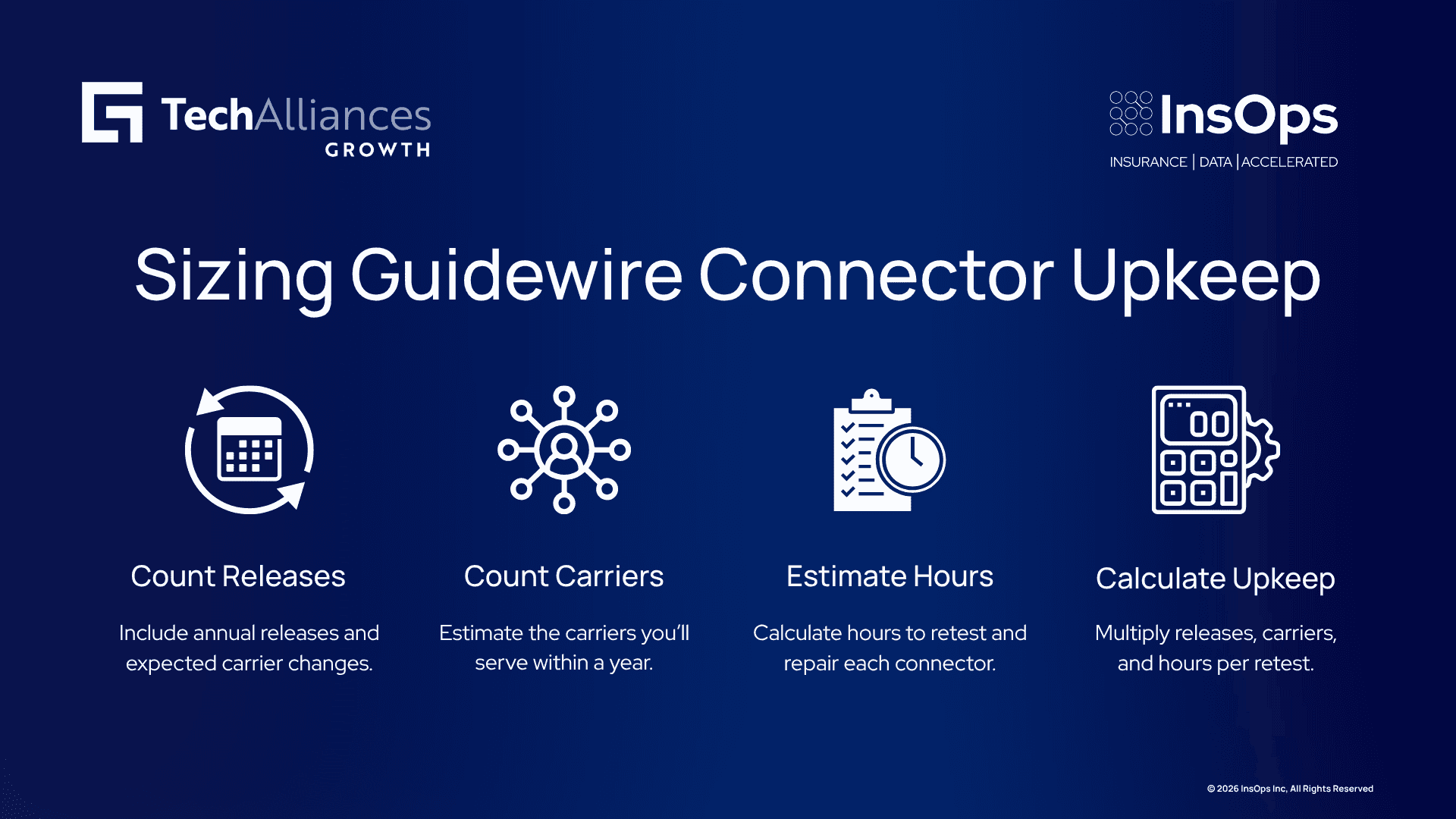
Count the Releases
Take the number of Guidewire releases per year and add the carrier-driven changes you expect. Each one is a re-test.
Count the Carriers
Multiply by the number of carriers you serve or plan to serve within a year. Each carrier has its own configuration and its own schedule.
Count the Hours
Multiply by the hours your team needs to re-test and repair one connector. Use your own number from the last release, not a guess.
The result is your upkeep load: releases per year, times carriers served, times hours per re-test. Compare that figure to the build estimate before you decide.
Five Questions to Ask Before You Choose

How many carriers will you serve within the next year?
Who on your team can diagnose a failed submission on their own?
What happens to the flow when Guidewire adds a mandatory field?
Who confirms a field mapping, and who is accountable when it is wrong?
Do you see a log of every request, response, and error?
How InsOps Helps
InsOps builds an insurance-trained AI that assists with moving submission and claims data into Guidewire. LiLa, our insurance-trained LLM, drafts the field mapping from your payload to the Guidewire structure, and your administrator confirms every mapping before data moves.
The InsOps Integration Gateway gives MGAs, TPAs, brokers, and underwriting vendors a prebuilt route into Guidewire PolicyCenter, ClaimCenter, BillingCenter, UnderwritingCenter, PricingCenter, and Quoting Services. Senders register in a self-service portal, bring their payload, and configure it without building their own connector. A vendor that serves several carriers keeps a separate mapping for each.
The gateway handles authentication, validation, and request logging, so your engineers spend their time on your product instead of on Guidewire APIs. It alerts you when Guidewire adds a mandatory field, while the flow keeps running, and it supports on-premises and cloud Guidewire APIs. It runs inside your own environment, so PII and PHI stay in controlled infrastructure.
InsOps is a Guidewire technology partner. If you are evaluating how to exchange submission data with Guidewire without a custom connector build and the upkeep that follows each release, contact us to talk through what this looks like for your operation.
Frequently Asked Questions
What does it mean to maintain a Guidewire connector?
It means keeping authentication, payload mapping, validation, error handling, and monitoring correct as Guidewire, the carrier's configuration, and the sender's data change. The work starts after go-live and does not end.
How often does a Guidewire connector need attention?
At every Guidewire release, whenever a carrier changes its configuration, and whenever the sender changes its own data. A sender that serves several carriers sees these triggers stack up across the year.
Why not build the connector once and leave it alone?
Because the platform it connects to keeps changing. A new mandatory field or a changed API breaks a connector that was correct on the day it shipped.
When is building the connector the right choice?
When you serve one carrier, have deep in-house Guidewire expertise, and need behavior a standard route does not offer. Under those conditions the upkeep is bounded and has a named owner.
What should a team track to know the connector stays healthy?
Track the share of submissions accepted on the first send, the time between a Guidewire change and the matching mapping update, and the time it takes to find the cause of a failure. Also track how many carriers each engineer maintains.
How does the InsOps Integration Gateway help?
It gives senders a prebuilt route into Guidewire, with LiLa drafting the field mapping and the gateway alerting when Guidewire adds a mandatory field. A person at the sender reviews and confirms every mapping before any data moves.
What slows down a first send to a carrier's Guidewire environment?
Waiting on credentials, producer checks that fail, mapping review, and mandatory fields the payload does not yet carry. A route that validates the payload on the request and logs every error shortens each of those waits.