

A policy does not stop moving once it binds. Carriers process address changes, coverage changes, cancellations and reinstatements every day, and each one has to land in Guidewire PolicyCenter correctly and on time.
The systems that generate these midterm transactions, MGA platforms, servicing portals and agency management systems, usually sit outside Guidewire. Without a dedicated connector, each one needs its own custom build, and every build needs upkeep through every PolicyCenter upgrade.
This article covers what makes policy change, cancellation and reinstatement data harder to integrate than a new submission, what breaks without a dedicated connector, and what a standardized entry point needs to do to move this data into PolicyCenter reliably.
Why these transactions are harder to integrate than new business
A new business submission moves once, from quote to bind. Policy change, cancellation and reinstatement data moves differently. The same policy gets touched more than once across its life, often by different senders, and each sender needs to see its current state before acting on it.
Transaction type | What it does | Key dependency |
|---|---|---|
Policy change | Adjusts coverage, limits or exposure mid-term | Has to reconcile against the policy's current state already in PolicyCenter |
Cancellation | Ends the policy before its term is up | The effective date drives earned premium and claims eligibility |
Reinstatement | Brings a cancelled policy back into force | Requires confirmation the policy was actually cancelled first |
An incorrect effective date on any of these three is not a formatting detail. A policy change dated wrong changes what was covered on a specific day. A cancellation dated wrong changes earned premium and claims eligibility. A reinstatement that does not check the prior cancellation status can be rejected by PolicyCenter or applied against the wrong policy state.
What goes wrong without a dedicated connector
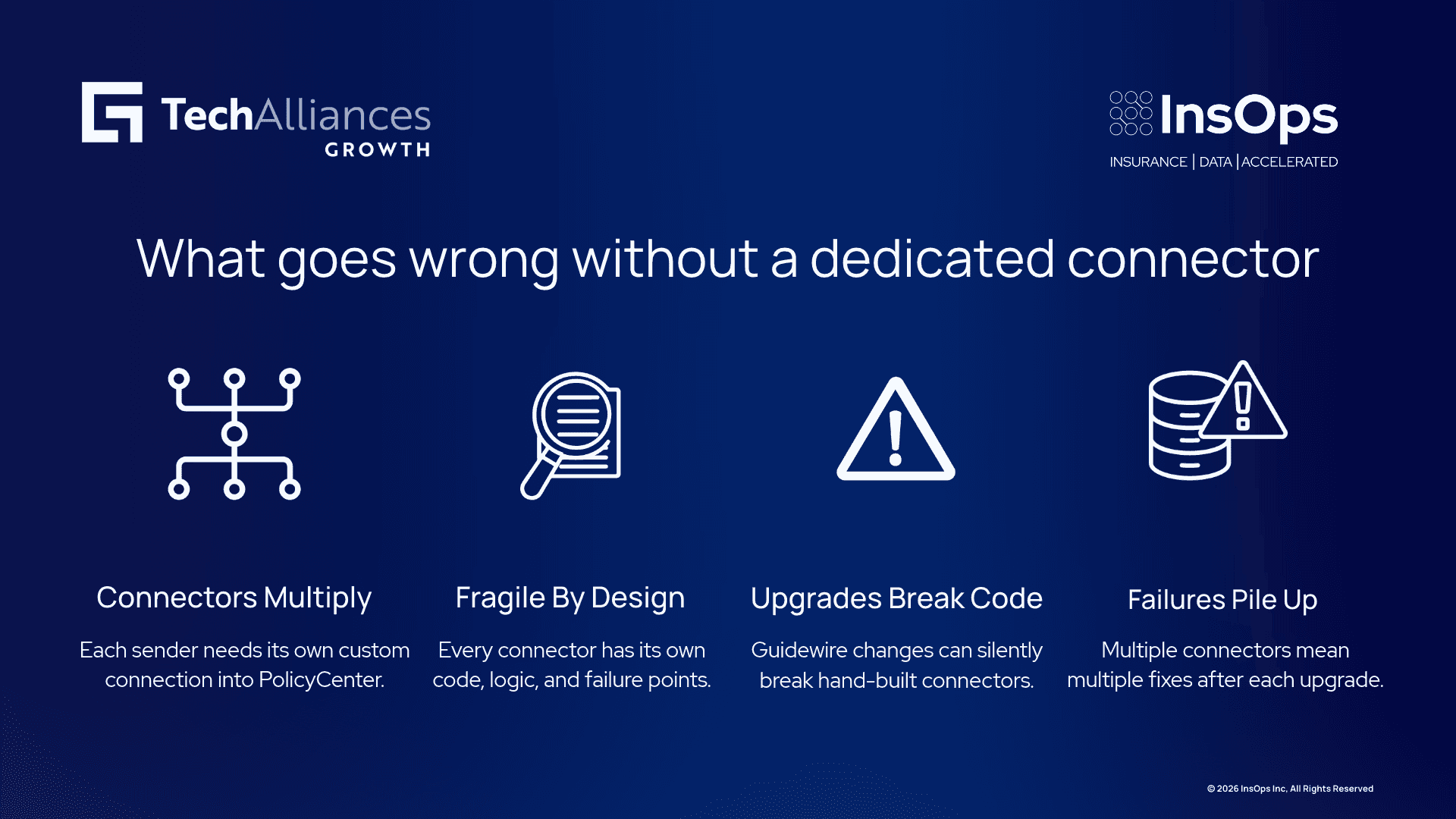
Point-to-point connectors multiply
Every MGA, TPA or servicing vendor that sends policy change, cancellation or reinstatement data needs its own connection into PolicyCenter. Built one sender at a time, this turns into a growing set of point-to-point connectors, each with its own code, its own mapping logic and its own failure points. Standardized API gateways exist precisely to replace this pattern with a single entry point instead of a separate link for every sender, as the shift away from point-to-point connections across the vendor ecosystem shows.
Upgrades break custom code
A Guidewire upgrade can add a mandatory field or change a structure PolicyCenter expects. A hand-built connector has no way to know this happened until a transaction fails. Multiply this across several connectors serving several senders, and one upgrade window turns into a backlog of broken integrations to fix one at a time, usually after a transaction has already failed in production.
What a standardized entry point needs to handle
A connector built for new business submissions alone does not cover these three transaction types. Each needs its own handling once it reaches PolicyCenter.

Field-level mapping into PolicyCenter's structures
A policy change, cancellation or reinstatement payload has to map into the exact structure PolicyCenter expects for that transaction type, not a generic policy record. Package products that bundle several coverages under one policy need a mapping that reflects that structure correctly.
Validation before an underwriter ever sees it
Incomplete or inconsistent data should get flagged and sent back to the sender before it reaches an underwriter's queue. This keeps gaps from turning into a manual cleanup task downstream.
Status visibility across every transaction
A sender needs to see what happened to a request they sent, whether it succeeded, failed, or is waiting on something. A dashboard that records every request, response and error gives both sides a shared, current view instead of a phone call to find out.
Tenant-specific mapping for multi-carrier senders
An MGA or TPA that serves more than one carrier on Guidewire needs its payload mapped differently for each one, since no two carriers configure PolicyCenter identically. The mapping has to be tenant-specific, not one mapping reused everywhere.
Comparing your options
Carriers facing this problem generally choose between three approaches. None is universally right, each trades effort now against upkeep later.
Approach | What it takes to start | What it costs over time |
|---|---|---|
Build a connector per sender in-house | In-house Guidewire API expertise and a build cycle for every sender | Upkeep through every Guidewire upgrade and every sender-side change |
License general-purpose integration middleware | Configuration work, with no Guidewire-specific mapping logic included | Your team still builds and maintains the PolicyCenter-specific mapping and validation |
Use a Guidewire-specific connector gateway | A sender payload and an admin to review the drafted mapping | Maintenance of the connector logic sits with the gateway provider |
The right choice depends on how many senders a carrier expects to onboard and how much Guidewire expertise already sits in-house. A carrier bringing on one MGA has different math than one consolidating several agency systems after an acquisition.
What to check before committing
A few questions tend to separate an approach that holds up from one that turns into a maintenance project. Confirm the approach covers all three transaction types, not just new business submissions, since cancellation and reinstatement logic is not the same as a policy change. Confirm where PII and PHI sit while the data moves, and whether it ever leaves infrastructure your team controls. Confirm how the approach behaves when Guidewire adds a mandatory field, specifically whether a person finds out before or after a transaction fails. Confirm whether a person reviews and confirms a mapping before it goes live, since this is what keeps an administrator accountable for what moves into PolicyCenter. An insurance-focused solution covering underwriting data more broadly tends to apply the same review step across every data type it touches, which is a reasonable baseline to check any option against.
How InsOps Helps
InsOps builds an insurance-trained AI that assists with moving policy change, cancellation and reinstatement data into Guidewire PolicyCenter. LiLa, our insurance-trained LLM, drafts the field mapping from a sender's payload to PolicyCenter's structure, and a person on the receiving team reviews and confirms every mapping before it moves.
The InsOps Integration Gateway gives MGAs, TPAs and servicing vendors a prebuilt route into PolicyCenter for these transaction types. Senders register in a self-service portal, bring their payload, and configure it without building their own connector. The gateway runs inside your own environment, so PII and PHI stay in controlled infrastructure.
InsOps is a Guidewire technology partner, with prebuilt connectors across PolicyCenter, ClaimCenter, BillingCenter, UnderwritingCenter, PricingCenter and Quoting Services.
If you are evaluating how to bring policy change, cancellation and reinstatement data into PolicyCenter without a custom connector build, contact us to talk through what this looks like for your operation.
Frequently Asked Questions
What counts as a policy change, cancellation or reinstatement transaction in Guidewire PolicyCenter?
A policy change adjusts coverage or limits mid-term, a cancellation ends the policy before its term is up, and a reinstatement brings a cancelled policy back into force. Each is a distinct transaction type inside PolicyCenter with its own rules.
Why does getting this data right matter so much?
An incorrect effective date on any of these transactions changes what the policy actually covered on a given day, which affects earned premium and claims eligibility later.
How do carriers typically bring this data in from outside systems today?
Most build a connector per sending system, mapping that sender's payload fields to PolicyCenter's structure by hand, then maintaining that mapping through every Guidewire upgrade.
What is the most common challenge carriers run into?
A hand-built connector does not flag when Guidewire adds a mandatory field or changes a structure. A transaction fails first, and the mapping gets fixed after the fact.
What should carriers track to know whether their integration approach is working?
Transaction failure rate by sender, the time between a Guidewire upgrade and the first failed transaction, and how many of the three transaction types still need a manual fix before they land in PolicyCenter.
How does InsOps assist with this specific use case?
The InsOps Integration Gateway drafts the field mapping from a sender's payload into PolicyCenter's structure for policy change, cancellation and reinstatement transactions. A person on the receiving team reviews and confirms every mapping before it moves.
What does a realistic timeline look like for standing this up?
Onboarding a sender is faster when the connectors to PolicyCenter already exist, since the work left is registering, uploading a payload, and reviewing a mapping. The sender's own review and confirmation step sets the actual pace.
Does a reinstatement need anything different from a cancellation?
Yes. A reinstatement has to confirm the policy was actually cancelled in PolicyCenter before it processes, otherwise PolicyCenter rejects the transaction or applies it against the wrong policy state.