

Two underwriters on the same team quote near-identical risks on the same morning and land on different terms. Nobody can name the feature of the risk that explains the gap. Leadership sees it only when loss experience arrives, long after the quotes went out.
Teams usually respond with a new guideline or a faster intake process. Neither shows where decisions diverge, so the effort lands on the wrong problem and the gap stays open.
This article lays out a five-stage roadmap that moves an underwriting team from scattered decisions to consistent ones. It covers how to baseline your variance, what to fix first, how to record the reasoning behind each exception, and where AI assistance fits without taking the decision away from the underwriter.
Why Do Underwriting Decisions Drift Apart on the Same Risk?
Decisions drift apart because each underwriter works from different inputs, different comparisons, and different unwritten rules. Talent is rarely the cause. The gap forms in what each person had in front of them at the moment of decision.
Teams often treat drift as a training problem. It behaves more like a plumbing problem, where facts, benchmarks, and reasoning reach each desk in a different shape.
What Chaos Looks Like on a Real Desk
One underwriter opens clean loss runs. Another opens a spreadsheet re-keyed from a PDF. A third remembers a similar account from two years ago and prices from that memory.
Each decision looks reasonable when read alone. Side by side, the three files describe three different risks, and the quote spread is the visible symptom of that difference.
Why Faster Intake Does Not Close the Gap
Investment has gone to speed. In the Underwriting Edge 2026 survey of 350 senior commercial P&C underwriters in the US and UK, 51 percent of respondents who use AI said its greatest contribution was saving time on manual admin. Only 21 percent of AI users said it had raised the quality of their decisions.
The survey was published by an underwriting software vendor, as Insurance Business noted. Read the figures as one data point, not an industry benchmark.
Faster intake gives every underwriter more time. It does not give every underwriter the same facts, the same comparisons, or the same reasoning.
What Drift Costs a Book
A quote set too high loses the submission to a competitor. A quote set too low binds a risk at a price the exposure does not support.
Neither error shows on a dashboard until claims arrive. That delay is why drift survives for long stretches inside teams that believe their standards are applied evenly.
What Is the Underwriting Consistency Roadmap?
The Underwriting Consistency Roadmap is a five-stage sequence for finding where underwriting decisions diverge and fixing the largest cause first. Each stage answers one question and leaves behind one working asset.
It rests on what underwriters and practitioners already report. Survey respondents named inconsistent submission data and missing context on prior risks among the biggest drags on decision quality. Practitioners describe the reasoning behind each decision as the layer current systems do not capture.
The Five Stages at a Glance
Stage | Name | Question it answers | What you hold at the end |
|---|---|---|---|
1 | Baseline | Where do our decisions diverge today? | A set of matched pairs, each tagged by cause |
2 | Standardize inputs | Does every underwriter see the same facts? | One defined file structure per line of business |
3 | Surface references | Does every underwriter see how similar risks were written and performed? | A comparable-risk view at quote time |
4 | Record reasons | Is the why behind each exception written down? | A reason log attached to every exception |
5 | Review and adjust | Is the gap closing, and which cause is next? | A recurring consistency report |
Why the Order Matters
Inputs come before references because a comparison built on inconsistent data inherits the inconsistency. References come before reasons because an underwriter cannot explain a departure from a benchmark that was never visible.
Baseline comes first for a simpler reason. Without it, you cannot tell which stage deserves your first month.
What the Roadmap Does Not Do
It does not remove judgment. Two experienced underwriters will still price some complex risks differently, and some of those differences are deliberate appetite calls. The goal is that every difference carries a recorded reason tied to the risk.
How Do You Run Stages 1 to 3?
The first three stages fix what underwriters see. Stage 1 locates the gaps. Stages 2 and 3 close the two gaps that sit in the data and in the comparisons.
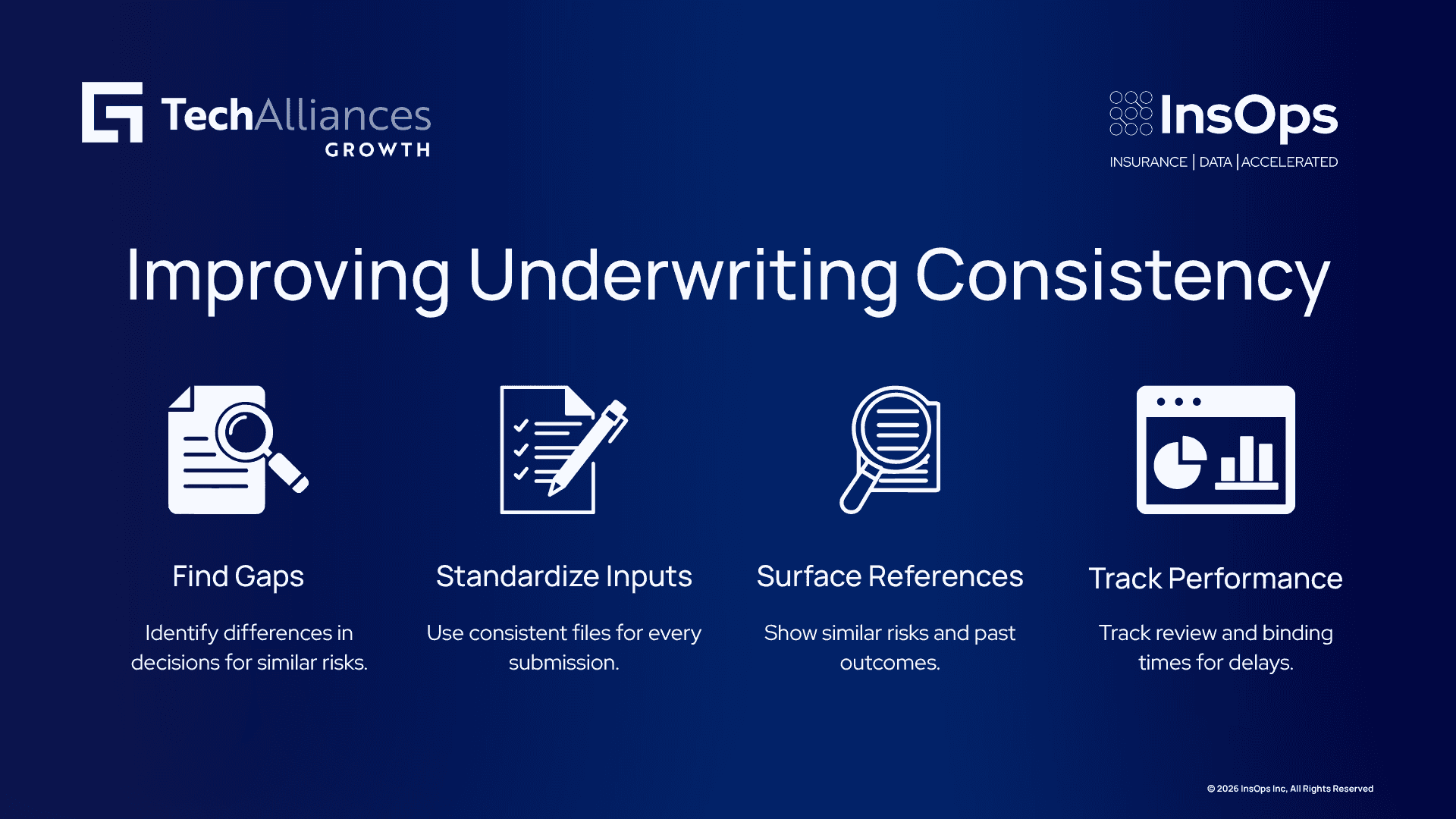
Stage 1: Baseline With Matched Pairs
Begin with decisions you already made. The review needs no new tooling. Closed files you already hold are enough.
Pull 20 to 30 matched pairs: risks with a similar class, limits, and profile where two underwriters reached different terms.
Rebuild what each underwriter saw at decision time, including the data, notes, loss runs, and any prior risks consulted.
Ask each underwriter for a one-sentence reason behind the call.
Tag every gap as an input gap, a reference gap, or a reasoning gap.
Count the tags. The largest count tells you where to start.
Record time on file and time to bind for each desk alongside the tags, since queue pressure shows up there. For a deeper look at what drives each gap, see our breakdown of why underwriters make inconsistent decisions.
Stage 2: Standardize Inputs
Define what a complete file contains for each line of business, then require that structure on every submission. Loss runs, exposure schedules, coverage requests, and broker notes should arrive in a fixed shape.
Manual data entry is the usual obstacle. Manual data entry across systems topped the workflow blockers in the survey, named by 42 percent of respondents.
Assign one owner in underwriting operations to the file standard, and version it. Every underwriter then knows which standard a file was written against.
Stage 3: Surface References
Give each underwriter a view of how comparable risks were written and how they performed. Without one, each person rebuilds a benchmark from memory, and two memories of "similar" rarely match.
Pick one class of business. Define "comparable" using three or four fields, such as construction, occupancy, limit, and loss history. Then put the list of comparable prior risks in front of the underwriter at quote time.
How Do You Run Stages 4 and 5?
Stages 4 and 5 capture the reasoning and keep the gains. They turn a one-time cleanup into a habit.

Stage 4: Record Reasons
Recording reasons means writing down why an underwriter departed from the guideline or the benchmark, at the moment of the decision. A manual written afterward records what people believe they do. A reason log records what they did.
Practitioners call the result decision memory. In an October 2025 article for Insurance Thought Leadership, Prathap Gokul of TCS describes it as a record of the reasoning behind each call and what followed, down to small decisions, collected through prompts the underwriter confirms.
The need is sharpest where senior knowledge sits with individuals. In the same survey, 37 percent of US underwriters said senior judgment is held mostly by individuals, against 26 percent of UK underwriters.
Take the exceptions from your Stage 1 review. Each one becomes a documented rule, a guideline update, or a reference example for newer underwriters.
Stage 5: Review and Adjust
Rerun the matched-pair review each quarter and track four measures.
Measure | What it shows | Direction you want |
|---|---|---|
Share of matched pairs with an unexplained gap | Whether variance is shrinking | Down |
Spread in terms on similar risks | How far two desks sit apart | Narrower |
Share of exceptions with a recorded reason | Whether Stage 4 is working | Up |
Overturn rate on referrals | Whether the referral desk reads the file the way the sender did | Stable, with reasons attached |
Treat a mixed result as normal. It tells you which stage to rerun next.
What a Realistic First 90 Days Looks Like
Plan the first quarter around one line of business. The table below is a planning guide, not a benchmark.
Weeks | Work | Output |
|---|---|---|
1 to 3 | Stage 1 baseline | Tagged matched pairs and a ranked list of gap causes |
4 to 8 | The stage your tags rank first | One fix live for one line of business or class |
9 to 12 | The stage your tags rank second | A second fix and the first reason log entries |
Quarter end | Stage 5 review | The first consistency report and the next cycle's priority |
The stage order is the default. If your tags point overwhelmingly at one cause, begin at that stage and schedule the earlier stages for the following cycle.
Where Should AI Assist Along the Roadmap?
AI should assemble and surface information at the point of decision, and the underwriter should keep the decision. Survey respondents described that split. Asked about the setup they want three years out, they described AI taking on data preparation, triage, and drafting while they keep complex risks and final approval.
Stages 2 and 3: Where Assistance Fits
Stage 2 is a data task. An insurance-trained model can read source fields, map them to a target structure, and flag mismatches, with a person validating the result.
Stage 3 is a retrieval task. An AI-assisted tool can find comparable prior risks and the guideline language that applies, then show both to the underwriter before the quote.
Stage 4: Why a Person Stays in the Loop
An underwriting decision has to hold up with a broker, a reinsurer, and a regulator. A tool suggestion is not a decision, and the underwriter who reviews and approves it owns the result.
When an underwriter overrides a suggestion, the override and its reason become an entry in the Stage 4 log. Human review therefore feeds the record the roadmap depends on.
How InsOps Helps
InsOps builds an insurance-trained AI that assists underwriting teams with the data behind each decision. LiLa, our insurance-trained LLM, runs inside your own environment, so PII and PHI never leave controlled infrastructure. A person reviews and validates every mapping before it is deployed.
Our Integration Gateway links source systems to Guidewire PolicyCenter and UnderwritingCenter, so policy and underwriting data lands in consistent Guidewire structures without custom engineering for each source. That supports the structural part of Stage 2.
Surfacing comparable prior risks and company guidelines at the point of an underwriting decision, the core of Stage 3, is a capability InsOps is building toward inside LiLa. It is not a shipped feature today. The underwriter reviews every suggestion and makes the final call.
If you are evaluating how to make underwriting decisions consistent without taking judgment away from your underwriters, contact us to talk through what this looks like for your operation.
Frequently Asked Questions
What does consistent underwriting mean?
Consistent underwriting means every difference between decisions on similar risks has a recorded reason tied to the risk. It does not mean every underwriter reaches the same price.
Why do two underwriters make different decisions on the same risk?
They work from different inputs, different comparisons, and different unwritten rules. Quotes diverge at once, but the pricing error surfaces later in loss results.
How do you standardize underwriting decisions across a team?
Baseline first, then fix the largest source of divergence: inputs, references, or reasoning. Standardize what every file contains, show comparable prior risks, and record why each exception was made.
Do written guidelines fix inconsistent underwriting decisions?
Not alone. A guideline states the rule for the standard case, and the gap opens on the exceptions it never listed.
How do you measure underwriting consistency?
Track the share of matched pairs with an unexplained gap and the share of exceptions with a recorded reason. A falling first number and a rising second number show the roadmap is working.
What is decision memory in underwriting?
Decision memory is a structured record of why each underwriting call was made and what happened afterward. It turns individual judgment into shared reference material that newer underwriters can use.
Where should AI assist in underwriting?
AI should prepare data, find comparable risks, and draft summaries. A person reviews each suggestion and owns the decision.
How long does it take to make underwriting decisions more consistent?
A first baseline takes weeks, while consistency builds over several quarterly cycles. The common pitfall is rewriting guidelines before the baseline shows which cause drives the gap.