

When an AI copilot arrives on the underwriting desk, the first question is not about features. Underwriters want to know whether the tool is there to help them or to replace them. If leadership answers with vague reassurance, the team hears a yes, and the rollout starts with distrust.
The honest answer is specific. A copilot prepares the file, sorts the queue, and drafts the summary. The underwriter prices the risk, sets the terms, and owns the bind decision.
This article shows where that line sits, task by task. It gives you a framework to hand to your team, evidence from a 2026 survey of senior underwriters, and a rollout path that keeps people in charge.
Will AI Replace Underwriters?
No. A copilot suggests and a person approves, and no recommendation becomes a decision until an underwriter has reviewed it and accepted responsibility for the result.
Underwriters describe the same arrangement when asked. A Coleman Parkes survey of 350 senior commercial P&C underwriters in the US and UK, fielded in June 2026 and reported by Insurance Business, asked them to picture an ideal setup three years out. They described AI taking on data, triage, and drafting, while they keep complex risks and the final call.
What Underwriters Actually Worry About
The survey points to a specific worry. Forty percent of respondents named AI making decisions too early in the underwriting process, at the cost of craft, as a top-three concern. The fear is about where the tool steps in, not only about headcount.
The survey was published by an underwriting software vendor, a point the trade press flagged. Read the figures as one data point, not as an industry benchmark.
Why Vague Reassurance Fails
Telling a team that AI frees them for higher-value work names no task and convinces nobody. A task-level answer does the job. The sections below build one.
What Does an AI Copilot Do for an Underwriter?
An AI copilot prepares data, sorts submissions, and drafts summaries for an underwriter, while the underwriter reviews every output and makes the pricing, terms, and bind decisions.
Each of those three jobs maps to a real piece of the underwriter's day.

Prepare the File
Submissions arrive as broker emails, loss runs, schedules of values, and inspection reports, each in its own format. A copilot reads those documents, pulls out the fields an underwriter needs, and lays them into the same structure every time. The underwriter checks the extraction instead of re-keying it.
That matters because re-keying is a known drag. In the survey, manual data entry across systems tops the list of workflow blockers at 42 percent.
Triage the Queue
A copilot checks each submission for completeness and compares it against stated appetite. It then lines up the queue so the risks that fit reach an underwriter first.
The sort is a suggestion. The underwriter reorders it whenever experience says otherwise, and the reason for that change is worth recording.
Draft the Summary
Submission summaries, referral notes, and file memos take time to write and add little judgment. A copilot drafts them from the prepared file. The underwriter edits the draft, corrects what it got wrong, and signs it as their own work.
Where Does the Copilot Stop and the Underwriter Start?
We call the answer the Four-Task Hand-Off Line. It splits underwriting work into four tasks and names who holds each one. The hand-off from copilot to underwriter happens at a named review checkpoint, not at a feeling about the tool's confidence.
Task | Copilot role | Underwriter role | Review checkpoint |
|---|---|---|---|
Prepare | Extracts and structures submission data from documents | Verifies the fields that drive pricing | Before the file opens for review |
Triage | Suggests priority by completeness and appetite fit | Accepts or reorders the queue | Start of each working session |
Draft | Writes summaries, referral notes, and file memos | Edits, corrects, and signs | Before anything leaves the desk |
Decide | Surfaces context on request | Sets price, terms, referral, and bind | The underwriter holds this task entirely |
The Fourth Task Never Moves
Decide is the row where the copilot makes no call. Pricing, terms, referral, and bind carry accountability to brokers, reinsurers, and regulators. A tool cannot hold that accountability, and an underwriter who reviews and approves a suggestion owns the outcome.
Human review also keeps the tool honest. Every override tells you where the copilot and the underwriter read the same file differently.
How to Use the Line With Your Team
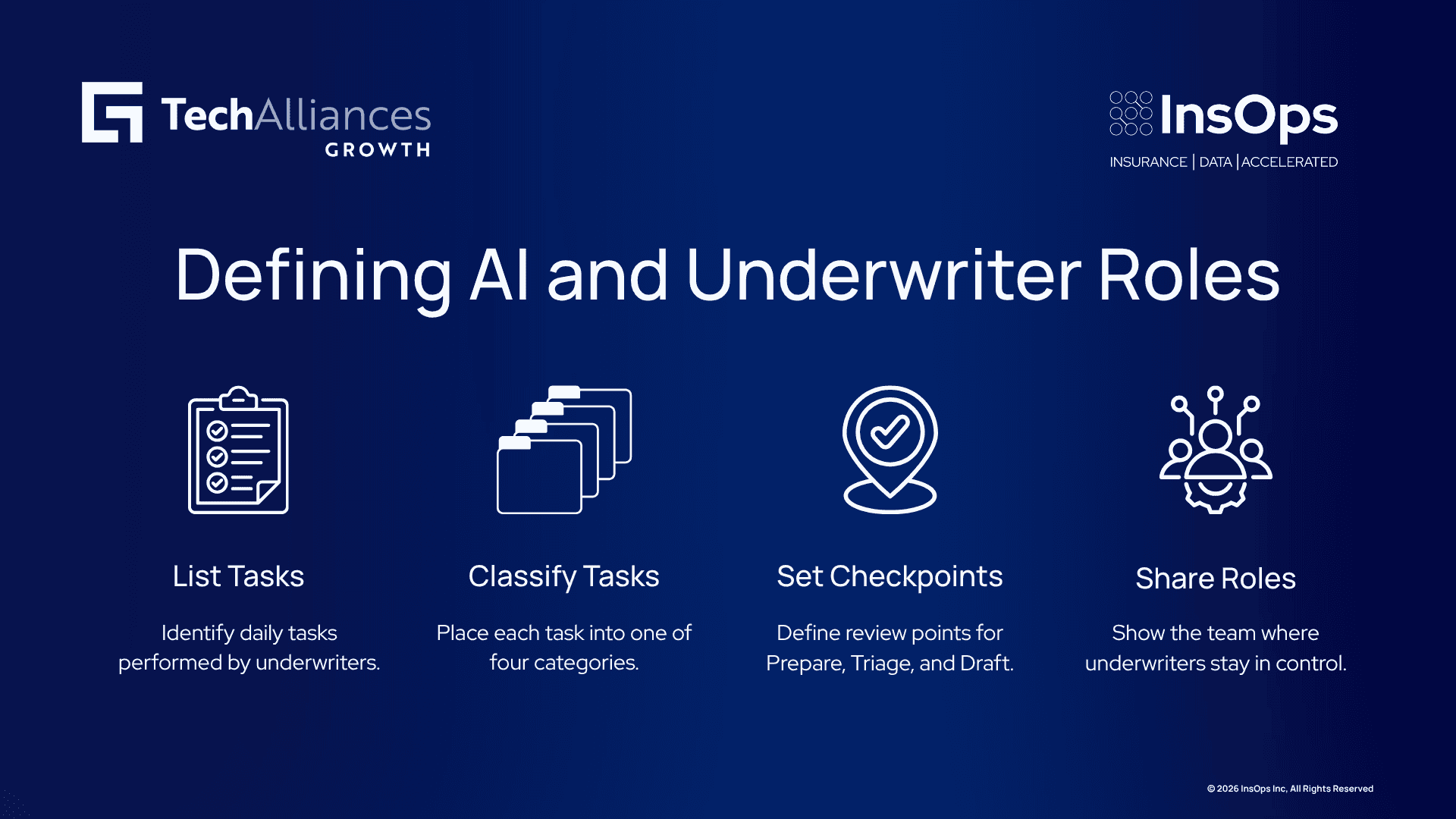
Run the exercise in four steps before any pilot starts:
List every task on a typical underwriter's day.
Place each task in one of the four rows.
Write the review checkpoint for every Prepare, Triage, and Draft task.
Share the finished table with the team, so they see exactly where they stay in charge.
The table also exposes tasks nobody has classified. Those are the ones that cause arguments after launch.
Does AI Improve Underwriting Decision Quality?
Among underwriters already using AI, 51 percent say its biggest contribution is saving time on manual admin, and only 21 percent say it improved the quality of their decisions.
That gap is the point. Speeding up the first three tasks on the Hand-Off Line gives hours back to the day. Better decisions need something else.
What Drags Decision Quality Down
Underwriters named pressure to bind quickly (38 percent) and no context on similar prior risks (35 percent) among the biggest drags on decision quality. Both are context problems, not speed problems.
When forced to choose, a majority picked a setup that carries more context and reasoning over a faster one. That tells you what to ask of any copilot.
What to Ask of Your Copilot
Judge a copilot on what the underwriter sees at the moment of decision, not only on how fast the file opens. Does the underwriter see how comparable risks were written? Does a recorded reason sit beside each past exception? Tools that answer yes put the missing context in front of the underwriter. Tools that only speed intake return time and leave the decision as it was.
Consistent context also narrows decision variance between desks. Our guide to inconsistent underwriting decisions breaks that variance into four sources and shows how to test your own team.
What Happens to Senior Judgment When the Copilot Takes the Admin?
It leaves with the people who hold it unless someone records it. In the survey, 44 percent of underwriters named losing senior judgment without passing it on as a top-three worry.
Investment runs the other way. Asked where their function would invest over the next 12 to 18 months, underwriters ranked coaching and knowledge transfer last of ten, with 8 percent naming it. End-to-end workflow tools led at 52 percent, followed by submission ingestion at 48 percent.
Keep Coaching Out of the Copilot
Underwriters guard coaching more closely than any other task. In the survey, 53 percent want AI kept out of it entirely or available only on request. Treat that as a design rule. Junior underwriters learn judgment from senior underwriters, and a copilot's job is to free the time for it.
Record Overrides as Judgment
When an underwriter overrides a copilot suggestion and writes one line explaining why, that line records judgment that otherwise stays in one person's head. Collect them. Each one is a candidate guideline update or a reference example for a newer underwriter. Our piece on institutional knowledge and retiring experts describes the same dynamic from the claims side.
How Do You Roll Out a Copilot Without Losing Your Underwriters' Trust?
Start narrow and let underwriters see the tool earn its place. Five steps keep the rollout honest:
Start with one class of business and one task row from the Hand-Off Line.
Run the copilot beside the current process first, so underwriters compare its output with their own file work.
Write the review checkpoint for each task before launch, not after.
Track every override and the reason behind it.
Expand to the next task row only when the override reasons are understood.
Measure What Matters
The table below pairs each metric with what it tells you.
Metric | What it shows |
|---|---|
Time from submission receipt to first underwriter review | Whether Prepare and Triage return time to the desk |
Override rate by task | Where underwriters and the copilot disagree |
Reasons recorded per override | Whether judgment is being captured |
Rework rate on drafted summaries | Whether Draft output is usable as written |
Submission-to-quote time | Whether the faster front end reaches the customer |
Read these together. A falling first-review time with a rising override rate means the copilot is fast and wrong, which is worse than slow.
Set Realistic Expectations
Plan for several review cycles instead of one. The first cycle shows where the copilot helps and where underwriters push back, and it does not close either gap. The common pitfall is expanding to a second task before anyone understands why underwriters changed the first one.
How InsOps Helps
InsOps builds an insurance-trained AI that assists underwriting teams with the data behind each decision. LiLa, our insurance-trained LLM, runs inside your own environment, so PII and PHI never leave controlled infrastructure. A person reviews and validates every mapping before it is deployed.
Our Integration Gateway connects to Guidewire PolicyCenter and UnderwritingCenter, so policy and underwriting data from your source systems arrives in consistent Guidewire structures without custom engineering for each source. That supports the Prepare task by fixing the structure the data arrives in.
Drafting submission summaries, suggesting triage priority, and surfacing comparable prior risks at the point of decision are capabilities InsOps is building toward inside LiLa. They are not shipped features today, and none of them replaces an underwriter's judgment. The underwriter reviews every suggestion and makes the final call.
If you are evaluating how to introduce a copilot to your underwriting desk without taking judgment away from your underwriters, contact us to talk through what this looks like for your operation.
Frequently Asked Questions
Will AI replace underwriters?
No. Underwriters keep pricing, terms, referral, and bind decisions, because those calls carry accountability a tool cannot hold. The copilot handles the preparation around them.
What does an AI copilot do for underwriters?
It reads submission documents, structures the data, suggests a queue order, and drafts summaries and notes. Each output goes to an underwriter for review before anyone uses it.
Do underwriters still control final decisions?
Yes. In a well-run rollout every task has a named review checkpoint, and the Decide task has no copilot step at all.
What can AI do in underwriting today, and what can it not do?
Today it prepares data, suggests priority, and drafts text. It does not exercise judgment on a complex risk, hold accountability for a bind decision, or take over the coaching of junior underwriters.
How much time can AI save commercial underwriters?
Published time-savings figures come mostly from software vendors and measure different things, so the reliable number is your own baseline. Measure time from submission receipt to first underwriter review before the pilot, then again after each cycle.
Does AI improve underwriting decision quality?
Not through speed alone. Time the copilot gives back leads to better decisions only when the underwriter spends it on context, such as comparable prior risks and the recorded reasons behind earlier exceptions.
How is an AI copilot different from an autonomous agent?
A copilot surfaces suggestions and drafts that a person reviews before anything moves forward. An autonomous agent completes steps without that review. InsOps builds assistance that keeps a person in the loop.
How long does it take to roll out an underwriting copilot?
Plan for a staged rollout, one class of business and one task at a time, with several review cycles before you expand. Skipping the override review in the first cycle carries its mistakes into the second.