

When a submission lands on an underwriter's desk, the risk decision is often the smallest part of what happens next. Before any judgment gets applied, someone has to open ACORD forms, loss runs, financial statements, and inspection reports, then read, cross-check, and re-key what's inside them.
That reconstruction work is real and necessary. But it isn't underwriting judgment, and it's where a large share of the day actually goes.
This article looks at where an underwriter's time is genuinely spent, why document review specifically is such a large piece of that, and what changes when that step gets handled differently.
Where an Underwriter's Day Actually Goes
How much of underwriting is actually underwriting?
Accenture's 2024 Underwriting Executive Survey found that more than a third of an underwriter's time goes to non-core activities like data collection and administrative work, not risk evaluation itself. That's a slight improvement over Accenture's 2021 survey, but the gap between "underwriting" and "everything around underwriting" remains wide.
Non-core work isn't one thing. It spans opening documents, extracting figures, checking that numbers match across files, and typing that data into a workbench or rating system before a risk can even be assessed.
What counts as "non-core" work?
It helps to name this step directly instead of folding it into a vague "admin" bucket. Call it the submission reconstruction tax: the time an underwriter pays, before judgment can start, to rebuild a clean, complete picture of a risk from scattered documents.
The tax is separate from underwriting itself. An underwriter can be excellent at pricing risk and still lose hours a day paying it, because reconstruction and evaluation are two different skills happening in sequence, not one blended task.
The Document Review Bottleneck, Concretely
Why document review specifically, not just "admin work"?
Indico Data, a vendor building submission-intake tools for insurers, stated in an October 2025 product post that underwriters can spend up to 70% of their day on manual data entry and information gathering rather than actual risk assessment. That's Indico's own industry observation, not an independent survey, but it points at the same pattern Accenture's research describes: document handling is where non-core time concentrates.
Commercial submissions are a good example of why. A single file can include an application, loss runs, a statement of values, certificates, and financial statements, each in a different format, each requiring its own read-through before the underwriter can move forward.
What does manual review cost beyond the underwriter's own time?
Manual review also means the same document gets reopened at multiple points: once during intake, again during underwriting, sometimes again during a quality check. Every reopening is a chance to miss a detail, transpose a number, or reconcile the same figure differently than the last person who touched it.
This is a consistency problem as much as a speed problem. The more times a person manually re-enters the same data point, the more chances there are for two systems to disagree about what that data point actually is.
What Changes When Document Review Is Handled Differently
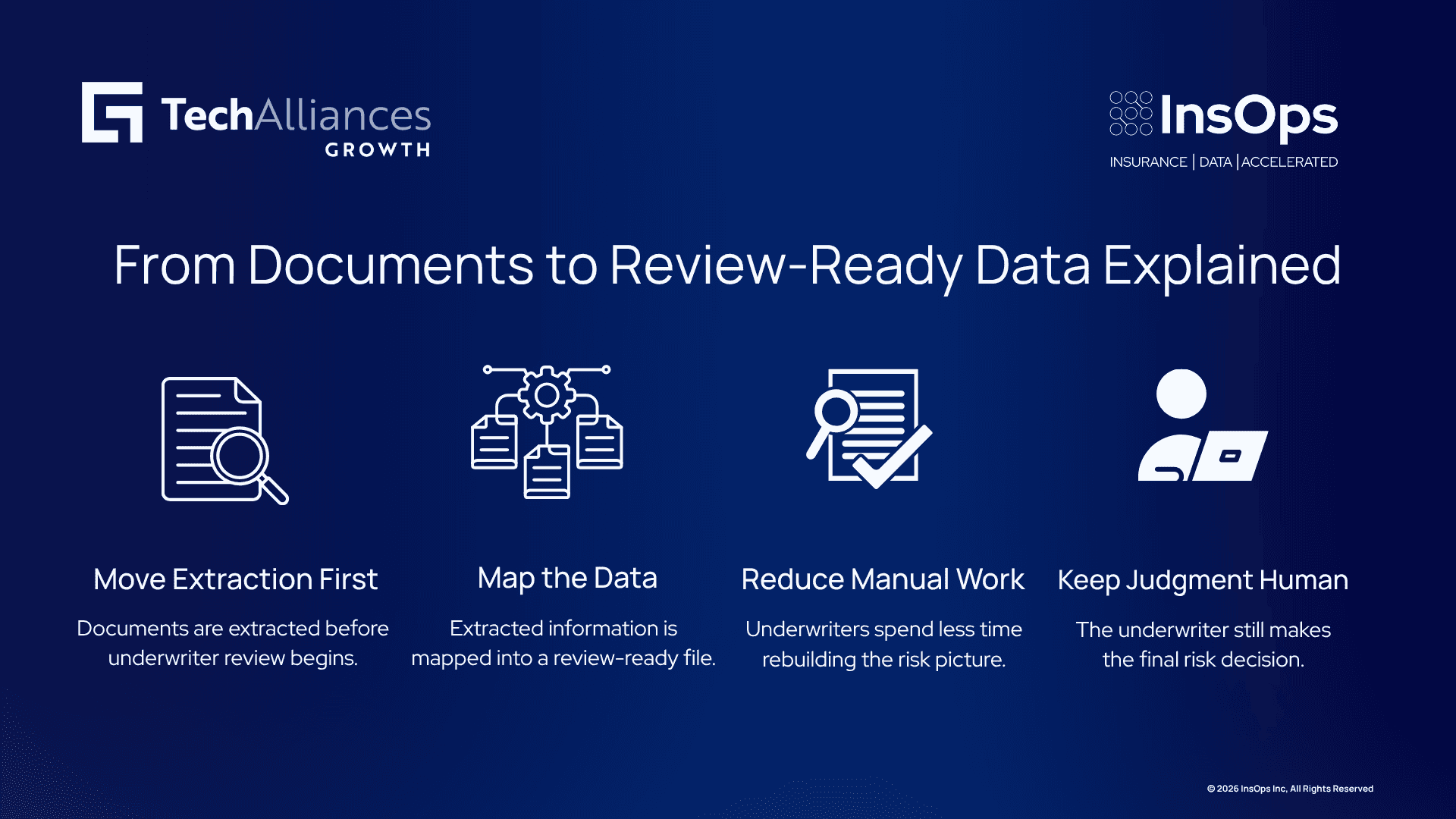
The reconstruction step doesn't disappear when it's handled differently. It moves.
Instead of an underwriter opening each document and typing figures into a workbench by hand, that extraction and mapping work happens first, so what reaches the underwriter is closer to a ready-to-review file than a stack of raw attachments.
The risk decision still belongs to the underwriter. What changes is how much of the day gets spent rebuilding the picture before that decision can even begin.
How InsOps Helps
InsOps builds an insurance-trained AI that assists with mapping and validating submission data as it moves into your systems. LiLa, our insurance-trained LLM, runs inside your own environment, so PII and PHI never leave controlled infrastructure.
A person reviews and validates every mapping before it's finalized. LiLa surfaces and structures the data; the underwriter still makes the call.
Our Integration Gateway connects directly to Guidewire PolicyCenter, UnderwritingCenter, and related systems, so submission data flows into your existing workflow without months of custom engineering.
If you're evaluating how to reduce the time your underwriters spend reconstructing submissions by hand, without exposing sensitive data to a generic, ungoverned model, contact us to talk through what this could look like for your operation.
Frequently Asked Questions
What is manual underwriting document review?
It's the process of an underwriter or intake staff opening submission documents such as applications, loss runs, and financial statements by hand, reading them, and typing the relevant data into a rating or policy system before risk evaluation begins.
Why does underwriting take longer than expected?
Much of the delay happens before the risk decision itself. Documents arrive in inconsistent formats, and someone has to reconcile and re-key that information manually, which adds time that has nothing to do with the actual risk judgment.
How much of an underwriter's time goes to administrative work versus risk evaluation?
A lot of it. Underwriting industry surveys have consistently found non-core work, mostly data collection and administrative tasks, consumes well over a third of a typical day, leaving less room than you'd expect for the actual risk decision.
What kinds of documents slow underwriting down the most?
Commercial submissions tend to be the heaviest, since a single file can include applications, loss runs, statements of value, certificates, and financial statements, each in its own format and each needing a separate read-through.
Does reducing manual document review actually improve accuracy, or just speed?
Both are affected. Every time a document is reopened and re-keyed by hand, there's a chance for a figure to be transposed or reconciled inconsistently with an earlier entry, so reducing manual re-entry reduces that specific failure point, not just the time it takes.
How does InsOps' Integration Gateway fit into this?
The Integration Gateway maps submission data directly into Guidewire systems. A person still reviews the mapped data before anything moves downstream, so the underwriter starts from a structured file instead of raw documents.
What's a realistic timeline to see less manual document review in a team's day?
This depends on submission volume, document variety, and how many systems the data needs to reach. Contact us to talk through a realistic timeline for your specific setup.
Does AI replace the underwriter's judgment in this process?
No. LiLa assists by structuring and validating the data underwriters would otherwise gather by hand. The risk decision itself stays with the underwriter, with a human reviewing every output before it's used.