

Your best underwriters spend part of every day on work that does not need their judgment. They open broker emails, check whether loss runs are attached, retype data into a rating system, and read files that fall outside appetite.
That work costs more than the hours. The complex, profitable risks that need senior attention wait in the same queue as submissions that should have been declined at the door. Brokers notice the wait, and they move on.
Submission triage fixes the order of work. This article covers where senior underwriter time goes, what triage is, a four-tier framework you can adopt, why manual triage breaks down, and how to roll it out on one line of business first.
Where Senior Underwriter Time Goes
Underwriters are hired and paid for risk selection and pricing. In practice, the first stretch of every submission is administrative, and it lands on whoever opens the file first.
Brokers route accounts to underwriters they know. That means the most experienced people on your team receive the most volume.
The Intake Work Nobody Budgets For
A commercial submission arrives as an email with attachments. The underwriter reads the body, opens each file, and works out what is included and what is missing.
Then comes the rekeying. Named insured, locations, limits, and loss history move from PDFs and spreadsheets into the underwriting system by hand.
The Underwriting Edge 2026 survey of 350 senior commercial P&C underwriters in the US and UK, conducted by Coleman Parkes in June, points to the same drag. Manual data entry between systems was the workflow problem respondents selected most often, at 42%.
Declines That Arrive Late
Some submissions are out of appetite from the first page. The class is excluded, the territory is not written, or the limits exceed authority.
When nobody screens these at intake, an underwriter reads the whole file before saying no. The broker waits longer for the answer, and a better-fit submission waits behind it.
Slow Answers Change Your Pipeline
Delay does not only cost individual deals. Brokers market to several carriers at once, and the carrier that answers first sets the anchor.
Over time, brokers send their easy placements elsewhere. The submissions that keep arriving skew toward the ones nobody else wanted, which reshapes your book without a single appetite decision. Our piece on why slow quote turnaround costs more than lost deals covers this selection effect in more depth.
What Submission Triage Is
Submission triage is the structured sorting of incoming submissions by appetite, completeness, and priority before an underwriter begins evaluating the risk. It decides what happens to each file first.
The goal is to route every submission to the right person, at the right time, with the right information attached.
Sorting Before Evaluating
Triage does not price a risk or bind coverage. Think of an emergency department. A triage nurse assesses each arrival in minutes and routes the patient, and the surgeon sees the patients the nurse sent.
Underwriting works the same way. Senior underwriters should see the files that earned their time.
The Three Questions Every Submission Gets
Triage applies the same three questions to every file. Consistency is what separates triage from an informal skim of the inbox.
Question | What it checks | Outcome |
|---|---|---|
Is it in appetite? | Class, territory, limits, and exclusions against written guidelines | Proceed or decline |
Is it complete? | Application, loss runs, schedules, and required supplements | Proceed or request information |
How urgent and complex is it? | Effective date, account size, broker priority, and exposure complexity | Route and prioritize |
Triage Versus Underwriting Judgment
Triage stops where judgment begins. A triage decision routes the file, and an underwriting decision selects and prices the risk.
Underwriters draw the same line. In the Underwriting Edge survey, respondents preferred a model where technology handles data preparation, triage, and drafting while experienced underwriters keep control of complex risks and final approval.
A Four-Tier Triage Framework
A workable framework has four tiers. Each tier has a clear signal, a defined owner, and a target response time.
Tier | Signal | Route | Example target |
|---|---|---|---|
1: Priority | In appetite, complete, strong account or broker fit | Senior underwriter | Same business day |
2: Standard | In appetite, minor gaps | Assistant requests missing items, then a mid-level underwriter | Two business days |
3: Hold | In appetite, material gaps | Specific request list returned to broker | Request sent same day |
4: Decline | Outside appetite | Standard decline, reviewed by an underwriter | Same day |
Adjust the targets to your book. The structure matters more than the exact numbers.
The Appetite Gate
Start with appetite because it removes the most wasted effort. Write your appetite as testable rules, not as a paragraph of intent.
A rule reads "no habitational risks above four stories in coastal counties." A phrase like "we prefer lower-hazard residential" cannot be tested in under a minute, and rules that cannot be tested cannot be applied consistently.
The Completeness Check
Next, confirm the file contains what the underwriter needs. Define a required-document list per line of business, covering the application, currently valued loss runs, statements of values, and any supplemental forms.
A file missing required items goes to Tier 3 with a specific request list. Underwriters stop discovering gaps halfway through their review.
Priority and Complexity Scoring
Among in-appetite, complete submissions, decide who works what first. Score on effective date, account size, exposure complexity, and broker relationship.
A large account with a near effective date and unusual exposures goes to a senior underwriter today. A routine renewal with clean history goes to a mid-level underwriter on a normal timeline.
Standard Responses for Brokers
Every tier needs a defined message back to the broker. A decline states the reason, and a hold lists exactly what is missing.
Brokers value a fast, clear no over a slow maybe. Standard responses also protect underwriter time, because nobody drafts the same email forty times a week.
Why Manual Triage Breaks Down
Most carriers and MGAs already triage informally. Someone skims the inbox, and experienced people develop instincts.
Informal triage fails for structural reasons, and volume is only one of them.
Unstructured Submission Packets
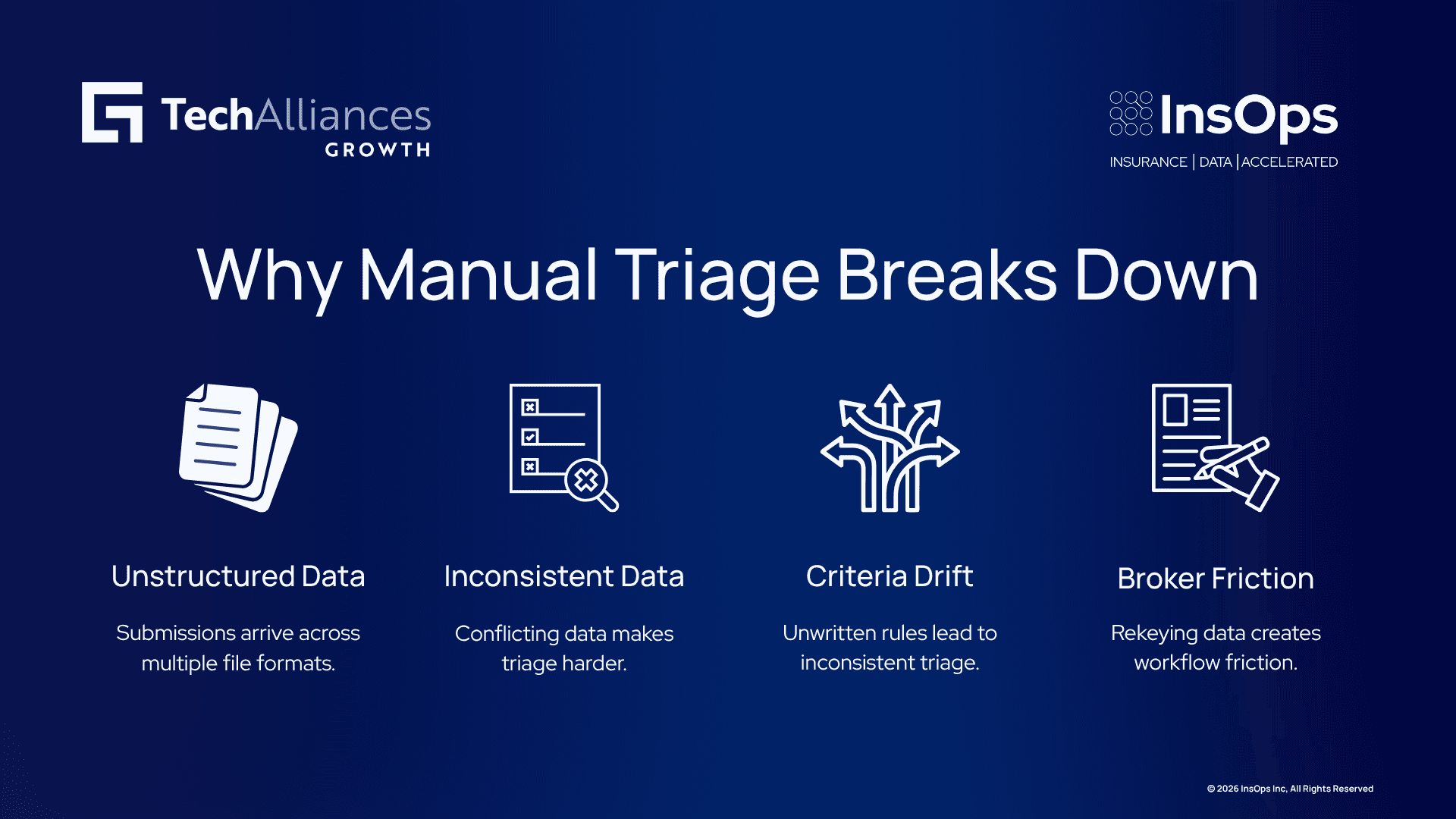
Submissions rarely arrive in one clean format. A single account can include an ACORD form, a broker email, a loss run in PDF, a statement of values in a spreadsheet, and photos.
Triage only works when someone extracts the same fields from every file in the same way. Reading across formats by hand takes time and produces uneven results.
Inconsistent Data and Inconsistent Criteria
In the Underwriting Edge survey, 44% of underwriters named inconsistent submission data as a major obstacle to better decisions. When two documents disagree on revenue or class code, someone has to decide which one is right before triage can proceed.
Criteria drift adds a second problem. Without written rules, two underwriters triage the same file differently, and performance data becomes hard to trust.
Rekeying Hurts Your Brokers Too
The friction is not only internal. According to Ivans' 2026 Agency-Carrier Connection Report, which surveyed more than 700 agents, re-keying data ranks as the top workflow pain point for 74% of them.
Agents who write more than 75% of their book in commercial lines report re-keying data more than 70% of the time. Across the full sample, 90% said they have reduced business with a carrier because of friction.
Rolling Out Triage in Your Book
A full rollout across every line of business is the wrong first step. A narrow start produces evidence, and evidence builds team support.
Start With One Line of Business
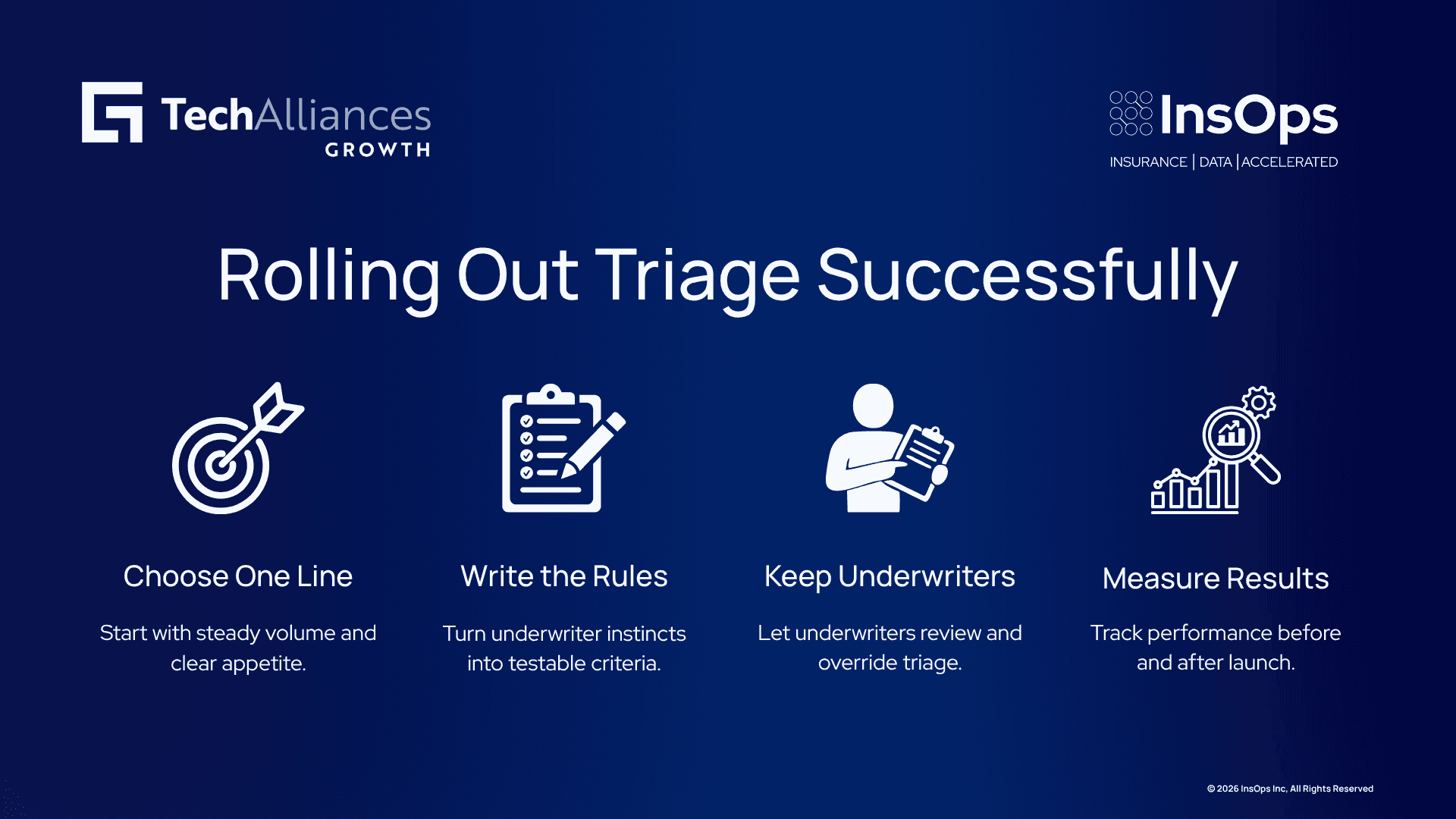
Choose a line with steady volume and a clear appetite. Commercial property, small commercial packages, and habitational often fit.
A single line keeps the rule set small and the feedback loop short. You learn what the framework needs before you scale it.
Write the Rules Down
Sit with your senior underwriters and convert their instincts into criteria. Ask what makes them decline a submission in the first two minutes.
Capture the answers as testable rules and version them. Underwriters own the rules, so any change goes through them.
Keep an Underwriter in the Loop
Triage output is a recommendation, not a final decision. Route every decline through an underwriter, and let underwriters override any tier assignment.
Overrides are useful data. Review them monthly to find rules that are too tight, too loose, or out of date.
Measure What Changes
Set a baseline before launch, then track the same measures afterward. Useful measures include time from receipt to first touch, share of senior time spent on Tier 1 files, and percentage of submissions returned for missing information.
Also track hit ratio by tier and the rate of declines after significant work. If the last number falls, the front door is working.
How InsOps Helps
InsOps builds an insurance-trained AI that assists with the data work surrounding submission triage. LiLa, our insurance-trained LLM, runs inside your own environment, so PII and PHI never leave controlled infrastructure. A person reviews and validates every mapping and recommendation before it is finalized.
Our Integration Gateway connects to Guidewire UnderwritingCenter, PolicyCenter, and Quoting Services, so submission data flows into your underwriting workflow without custom engineering. LiLa maps and transforms incoming payloads into Guidewire structures, and your team validates every mapping before deployment.
InsOps migrates legacy data into Guidewire and keeps it flowing in real time.
Reading and scoring submission content for triage is a direction InsOps is building toward inside LiLa. If you are evaluating how to give senior underwriters their time back without exposing submission data to a generic model, contact us to talk through what this could look like for your operation.
Frequently Asked Questions
What is submission triage in insurance underwriting?
Submission triage is the structured sorting of incoming submissions before full evaluation. Each file is checked for appetite fit, completeness, and urgency, then routed to the right underwriter, returned to the broker, or declined.
Why does submission triage matter?
It protects senior underwriter time for work that needs judgment. It also gives brokers faster answers, because declines and information requests go out at intake instead of after hours of review.
How do we implement submission triage?
Pick one line of business and write your appetite as testable rules. Define a required-document list, set tier definitions with owners, and run the process alongside your current one before you switch over.
What are the most common challenges?
Unwritten appetite is the biggest one, because rules held only in underwriters' heads cannot be applied consistently. Unstructured submission formats and disconnected systems come next, since both force manual rekeying before any sorting starts.
Which metrics show that triage is working?
Track time from receipt to first touch, the share of senior time spent on Tier 1 files, and hit ratio by tier. Also watch the rate of declines after significant work, since a falling rate means out-of-appetite files are stopped earlier.
How does InsOps assist with submission triage?
InsOps assists with the data flow around triage. LiLa maps incoming submission data into Guidewire structures inside your environment, and a person validates the mapping before it goes live. Triage scoring itself is a direction InsOps is building toward.
How long does implementation take?
Plan on six to eight weeks for a single-line pilot: two weeks to write criteria, two to configure intake, and two to four to run alongside current practice. The usual pitfalls are launching across every line at once and skipping the baseline measurements.
Does submission triage replace underwriter judgment?
No. Triage decides the order and owner of work, and underwriters still select and price every risk. Declines are reviewed by an underwriter, and the underwriting team owns the appetite rules.