

The Hidden Litigation Risk in Subrogation Claims: How to Prioritize Subrogation Litigation
When a subrogation team is sitting on more potential claims than it can realistically take to court, the real problem isn't finding the claims. It's deciding which ones are worth the time, the budget, and the legal risk of litigating.
Every claim left on that list has a clock running against it. Evidence gets harder to prove with each passing week, and the statute of limitations on a subrogation claim eventually closes the door on the decision entirely, whether a team has made a call or not.
This article walks through why that sorting decision is harder than it looks, a three-part framework for making it consistently, and how to tell when a claim belongs in arbitration versus civil court.
Why Subrogation Litigation Decisions Are Harder Than They Look
Insurers miss out on 15% of all claims that could be recouped through subrogation, according to the National Association of Subrogation Professionals. Even when a team correctly identifies an opportunity, it fails to follow through to recovery in nearly a third of those cases.
That gap doesn't point to a detection problem. It points to a decision problem.

The identification problem is mostly solved
Most claims teams already have a process for flagging when a third party might be liable for a loss. Police reports, repair estimates, and adjuster notes usually contain the information needed to spot a subrogation opportunity early.
The decision problem is not
What most teams lack is a consistent way to decide, once a claim is flagged, whether it's actually worth pursuing through litigation. Without that, claims sit in a queue until someone runs out of time to act on them.
The Real Cost of Getting the Timing Wrong
Subrogation claims are bound by statutes of limitations that vary by state and by claim type. An insurer typically has a window of one to six years to file a subrogation claim after paying out a loss, depending on the jurisdiction.
That legal deadline is often not the binding constraint. Evidence decays long before the statute of limitations runs out.
Evidence decays faster than deadlines suggest
Witnesses forget details. Physical evidence like damaged parts or building materials gets discarded during repairs. A claim that was clearly winnable at first notice of loss can become unprovable within months, well before any statutory deadline is close.
Statute of limitations varies by state and claim type
Because the filing window differs by jurisdiction and by whether the claim sounds in contract or in tort, a national or multi-state carrier cannot rely on a single internal deadline. Tracking the applicable statute for each open subrogation file is a prerequisite for any prioritization decision, not an afterthought.
The Litigation Worth Test
Before a subrogation claim advances to litigation, it needs to clear three checks. Fail any one of them, and litigation is unlikely to be worth the cost, regardless of how strong the underlying facts feel.
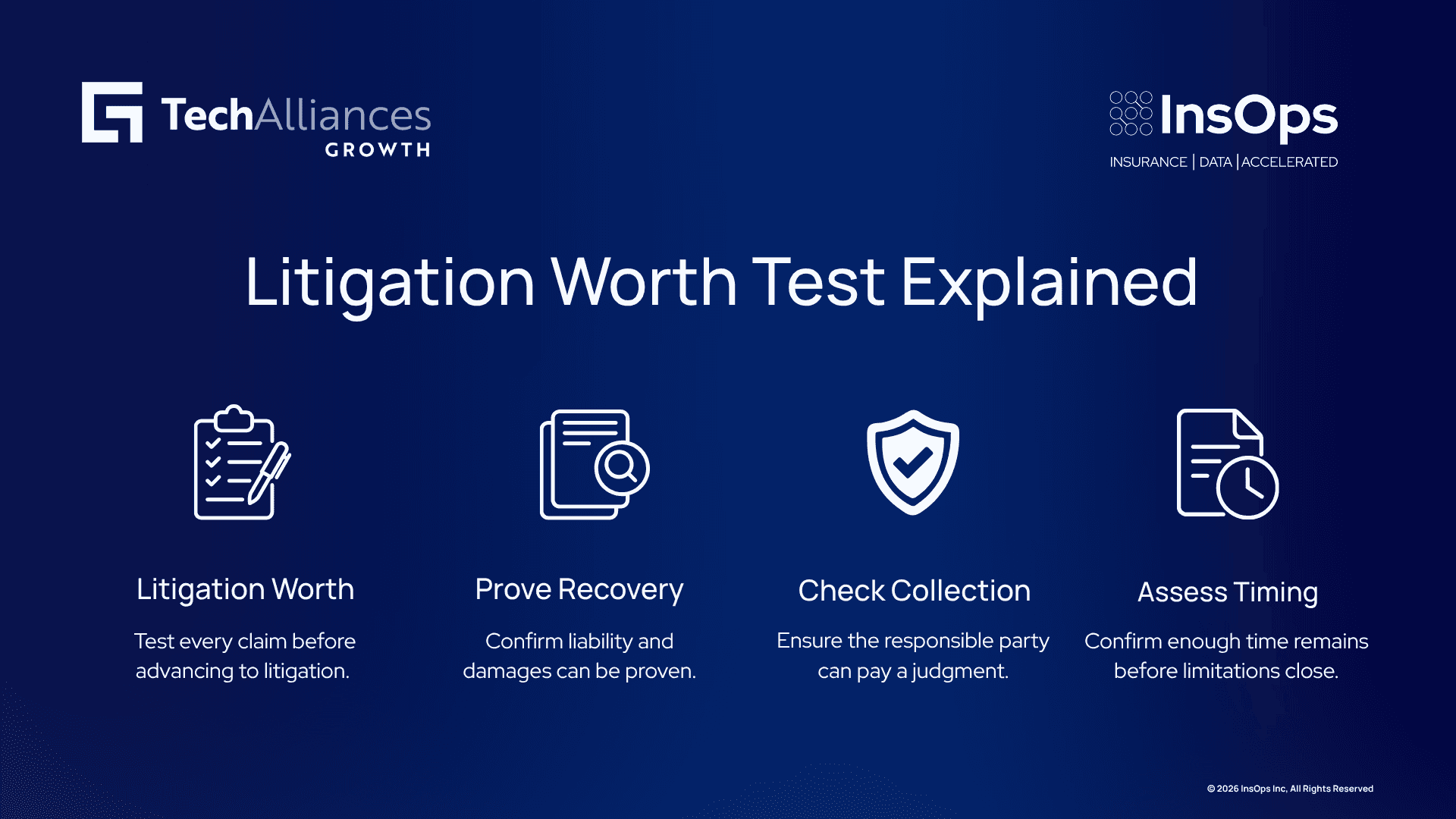
Recoverability. Can liability and damages actually be proven with the evidence currently on file.
Collectability. Does the responsible party, or their insurer, have the means to pay a judgment.
Timing. Is there still enough runway before the statute of limitations closes to build and file the case.
A claim that passes all three is a strong candidate for litigation. A claim that fails even one usually belongs in settlement, arbitration, or the closed file.
Applying Recoverability, Collectability, and Timing to Real Claims
Factor | What to check | What fails it |
|---|---|---|
Recoverability | Police report, repair estimate, and witness statements clearly establish fault | Conflicting accounts, missing documentation, or physical evidence that was already discarded |
Collectability | The responsible party carries insurance, or has identifiable assets | An uninsured individual with no attachable assets |
Timing | Enough time remains under the applicable state statute of limitations to investigate and file | The claim is already close to its filing deadline with investigation still incomplete |
Running every open file through this same table, rather than relying on individual adjuster judgment case by case, is what turns prioritization into a repeatable process instead of a series of one-off calls.
Arbitration or Litigation? Knowing When a Claim Needs to Go to Court
Not every subrogation claim that passes the Litigation Worth Test needs to go to civil court. Most claims move through negotiation, mediation, or arbitration first, and only proceed to a lawsuit if those routes fail or the carrier opts out of them.
When pre-suit resolution works
If liability is clear, for example a documented case of a driver running a red light, the opposing carrier is often willing to pay the claim through informal negotiation. Arbitration forums built for insurance disputes offer a faster, lower-cost path when both parties are already members and have agreed in advance to abide by the panel's decision.
When a claim needs to go to court
Litigation becomes necessary when pre-suit negotiation or arbitration doesn't produce an acceptable recovery, or when the carrier's own strategy calls for filing suit directly. In court, the subrogating carrier has to prove liability, the damages that resulted, and the amount it paid out to its insured, all by a preponderance of the evidence.
How InsOps Helps
InsOps builds an insurance-trained AI that assists subrogation and claims teams with prioritization decisions like these. LiLa, our insurance-trained LLM, runs inside your own environment, so claim and policyholder data never leaves controlled infrastructure.
InsOps reduces litigation risk by analyzing case patterns and claim history to surface high-risk claims. A person on your team reviews and validates every flagged claim before any litigation decision is finalized.
Our Integration Gateway connects to Guidewire ClaimCenter and related systems, so claim history and case data flow directly into the workflow your subrogation team already uses, without custom engineering.
If you are evaluating how to prioritize subrogation litigation without adding headcount or building a scoring model from scratch, contact us to talk through what this could look like for your operation.
Frequently Asked Questions
What is subrogation litigation?
Subrogation litigation is the lawsuit an insurer files against a third party, or that party's insurer, to recover the money it already paid out on a covered claim. It's the final step in the subrogation process, used when pre-suit negotiation or arbitration doesn't resolve the claim.
Why don't insurers pursue every subrogation claim they identify?
Most subrogation programs already identify more opportunities than they act on. Limited capacity and no consistent way to judge which claims are worth the cost of pursuing are the two most common reasons a recognized opportunity never turns into a recovery.
How do insurers decide which subrogation claims to litigate?
The strongest approach checks three things for every claim: whether liability and damages can actually be proven, whether the responsible party can pay a judgment, and whether enough time remains before the statute of limitations closes. A claim that fails any one of these rarely justifies the cost of litigation.
How long does an insurer have to file a subrogation lawsuit?
It depends on the state and the claim type. Most jurisdictions allow somewhere between one and six years from the date of loss, so tracking the exact deadline for each open file matters more than assuming a single default number applies everywhere.
What's the difference between arbitration and litigation in subrogation?
Arbitration resolves a dispute through a forum both parties have already agreed to, with a panel decision both sides are bound by. Litigation means filing a lawsuit in civil court, which requires proving liability and damages before a judge or jury. Most subrogation claims attempt arbitration or negotiation first and only move to litigation if that doesn't produce an acceptable result.
What KPIs show whether a subrogation litigation program is working?
Recovery rate as a percentage of paid claims, average time from claim identification to demand, and win rate at arbitration or trial are the core metrics most subrogation programs track. Reviewing these regularly helps a team see whether its prioritization approach is actually improving outcomes or just keeping pace with intake.
How does AI assist with subrogation litigation prioritization?
Insurance-trained AI can review case patterns and claim history across an entire portfolio of open files at once, something that's difficult to do manually claim by claim. It surfaces which claims show the strongest liability and collectability signals, so a person can review those first instead of working strictly by order of arrival.
How long does it take to see results from a better prioritization process?
Most teams see the clearest early signal within one to two claim cycles, since the Litigation Worth Test changes which claims get resourced immediately rather than requiring a system overhaul. Full recovery-rate impact takes longer to show up, since claims that go to litigation can take months to resolve regardless of how well they were prioritized going in.