

When a claim's reserve keeps drifting upward in small increments well after intake, it's easy to treat each adjustment as routine. New information came in, the reserve moved, that's how reserves are supposed to work. Sometimes that's exactly what's happening.
Other times, that same pattern is the earliest visible sign that a claim is heading toward a dispute, and the file just hasn't been flagged yet. This article covers what actually distinguishes normal reserve movement from a warning sign, what stair-stepping is and why it matters, and what to watch for beyond the dollar amount alone.
Why a Reserve Keeps Changing Long After a Claim Opens
A reserve that keeps moving late in a claim's life, rather than settling early and holding, is one of the clearest signs that the claim's real exposure wasn't visible at intake.
This isn't unusual on its own. A reserve is set from limited information at first notice of loss, before medical treatment plans are finalized, before liability facts are fully known, before an attorney may or may not enter the picture. As those facts firm up, the reserve is supposed to move to reflect them.
The distinction that matters is why the reserve is moving. A reserve that adjusts because new documentation confirmed a higher repair estimate is doing exactly what it should. A reserve that keeps climbing in small steps with no single piece of new information driving each increase is a different pattern entirely, and it's worth a second look.
Claims that stay open longer are where this distinction becomes visible. A claim that closes in thirty or sixty days rarely has time to show a meaningful drift pattern. A claim that stays open for a year or more, common in liability and workers' compensation files, has plenty of time for small reserve adjustments to compound into something that looks very different from where the file started.
What Is Stair-Stepping, and Why Does It Matter?
Stair-stepping happens when an initial reserve is set too low and then raised in small increments as bills arrive, a pattern that only becomes visible once a claim has stayed open long enough to show it.
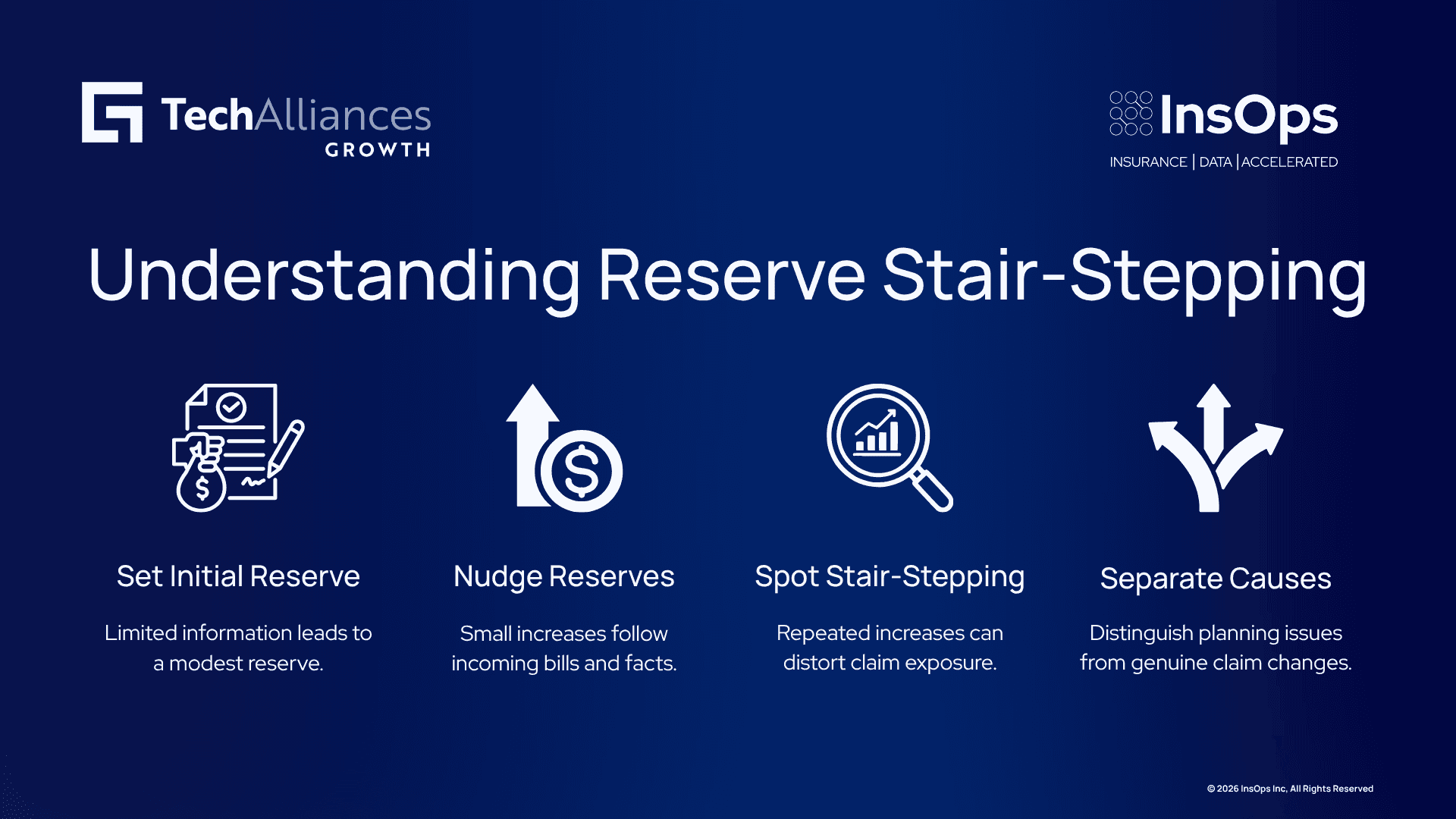
The mechanism is straightforward. A claim representative sets a modest initial reserve, often because early information is limited. As bills or new facts arrive, rather than resetting the reserve to reflect the claim's actual current exposure, the reserve gets nudged up just enough to cover what's needed right now. This repeats, one small step at a time, rather than the reserve being reset in one deliberate move when new information genuinely changes the picture.
On a claim that closes quickly, stair-stepping barely matters. It might reveal a claim representative's handling habits, but it doesn't have time to distort anything meaningful. On a claim that stays open for years, the incremental increases compound, and by the time the pattern is obvious, the reserve has often been wrong for most of the claim's life.
The important thing to separate is a stair-stepped reserve from a reserve that's genuinely being adjusted because circumstances changed. Both look like "the reserve went up again" from a distance. Only one of them reflects a planning problem rather than a claim problem.
Is a Big Reserve Jump Always a Red Flag?
Not necessarily. A single large reserve adjustment, even one that moves the reserve by a meaningful amount, can simply reflect a piece of new information that genuinely changed the claim's exposure: a revised repair estimate, a new diagnosis, an updated demand.
What makes a reserve change worth flagging isn't its size in isolation. It's whether the adjustment happened right before a claim closed, or whether it doesn't line up with any specific new information in the file. A large jump tied to a documented change in circumstances is the system working as intended. A large jump with no clear driver, especially one that lands right before settlement, is worth asking questions about.
This is why looking at a reserve number alone, without the context of when it moved and what prompted the move, gives an incomplete picture. The timing and the trigger matter as much as the dollar figure.
The Drift-to-Dispute Signal Stack
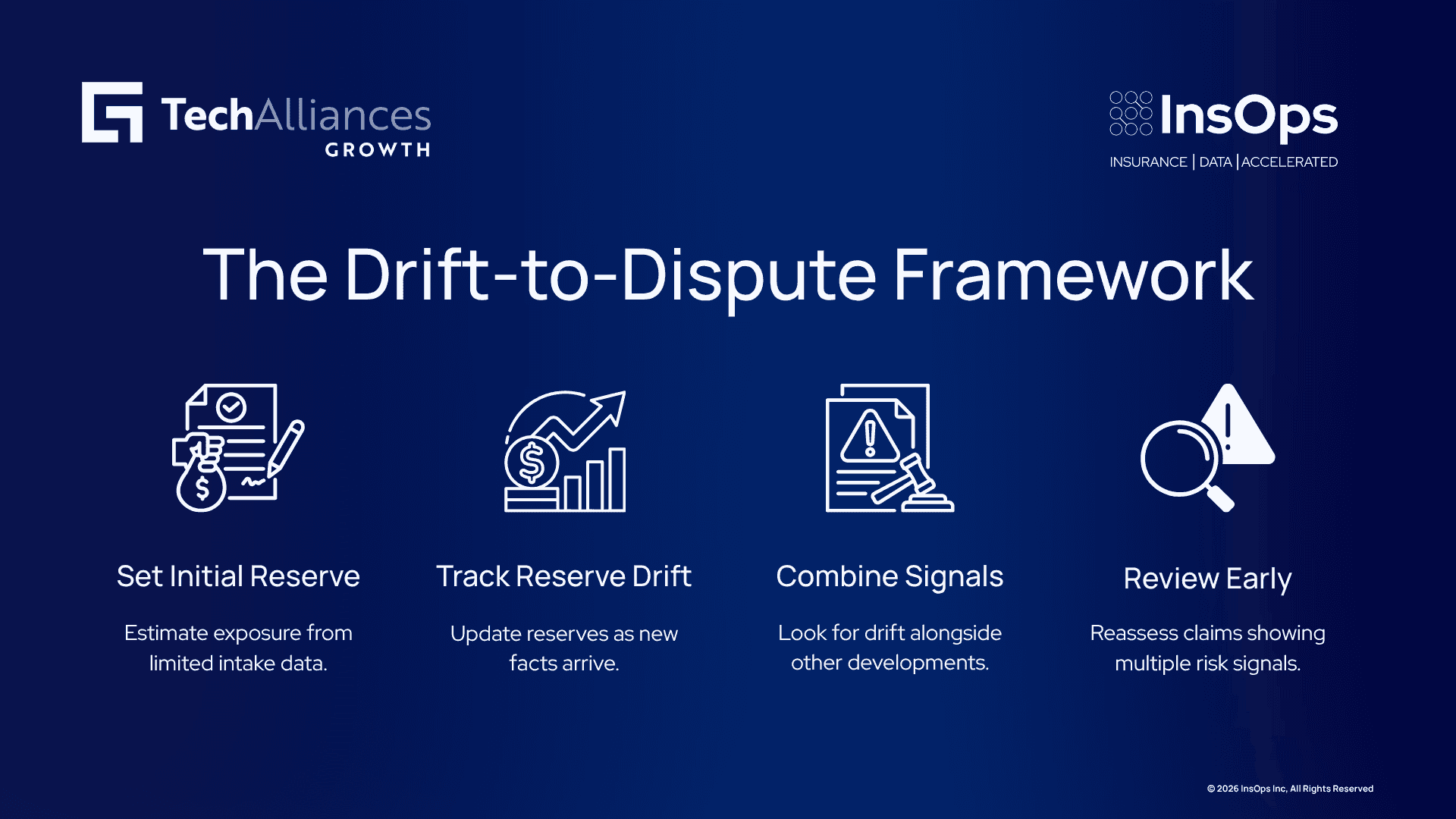
It helps to think about reserve drift as part of a sequence rather than a single event:
Initial reserve, set from limited information. At intake, the reserve reflects whatever is known at that moment, which is often incomplete by design.
Reserve drift. As bills and new facts arrive, the reserve moves in small increments rather than being reset to reflect the claim's true current exposure, matching the stair-stepping pattern.
Compounding with other signals. That drift, combined with other developments like attorney involvement or a widening settlement demand, is what actually indicates a claim is heading toward a dispute rather than a routine close.
No single step in this sequence guarantees a dispute is coming. The value of thinking about it as a sequence is that a claim showing more than one of these steps together deserves a second look sooner than a claim showing only the first.
What to Watch For Beyond the Dollar Amount
Reserve changes that line up with attorney involvement or a widening demand are worth flagging early, since by the time both signals appear together the file has often already moved past the point of an easy resolution.
Attorney involvement timing is one of the more useful things to track alongside reserve movement. A reserve that starts climbing around the same time an attorney enters the file is a different situation than a reserve climbing on its own. Treatment duration matters too. A claim where medical treatment keeps extending past what was initially expected, alongside a reserve that keeps needing small increases, is showing two related signals rather than one isolated one.
None of this means every represented claim, or every claim with a longer-than-expected treatment plan, should be treated as high-risk. Most represented claims still resolve through ordinary negotiation. The goal of watching these signals together isn't to flag every claim that shows one of them. It's to identify the smaller set of files where more than one signal is present at the same time, since those are the files where early attention has the best chance of avoiding an avoidable dispute.
How InsOps Helps
Reserve estimation is a hard problem, and it's one InsOps is building toward inside LiLa, our insurance-trained LLM, as a natural extension of the case-pattern analysis it already assists with today. LiLa currently assists with analyzing case patterns and claim history to surface high-risk claims, the same kind of pattern analysis that would eventually support flagging reserve drift.
LiLa runs inside your own environment, so PII and PHI never leave controlled infrastructure, and a person reviews and validates every output before it informs a decision.
If you're evaluating how to catch reserve drift before it becomes a dispute, contact us to talk through what this could look like for your operation as this capability develops.
Frequently Asked Questions
What is claims leakage?
Claims leakage is the unintentional loss of funds during the claims process, which can come from overpayments, missed subrogation, or reserves that don't reflect a claim's actual exposure.
What is stair-stepping in claims reserves?
It's the pattern described above: small, repeated reserve increases in place of a single deliberate reset when circumstances actually change, most visible on claims that stay open long enough to show it.
What are the warning signs that a reserve is inadequate?
Common warning signs include a reserve that's nearly depleted while treatment is still ongoing, a reserve with significant funds left over on a claim that's close to resolution, and repeated small increases over the life of a long-open claim.
How is hidden claims leakage detected?
Detection typically involves comparing claim outcomes against expected patterns, watching for late reserve movement, and looking at attorney involvement timing and demand amounts together rather than any single signal in isolation.
What causes reserve inadequacy?
Common causes include setting the initial reserve from limited information, failing to update the reserve as new facts emerge, and relying on outdated assumptions instead of reviewing the file at regular intervals.
How do reserve changes signal a claim is heading toward a dispute?
A reserve that keeps drifting upward without a clear documented trigger, especially alongside attorney involvement or an extending treatment plan, is a stronger signal than either pattern alone.
What data helps catch reserve leakage before it grows?
Comparing initial reserve, reserve updates, treatment duration, attorney representation timing, and settlement timing against similar past claims helps identify which files are drifting off their expected path.