

When claim volume spikes, whether from a storm event or a slow accumulation of routine files, claims operations leads face the same problem. Some of those claims will resolve quickly. Others will escalate into disputes, attorney involvement, and eventually litigation, and the file often gives no early warning of which is which.
Working strictly in order of arrival means a high-risk claim can sit untouched for days while adjusters clear routine files first. This article covers what actually drives a claim toward litigation, how continuous triage differs from static, rules-based sorting, and what a ranking approach needs from your data to work.
Why a Routine-Looking Claim Can Still End Up in Litigation
A claims triage framework works only if it keeps rescoring a file as new information arrives, since the costliest claims are often the ones that looked routine at first notice of loss.
A soft-tissue auto claim, a minor premises incident, or a standard property loss can all pass initial review without raising a flag. Then, over the following weeks, signals accumulate: an attorney enters the file, a treatment pattern escalates, a prior claim history surfaces. By the time these signals are visible together, the window for early, lower-cost intervention has often already closed.
Static, one-time sorting at intake misses this pattern entirely, because it evaluates a file once and never revisits the score as the file changes.
This creates a specific operational blind spot. A claims operations lead who only reviews severity at first notice of loss is effectively making a permanent decision about a file's priority based on incomplete information. The file that looked like a two-day close on Monday can look very different by Friday, once a demand letter arrives or a claimant retains counsel.
The practical effect shows up in staffing and workload, not just outcomes. Adjusters who work strictly by arrival order end up splitting attention evenly across files that don't carry equal risk. A senior adjuster's time on a low-complexity file is time not spent on a file that's quietly accumulating litigation signals in the background. Over a large enough portfolio, that imbalance compounds.
Volume spikes make this worse, not better. When a catastrophe event or a seasonal surge pushes intake well above normal weekly volume, the temptation is to process claims faster across the board. Faster processing without a way to separate escalating claims from routine ones just means the high-risk files move through the queue at the same undifferentiated pace as everything else.
What Actually Predicts Litigation Risk
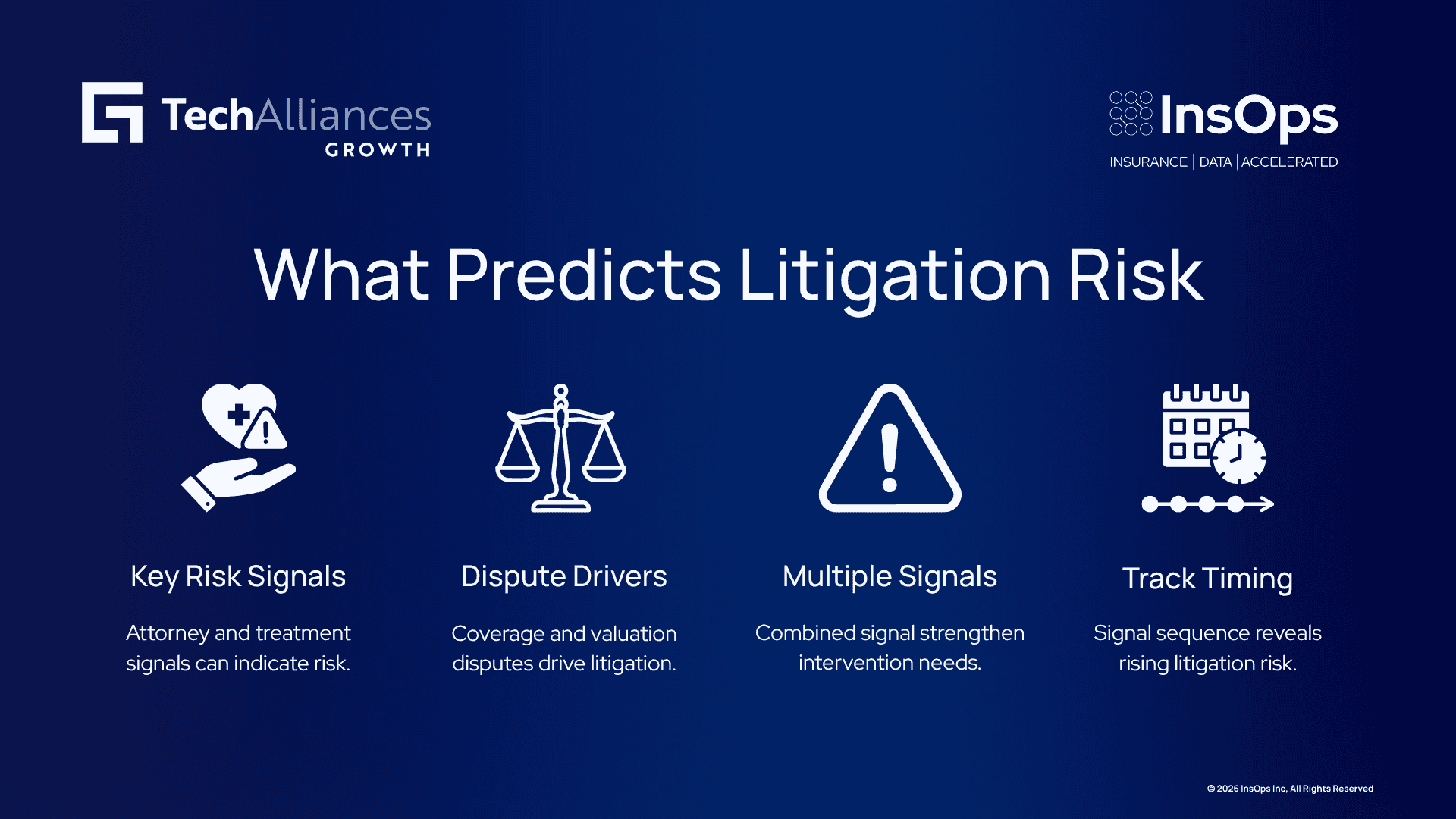
Attorney involvement, escalating treatment patterns, and jurisdictional venue are among the signals that most consistently precede litigation in a claim file. None of these signals is visible in isolation at first notice of loss. They accumulate over the life of the claim.
Coverage disputes are the most frequent driver: a claim moves toward litigation when the parties disagree on whether a loss is covered at all. Valuation disputes are the second most common driver, where the parties agree coverage exists but disagree on the amount owed, often surviving an appraisal process before reaching court. Bad-faith claims, recognized in some form in every state, add a separate track: unfair settlement practices open a distinct legal exposure beyond the underlying claim itself.
A file that shows more than one of these signals at once, for example a valuation dispute combined with an attorney's early involvement, is a stronger candidate for early intervention than a file showing just one.
Subrogation conflicts add a fourth pattern worth watching separately. After an insurer pays a claim, it may pursue the responsible third party to recover what it paid. Contested subrogation, particularly disputes over which party recovers first, generates its own litigation track that runs independently of the underlying claim's coverage or valuation questions.
Timing matters as much as the signal itself. A claim that shows an early reporting delay, followed later by inconsistencies between what was initially reported and what the documentation shows, carries more risk than either issue would on its own. The sequence of signals, not just their presence, is part of what a claims professional needs visibility into.
None of this means every claim showing one of these signals is destined for court. Most disputes over valuation resolve through negotiation or appraisal without ever reaching a courtroom. The purpose of tracking these signals isn't to predict litigation with certainty. It's to give a claims team enough advance notice to intervene while intervention is still cheap, rather than finding out a file was high-risk only after a lawsuit is filed.
Manual Rules vs. Continuous Triage: Why Static Sorting Misses Escalating Claims
Traditional claims routing applies fixed rules at intake and stops. If injury type equals fracture, route to a senior adjuster. This catches obvious cases but misses the signal combinations that actually drive cost, because those combinations often don't exist yet on day one.
The distinction that matters is not whether a system uses fixed criteria or a model. It's whether the file gets rescored as it evolves.
Fixed-rule sorting at intake | Continuous rescoring | |
|---|---|---|
When it evaluates | Once, at first notice of loss | Repeatedly, as new documents and signals arrive |
What it catches | Claims that already look severe on day one | Claims that start routine and later show escalation signals |
What it misses | Multi-factor combinations not anticipated in the ruleset | Nothing inherently, but depends on data completeness reaching the model |
Fixed rules also require someone to keep updating them. Every time a new pattern shows up in a closed-claim review, a rules-based system needs a person to translate that pattern into a new if-then condition, then test it against existing rules to make sure it doesn't conflict. That maintenance burden grows with the size of the ruleset, and it always lags behind the claims the team has already seen close badly.
Continuous rescoring shifts that burden differently. Instead of manually encoding every new pattern as a rule, the file is compared against the outcomes of similar past claims each time new information arrives. This doesn't remove the need for oversight. It changes what a claims professional is reviewing: not whether a rule fired correctly, but whether the ranking's stated reasoning, the specific signals driving a high score, actually holds up against their own read of the file.
That reasoning has to be visible to be useful. A ranking that flags a claim as high-risk without stating which signals drove that score gives a claims professional nothing to evaluate or challenge. Any triage approach a team adopts should be able to state, in plain terms, why a specific file scored the way it did, not just what the score is.
The Volume-to-Verdict Ranking Framework
A useful way to think about this is as a three-step process, moving a claim from intake to a litigation-risk ranking:
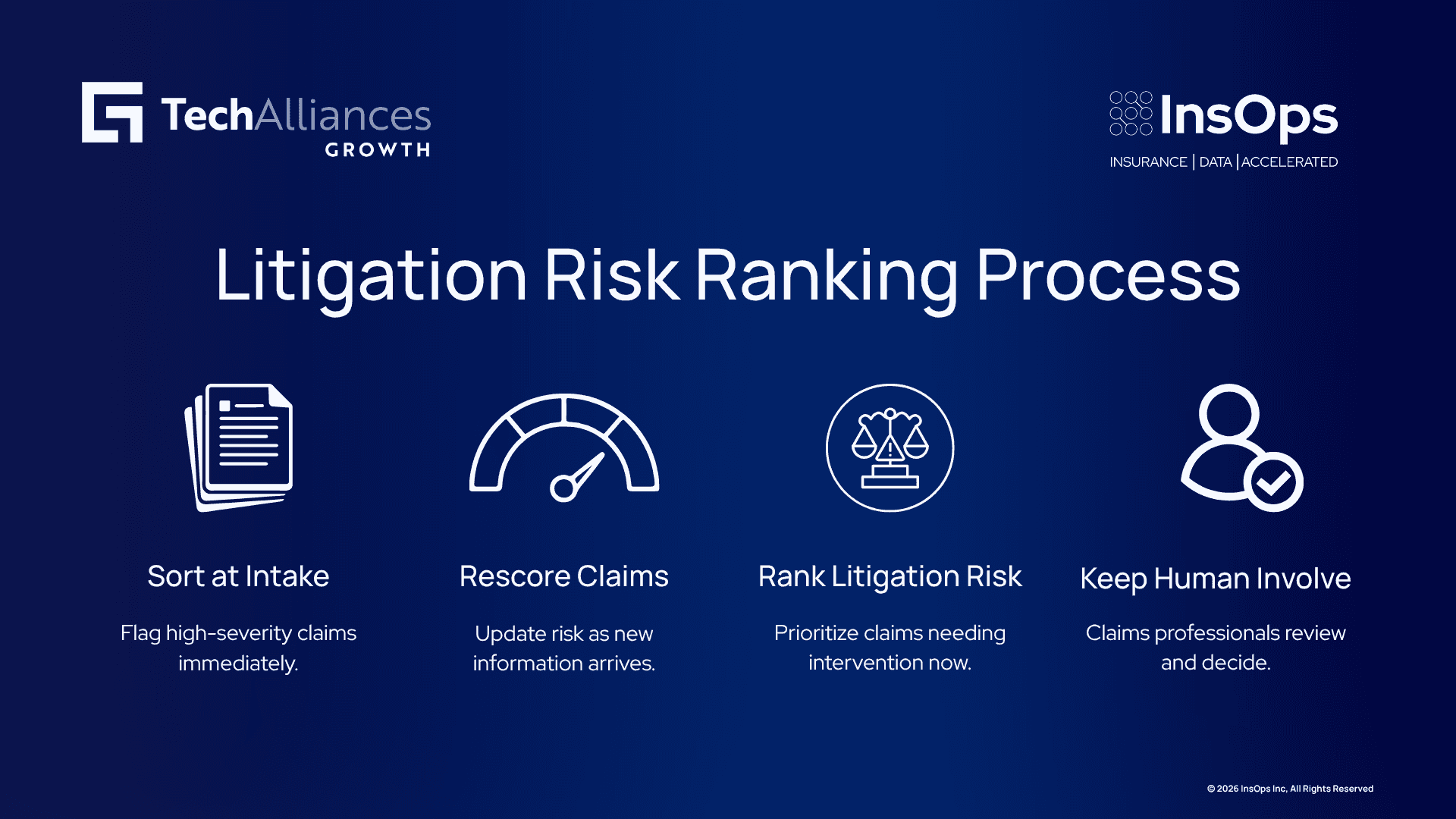
Intake sort. Every incoming claim is sorted by the complexity and severity signals present at first notice of loss, so obviously high-severity files are flagged immediately.
Continuous rescoring. As new documents enter the file, attorney representation notices, treatment escalation, jurisdictional detail, the file is rescored rather than left with its intake score.
Litigation-risk ranking. Claims are ranked against each other by their current litigation-risk signals, so adjusters and claims leadership can see which files need intervention now, not just which ones arrived first.
This framework describes a process, not a promise that every claim will be caught. Human review of the ranking, and the decision to intervene, stays with the claims professional at every step.
Common Misconceptions Worth Correcting
A few assumptions about triage approaches tend to get in the way of adopting one, and most of them don't hold up once you look at how the process actually works.
"Triage happens once, at intake, and that's it." This is the most damaging misconception, because it describes the exact failure mode that lets jumper claims through. Treating an intake score as final rather than a starting point defeats the purpose of tracking escalation signals at all.
"Using a ranking approach means adjusters stop reviewing claims." This isn't how any responsible implementation works. A ranking or score is a starting point for a claims professional's review, not a replacement for it. Complex commercial liability claims, large-loss negotiations, and litigation strategy all still require direct human judgment, and always will.
"A severity or litigation-risk score is a black box you have to trust blindly." A score with no visible reasoning behind it is a reasonable thing to be skeptical of. A claims team evaluating any triage approach should treat an unexplained score as a red flag, not a feature, and should expect the reasoning behind a ranking to be as visible as the ranking itself.
What Data a Triage Approach Actually Needs to Work
A ranking approach is only as good as the data reaching it. Two conditions call for extra caution before relying on any triage output.
Fragmented or siloed records are the first. If policy, billing, and claims data live in disconnected systems, a rescoring step can only work from whatever data actually reaches it, which may be incomplete. Insurers commonly carry policy data in one system, billing in another, and claims documentation in a third, with no consistent way to move information between them without manual entry.
Unstructured documentation adds a related complication. Adjuster notes, medical records, demand letters, and correspondence carry much of the signal that predicts escalation, but that signal is buried in free text rather than structured fields. A triage approach that can only read structured data, claim type, date of loss, policy limits, misses the narrative detail that often shows the earliest sign of risk.
Highly novel claim types are the third condition worth flagging separately. A claim type with little historical resolution data to compare against gives any ranking approach less to work from, and still needs a claims professional's direct judgment rather than a data-driven score. Newly emerging claim categories, where few past cases have resolved yet, are a case where human-led evaluation should lead until enough closed-case history exists to compare against.
Before adopting any triage approach, it's worth asking what data currently reaches claims decisions today, where the gaps are, and whether those gaps are addressed before or after a ranking tool is layered on top. A ranking built on incomplete data will simply reproduce whatever blind spots already exist in the underlying records.
How InsOps Helps
InsOps builds an insurance-trained AI that assists with analyzing case patterns and claim history to surface high-risk claims. LiLa, our insurance-trained LLM, runs inside your own environment, so PII and PHI never leave controlled infrastructure. A person reviews and validates every ranking before it drives an intervention decision.
Our Integration Gateway connects to Guidewire ClaimCenter and related systems, so claim and policy data flows directly into your workflow without custom engineering.
If you are evaluating how to rank incoming claims by litigation risk without adding new compliance or data-exposure risk, contact us to talk through what this could look like for your operation.
Frequently Asked Questions
What is claims triage?
Claims triage is the process of sorting incoming claims by urgency and complexity, rather than working strictly in order of arrival, so higher-risk files get attention sooner.
What is the difference between AI claims triage and traditional manual triage?
Manual triage applies a claims professional's judgment once, at intake, based on limited information. AI-assisted triage continues to evaluate a file's signals as new information arrives, rather than treating the intake score as final.
How does AI assign a severity score to a claim?
It compares the signals in a file, such as injury type, attorney involvement, and documentation patterns, against patterns observed in historically similar, resolved claims, to produce a score reflecting predicted cost and complexity.
Why do insurance claims end up in litigation?
Coverage and valuation disagreements are the two most common paths, covered in detail above. Bad-faith conduct and subrogation disputes can also push a claim toward litigation, though less frequently.
Does AI triage replace claims adjusters or defense attorneys?
No. It handles volume, pattern detection, and rescoring so adjusters and attorneys can concentrate on the claims that genuinely need direct judgment.
How do defense teams measure whether AI claims triage is working?
Common indicators include fewer unexpected claim escalations, improved reserve accuracy, and faster time-to-intervention on high-risk files.
What types of claims are best suited for AI triage?
High-volume, standardized claim types, such as auto liability and general liability, benefit most. Highly novel or legally complex claims still need direct, human-led evaluation.