

Claims inconsistency happens when adjusters facing similar facts reach different decisions on liability, reserves, or settlement value. It's one of the most preventable drivers of litigation exposure a P&C carrier faces.
The problem is that inconsistent past decisions are hard to defend. If a carrier settled a similar claim one way last year and a different way this year, that gap can look like leverage to a plaintiff's attorney.
This article covers what claims inconsistency actually looks like, why it specifically drives litigation risk, and a framework for standardizing decisions across your adjuster team.
What Claims Inconsistency Actually Looks Like
Inconsistency rarely comes from bad intent. It usually comes from adjusters applying their own judgment to gaps that written guidelines don't fully cover.
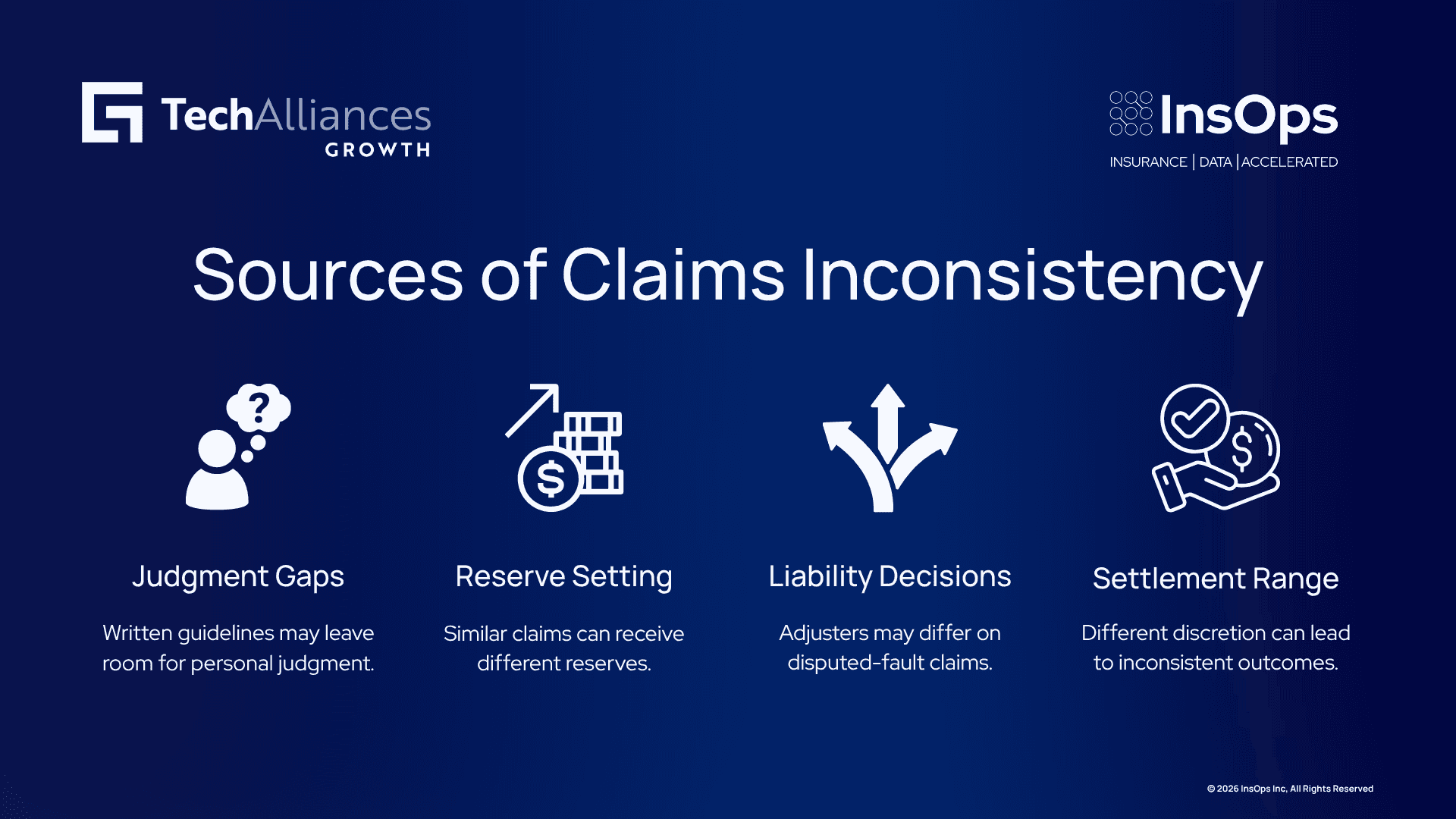
Two adjusters can look at the same set of facts, a rear-end collision with similar injuries and similar repair costs, and land on different liability positions or different reserve amounts. Neither one is necessarily wrong. They're just applying judgment differently.
Where Inconsistency Tends to Creep In
Reserve-setting is one of the most common places inconsistency shows up. Two adjusters working from the same claim facts can set reserves that differ significantly, simply because their internal sense of what's "typical" for a claim like this differs.
Liability calls on multi-party or disputed-fault claims are another common source. Settlement authority is a third, when adjusters have discretion within a range and use it differently without a clear rationale attached to each decision.
Settlement amounts that fall outside normal ranges for similar claims are one of the clearest signals this gap exists on a team. For a closer look at the specific people, process, and technology causes behind it, see why similar claims get different settlements.
Why Inconsistency Specifically Drives Litigation Risk
Inconsistent handling creates a specific legal problem that consistent handling doesn't. Past decisions become comparison points a plaintiff's attorney can use.
If a carrier resolved a comparable claim favorably for a different policyholder, that becomes something a plaintiff's counsel can raise. It doesn't have to be a formal legal precedent to be useful leverage in negotiation or in front of a jury.
How This Surfaces in Discovery
During discovery, claims files and reserve histories are often reviewable. If a carrier's documentation shows no consistent rationale for why similar claims were handled differently, that gap itself becomes a point of attack.
It's not usually the difference in outcome alone that creates risk. It's the absence of a documented reason for the difference, which makes the decision look arbitrary rather than considered.
The financial gap between claims that stay unrepresented and claims that end up litigated is significant. Workers compensation claims with attorney involvement average $77,807, compared to $15,936 for unrepresented claims, and litigation-related leakage can represent 7 to 14 percent of total carrier spend. Inconsistent handling is one of the signals that pushes a claim from the first category into the second, since claimants who sense unfair or unpredictable treatment are more likely to seek representation. For a closer look at how carriers catch that shift early, see how early litigation risk prediction cuts claims costs.
The Four Pillars of Claims Consistency
Standardizing claims decisions comes down to four connected practices.
Pillar | What It Standardizes | Example |
|---|---|---|
Documented criteria | The thresholds adjusters use to evaluate liability and severity | Written reserve-setting guidelines |
Calibration reviews | Periodic comparison of decisions across adjusters on similar claims | Same-case review sessions |
Decision audit trail | A record of what was decided and why, for every claim | Logged rationale at each claim milestone |
Escalation triggers | Clear rules for when a claim needs supervisory or legal review | Defined complexity or exposure thresholds |
Documented Criteria Come First
None of the other three pillars work without this one. Calibration reviews need a standard to calibrate against, and audit trails need something to reference when explaining a decision.
Criteria should be specific enough that two adjusters reading them would reach the same conclusion on a given claim, not general guidance open to interpretation.
Calibration Turns Criteria Into Habit
Written criteria drift over time if nobody checks that they're being applied the same way. Calibration reviews, where a group looks at the same claim facts and compares their conclusions, catch that drift early.
These sessions work best when they're routine rather than reactive. Waiting until a claim is already in litigation to discover inconsistent handling is too late to fix it for that case.
What Defensible Documentation Looks Like in Practice
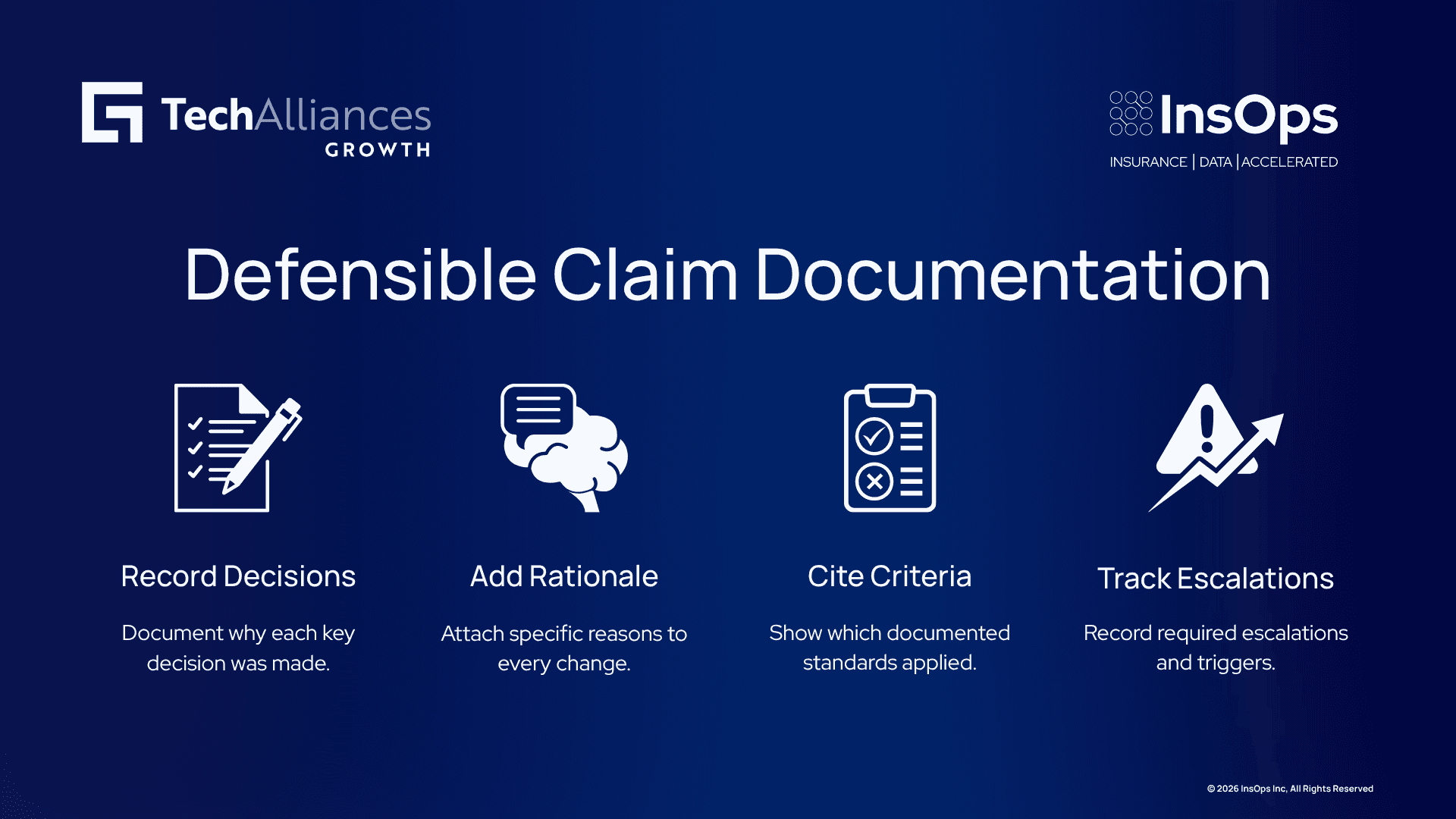
A defensible claim file does more than record what happened. It records why each significant decision was made.
What a Strong Claim File Includes
Every reserve change, liability determination, and settlement offer should have a short, specific rationale attached, not just the number or the decision itself. That rationale is what makes the file defensible later.
The file should also reference which documented criteria applied, so a reviewer, whether internal QA or opposing counsel, can see the decision followed a standard rather than individual discretion.
Common Documentation Gaps That Create Exposure
The most common gap is a decision recorded without a stated reason. A reserve that changes from $10,000 to $40,000 with no note explaining why looks arbitrary, even if the underlying reasoning was sound.
Missing escalation records are another common gap. If a complex claim should have been escalated per the defined triggers and wasn't, that's a second documentation failure layered on top of the first.
How This Connects to Litigation Risk Prediction
Standardization and litigation risk prediction solve related but distinct problems. Standardization makes sure similar claims get handled the same way. Litigation risk prediction flags which specific claims are most likely to escalate, regardless of how consistently they've been handled.
The two work best together. A carrier with documented criteria and calibration in place gives a litigation risk model cleaner, more consistent claim data to learn from, which makes the risk scoring itself more reliable over time.
Building a Standardization Program Without Slowing Down Adjusters
Consistency doesn't have to come at the cost of speed. The two goals actually support each other once criteria are clear.
Start With the Highest-Risk Claim Types First
Not every claim type carries equal litigation exposure. Prioritize standardization work on claim types with the highest historical dispute rates or the highest average severity first, rather than trying to standardize everything at once.
Make Consistency a Habit, Not a One-Time Audit
A single round of calibration reviews helps, but the value comes from making it routine. Build calibration into the regular claims operating rhythm, not a special project that happens once and gets shelved.
How InsOps Helps
InsOps builds an insurance-trained AI that assists by analyzing case patterns and claim history to surface high-risk claims. LiLa, our insurance-trained LLM, runs inside your own environment, so PII and PHI never leave controlled infrastructure. A person reviews and validates every flagged claim before any action is taken.
Our Integration Gateway connects directly to Guidewire ClaimCenter, so claim history and documentation flow into your existing review workflow without custom engineering.
If you're evaluating how to build more consistency into your claims decisions before the next disputed claim exposes a gap, contact us to talk through what this could look like for your operation.
Frequently Asked Questions
What is claims inconsistency?
Claims inconsistency is when adjusters facing similar claim facts reach different decisions on liability, reserves, or settlement value, without a documented reason for the difference.
Why does claims inconsistency increase litigation risk?
Inconsistent past decisions become comparison points a plaintiff's attorney can raise. Without a documented rationale explaining the difference, the decision can look arbitrary rather than considered, which is a specific vulnerability in discovery.
How do carriers standardize claims decisions?
Start with documented criteria specific enough that two adjusters would reach the same conclusion. Add regular calibration reviews, a decision audit trail on every claim, and clear escalation triggers for complex cases.
What's the hardest part of maintaining consistency across adjusters?
Keeping criteria applied the same way over time. Written standards drift as adjuster turnover happens and claim types evolve, which is why calibration needs to be routine rather than a one-time exercise.
What metrics show claims decisions are becoming more consistent?
Track variance in reserve amounts across similar claim types, the rate of claims escalated per defined triggers versus those that should have been, and the percentage of claim files with a documented rationale for each major decision.
How does AI assist with claims consistency and litigation risk?
AI can assist by analyzing case patterns and claim history to surface high-risk claims that may warrant closer review. A person still reviews and validates every flagged claim before any action is taken.
How long does it take to build a standardization program?
Documenting criteria for your highest-risk claim types can happen in a few weeks. Building calibration into the regular operating rhythm and seeing measurable variance reduction typically takes several months of consistent practice.