

Claims triage is the process insurers use to sort incoming claims by severity, complexity, and urgency immediately after First Notice of Loss. It determines which claims get an experienced adjuster right away and which can move through a standard queue.
The problem shows up fast during a catastrophe. When a hurricane, wildfire, or major storm hits, claim volume jumps in days, not weeks, and carriers without a clear triage system fall behind almost immediately.
Most carriers already have some version of triage built into daily operations. The real test is whether that process holds up when claim volume multiplies in a matter of days instead of arriving at a predictable weekly pace.
This article covers what claims triage actually means, the criteria carriers use to make triage decisions, and a phased framework for preparing your claims operation before the next surge event arrives.
What Claims Triage Actually Means
Claims triage happens at the very start of the claims lifecycle, before any investigation or settlement work begins. It is a sorting decision, not a resolution decision.
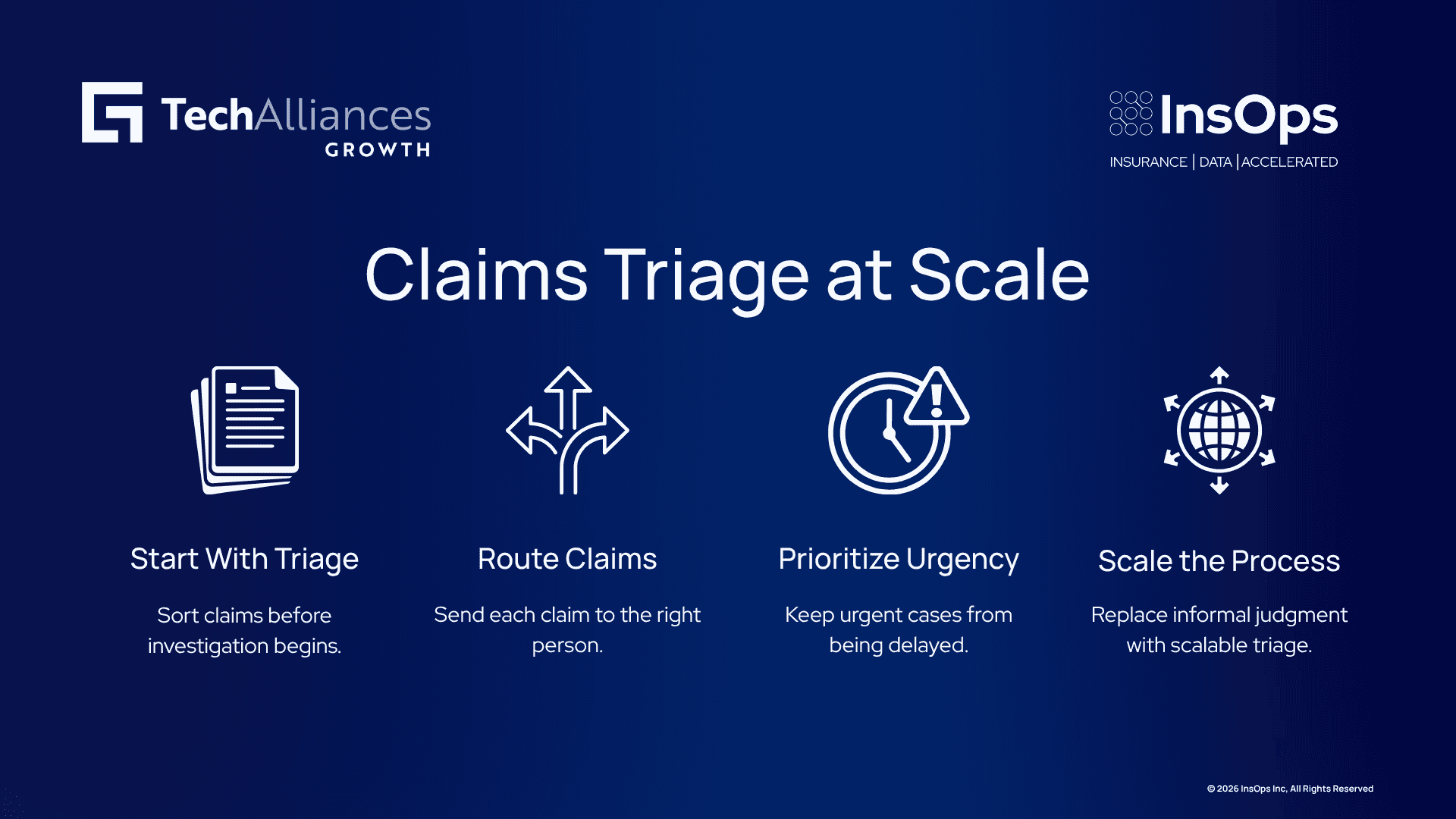
The goal is simple to state and hard to execute at scale. Route the right claims to the right people at the right time, so urgent and complex cases don't sit behind simple ones just because they arrived later.
Every carrier triages claims in some form, even informally. A senior adjuster glancing at a new file and deciding it needs immediate attention is a form of triage. The difference during a surge is that informal, judgment-based triage doesn't scale when hundreds of claims arrive on the same day.
How Triage Differs From Claims Processing
Claims processing covers the full lifecycle: investigation, documentation, evaluation, and settlement. Triage is the gate that decides how a claim enters that lifecycle.
A well-triaged claim still has to go through processing. Triage just determines the path and the priority it takes to get there.
Confusing the two creates real operational problems. Carriers that treat triage as part of general processing, rather than a distinct first step, often lose visibility into which claims are actually waiting the longest for attention.
Where Triage Sits in the FNOL Workflow
Triage decisions happen immediately after First Notice of Loss, before an adjuster is formally assigned. The claim's initial details, what happened, what's damaged, whether anyone was hurt, feed directly into the severity, complexity, and urgency assessment.
Getting this step right early matters because everything downstream depends on it. A claim triaged as high urgency but assigned late has already lost the benefit of that classification.
The Three-Factor Triage Model
Most triage decisions come down to three questions, evaluated together rather than in isolation.
Factor | What It Assesses | Example Signal |
|---|---|---|
Severity | Dollar exposure and physical impact | Total loss vs. minor damage |
Complexity | Number of parties, coverage questions | Multi-vehicle claim, disputed liability |
Urgency | Time-sensitivity, safety risk | Structural damage, injury involved |
A claim can score low on severity but high on urgency, a minor injury claim with a safety concern, for instance. The model works because it evaluates all three factors together instead of ranking claims on a single dimension like dollar amount.
Why Single-Dimension Sorting Fails
Many carriers default to sorting claims by dollar amount alone, because it's the easiest number to pull from initial reports. That approach misses claims that are low-dollar but time-sensitive, like a minor water leak that will cause major damage if left unaddressed for days.
Ranking by arrival order has the same problem in a different direction. It treats a straightforward fender-bender the same as a claim involving a collapsed roof, simply because both happened to come in around the same time.
Applying the Model Consistently
The Three-Factor Model only creates value if it's applied the same way across every adjuster and every shift. That requires written thresholds, not general guidance, so two different adjusters looking at similar claims reach similar triage decisions.
Written thresholds also make the model auditable. If a claim was misrouted, a documented framework makes it possible to see exactly where the assessment went wrong and correct it going forward.
What Changes When Claims Concentrate Geographically
Catastrophe claims are rarely spread evenly. An ice storm might hit three counties. A hurricane might devastate one stretch of coastline.
That concentration creates a specific triage problem. Carriers need adjusters who are licensed and physically located in the impacted area, and when an adjuster has to travel or isn't licensed in that state, time is lost immediately.
Those delays compound. A claim that should have moved to an adjuster within hours instead sits waiting, and the backlog grows faster than most teams expect.
Common Failure Points During a Surge
Three patterns show up again and again when triage breaks down under volume.
Inconsistent criteria across adjusters is the first. When each adjuster applies severity and urgency differently, similar claims get routed differently, and the whole system loses predictability.
Licensing and location mismatches are the second, as described above. The third is a document backlog: police reports, repair estimates, and photos arriving faster than anyone can review them, which delays the triage decision itself.
A Phased Framework for Surge Preparation
Surge readiness is not something a carrier builds during the event. It has to exist before the first claim comes in.
Phase | Key Actions | Typical Owner |
|---|---|---|
Pre-event | Define triage criteria, build staffing and escalation plans | Claims operations leadership |
During-event | Handle bulk intake, apply dynamic routing, use temporary thresholds where appropriate | Claims managers, adjuster teams |
Post-event | Review reserve accuracy, resolve backlog, capture lessons learned | Claims operations, finance |
Pre-Event: Set the Criteria Before You Need Them
The Three-Factor Model only works if every adjuster applies it the same way. That means documenting specific thresholds for severity, complexity, and urgency before a surge hits, not while claims are already piling up.
Staffing plans need the same advance work. Know in writing who gets activated, at what volume threshold, and from where.
Escalation paths belong in this phase too. Define exactly who a frontline adjuster contacts when a claim doesn't fit cleanly into the triage criteria, so ambiguous cases don't stall waiting for someone to make a judgment call.
During-Event: Protect Consistency While Moving Fast
Bulk intake tools help absorb the initial wave, but routing still has to follow the same criteria set in the pre-event phase. Speed without consistency just creates rework later.
Temporary thresholds, adjusted approval limits for straightforward claims, for example, can help move volume without sacrificing oversight on the complex cases that need it.
Communication matters as much as routing during this phase. Policyholders who understand where their claim stands in the queue file fewer status-check calls, which frees adjuster time for the claims that actually need attention.
Dynamic rebalancing also helps here. As some claim types resolve faster than expected and others slow down, shifting adjuster capacity toward the backlog in real time keeps the whole queue moving instead of letting one category stall the rest.
Post-Event: Close the Loop
Once volume normalizes, review reserve accuracy against what was set during the surge. Reserves set under pressure often need adjustment once full documentation comes in.
Resolve any remaining backlog deliberately, and capture what broke down. That record is what makes the next surge easier than this one.
A structured post-event review should look specifically at where triage criteria held up and where they didn't. If a category of claims was consistently misrouted, that's a signal to revise the thresholds before the next event, not just note it and move on.
What Good Triage Looks Like in Practice
Two signals separate strong triage operations from struggling ones: consistency and speed that doesn't sacrifice accuracy.
Consistency means a claim gets the same severity and urgency read regardless of who picks it up. Speed without sacrificed accuracy means faster routing doesn't create claims that need to be re-triaged later.
Carriers that get both right treat triage as a defined, documented process, not individual adjuster judgment applied ad hoc.
How InsOps Helps
InsOps builds an insurance-trained AI that assists with claims prioritization at intake. LiLa, our insurance-trained LLM, runs inside your own environment, so PII and PHI never leave controlled infrastructure. A person reviews and validates every routing recommendation before it's finalized.
Our Integration Gateway connects directly to Guidewire ClaimCenter, so claim and document data flows into your existing triage workflow without custom engineering.
If you're evaluating how to keep triage consistent during the next surge without adding headcount you can't sustain year-round, contact us to talk through what this could look like for your operation.
Frequently Asked Questions
What is claims triage in insurance?
Claims triage is the process of sorting incoming claims by severity, complexity, and urgency immediately after First Notice of Loss, so the most critical claims reach an adjuster first.
Why does claims triage matter during a catastrophe event?
Catastrophe events concentrate claims geographically and compress volume into days. Without clear triage criteria, urgent claims can get stuck behind simple ones purely by order of arrival.
How do carriers implement a triage model?
Start by documenting specific thresholds for severity, complexity, and urgency before a surge hits. Every adjuster needs to apply the same criteria the same way for triage to stay consistent at scale.
What's the biggest challenge in triaging claims during a surge?
Geographic concentration is a major one. Catastrophe claims cluster in specific areas, and carriers need adjusters who are licensed and located there, or the claim simply waits longer than it should.
What metrics show triage is working?
Track time from FNOL to first adjuster contact, consistency of severity scoring across adjusters, and the rate of claims that get re-triaged after initial routing. A rising re-triage rate usually points to unclear or inconsistently applied criteria rather than a staffing problem.
How does AI assist with claims triage?
AI can assist by applying triage criteria consistently at intake and surfacing severity and urgency signals faster than manual review alone. A person still reviews and validates the routing decision before it's finalized, so the model supports the adjuster's judgment instead of replacing it.
How long does it take to build a surge-ready triage process?
Documenting criteria and staffing plans can happen in weeks. Testing them against an actual surge, and refining based on what breaks, typically takes a full CAT season before the process is fully reliable. Carriers that skip the refinement step often find their documented criteria don't hold up the first time volume actually spikes.