

Litigation risk rarely arrives as one obvious event. It can build across claim details, claimant interactions, injury information, representation, and patterns that are hard to review together.
For claims teams, the practical question is not whether a model can predict a lawsuit with certainty. It is which claims show enough warning signs to justify closer human review.
This article uses a five-signal check to structure that review: representation, severity, causation, dispute, and pattern.
What are the early warning signs of litigation risk in an insurance claim?
Litigation risk can be surfaced by reviewing claim history, injury characteristics, claimant behavior, legal representation, jurisdictional patterns, and other signals that indicate a claim may warrant closer attention.
The signals below are indicators for review, not proof that a claim will become litigated.
The Five-Point Litigation Signal Check
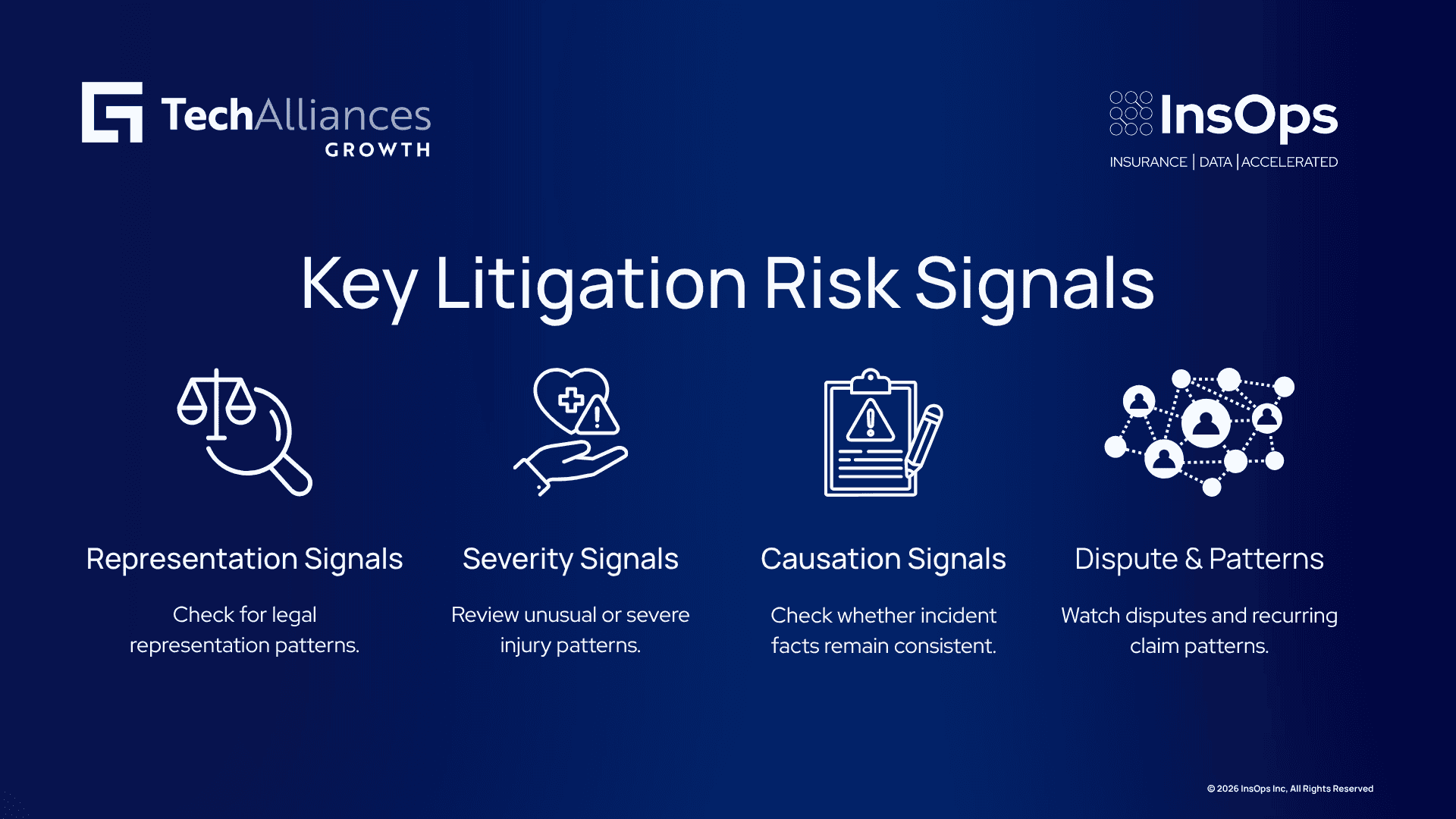
Representation signal: Look for legal representation or representation patterns that may indicate a claim needs closer review.
Severity signal: Review injury severity and unusual injury patterns, especially when they differ from the characteristics of comparable claims.
Causation signal: Examine whether the reported cause, incident facts, and supporting information remain consistent as the claim develops.
Dispute signal: Watch for recurring complaints, disagreements, investigation resistance, or communication patterns that suggest the claim is becoming harder to resolve.
Pattern signal: Compare the claim with historical claims to identify recurring characteristics, unusual frequency, jurisdictional trends, or other patterns associated with escalation.
These signals work best together. A single indicator should not determine how a claim is handled. Several can give an adjuster a clearer reason to pause, review the evidence, and decide whether more human attention is warranted.
Which insurance claim signals should adjusters review when litigation risk is rising?
A useful review starts with observable claim information rather than a generic litigation score. Each signal should answer a practical question: what changed, what evidence supports it, and does the claim deserve closer attention?
1. Representation signal
Legal representation can be an important early indicator of potential escalation. Claims teams should note when an attorney becomes involved and whether the representation pattern resembles claims that previously required closer review.
Representation does not mean litigation is inevitable. It is a reason to understand the claim more fully, including the issues being raised and the information already gathered.
2. Severity signal
Injury severity can change the level of attention a claim requires. Unusual injury patterns can also stand out when compared with historical claims.
Context matters. Severity should be reviewed alongside incident facts, available medical information, and comparable claims rather than treated as a standalone prediction.
3. Causation signal
Causation becomes a review point when the facts supporting how an injury or loss occurred are unclear, inconsistent, or change over time.
Adjusters can compare the reported incident with the supporting claim information and identify where additional clarification is needed. The goal is not to label a claim as high risk from one discrepancy. It is to surface questions that deserve human review before the dispute becomes harder to resolve.
4. Dispute signal
Repeated complaints, disagreements, or friction during the claim can indicate that the situation needs more attention.
Communication matters here. When concerns are not addressed clearly, a routine claim can become more difficult to resolve. Claims teams should review what the claimant is disputing, what has already been communicated, and what evidence supports the current position.
5. Pattern signal
A single claim can be difficult to interpret in isolation. Historical claims can reveal recurring complaints, incident frequency, problematic jurisdictions, and unusual injury patterns that warrant closer attention.
This is where claims history becomes useful. Comparing the current file with relevant historical patterns can help teams recognize characteristics that may otherwise be easy to miss during manual review.
How do insurers identify high-risk claims before counsel gets involved?
Insurers can combine early claim indicators with historical claims data to identify cases that warrant closer review before escalation, rather than relying only on manual file review.
One approach is litigation propensity scoring. These models use historical claims information and early indicators to estimate which claims may be more likely to escalate. Some approaches can assess signals from the first notice of loss and provide risk ratings during the claim cycle.
The output should support prioritization, not replace the adjuster's judgment. Human oversight remains important when a claim is flagged, particularly because the underlying facts and circumstances can vary significantly from one claim to another.
A practical process looks like this:
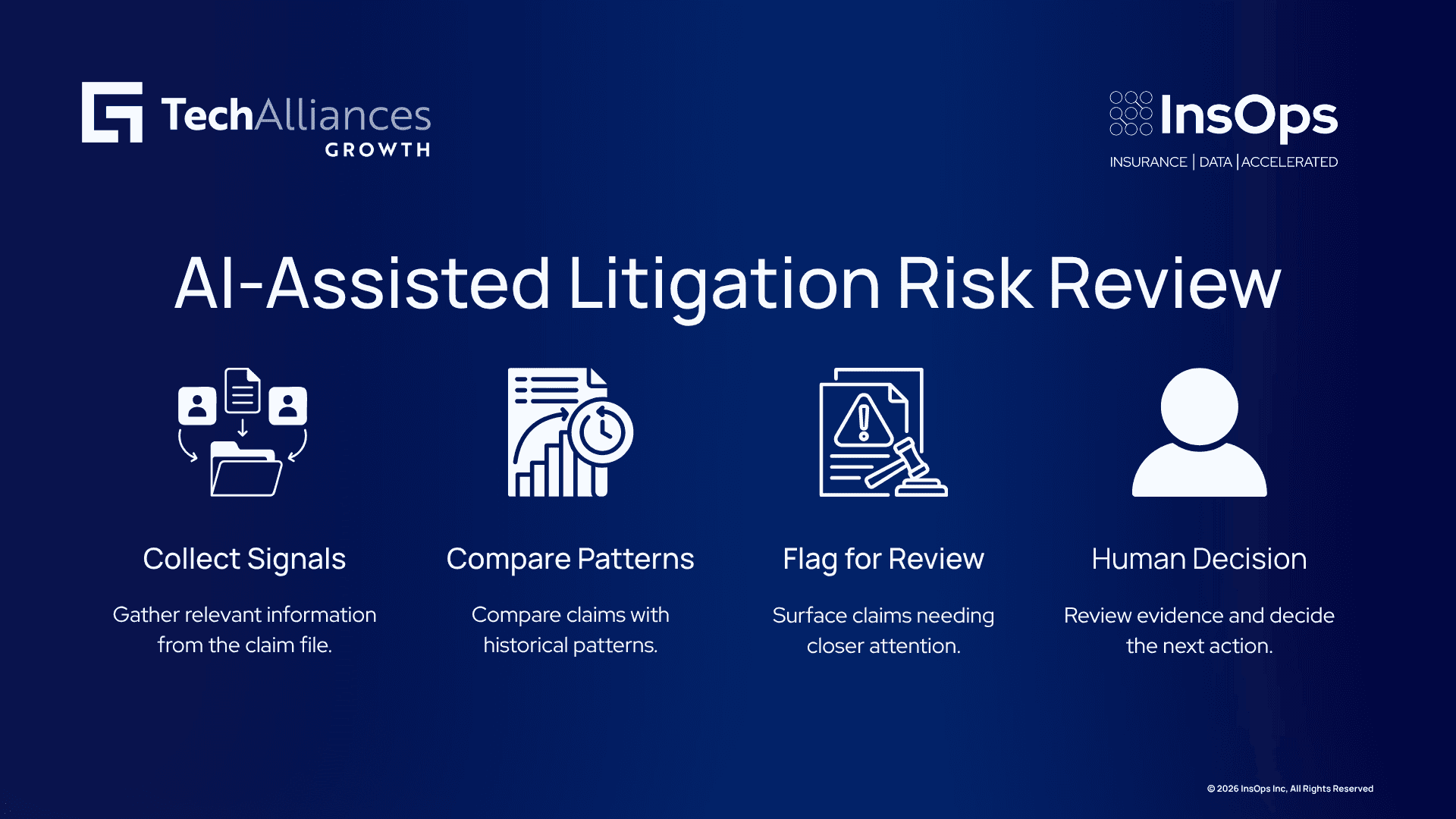
Collect the relevant claim signals. Bring together the information already available in the claim file.
Compare the claim with historical patterns. Look for recurring characteristics, outliers, and combinations of indicators.
Surface claims for closer review. Use the available analysis to help identify files that deserve additional attention.
Review the underlying evidence. An adjuster or other qualified reviewer assesses why the claim was flagged.
Decide the next human action. The claims team determines whether further investigation, communication, specialist review, or legal input is appropriate.
The operational question stays simple: which files should receive more attention now?
How should adjusters respond when a claim shows several litigation warning signs?
When several signals appear together, do not assume litigation will occur. Instead, increase the quality and focus of human review.
A practical response can include:
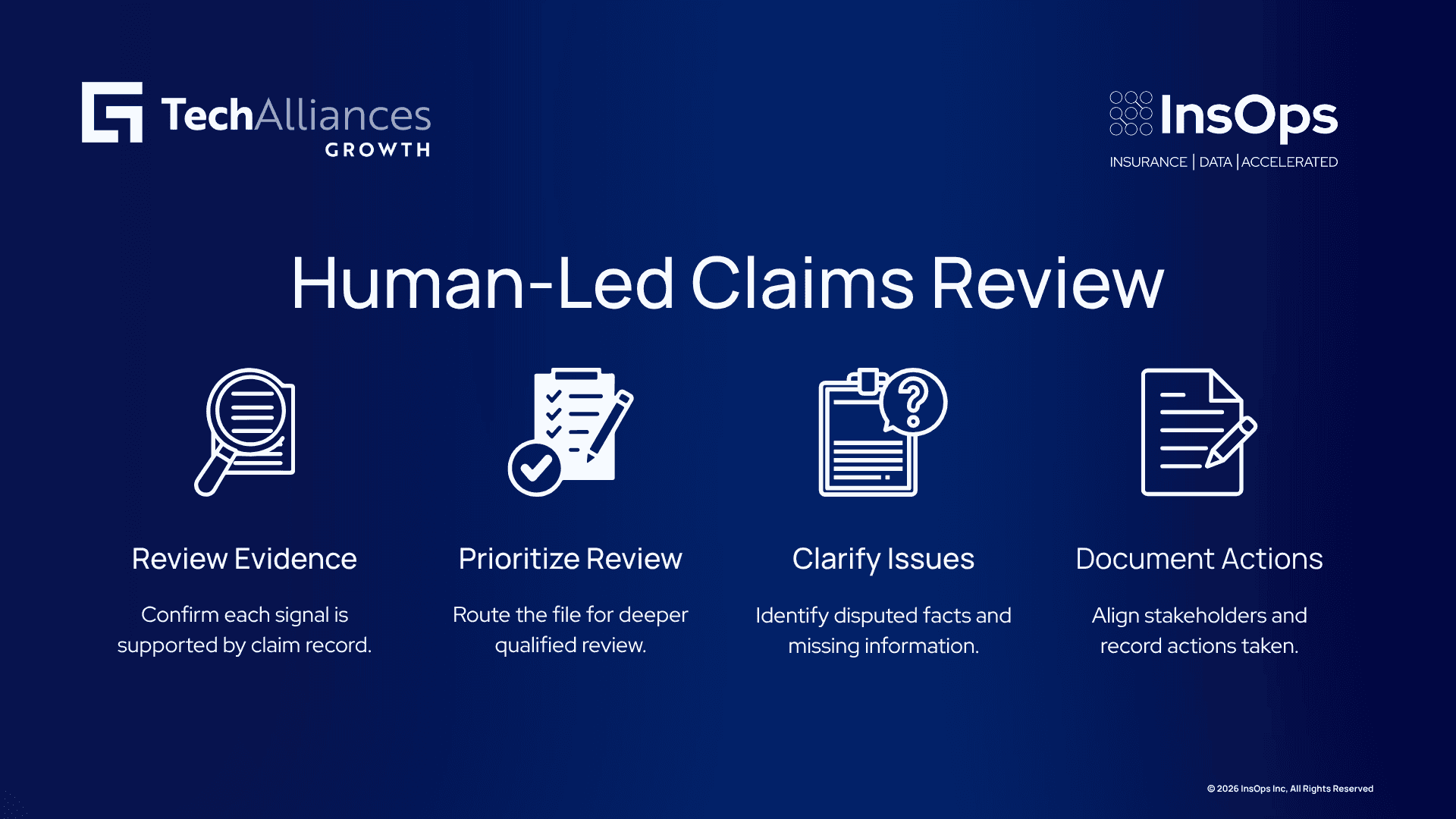
Review the evidence behind each signal. Confirm that the indicators are supported by the claim record.
Prioritize the file for appropriate attention. A senior adjuster, specialist, or other qualified reviewer can examine the claim in greater depth.
Clarify unresolved issues. Identify disputed facts, missing information, or questions about the incident and claimed injury.
Coordinate communication. Keep relevant stakeholders aligned on what has been established and what still needs attention.
Document the review and intervention. Record the investigation, communications, and actions taken so the claim history remains clear.
Marsh recommends regular claim reviews, use of predictive analytics, early legal engagement where appropriate, coordinated communication, and documentation of interventions as part of early claim identification and response.
What claim data is most useful for identifying litigation risk early?
Useful data helps a claims team compare the current file with known patterns and see what is changing.
Key areas include:
Claim history: Comparable claims, recurring complaints, incident frequency, and other historical patterns.
Injury information: Severity and unusual injury characteristics that stand out against relevant claims.
Claimant behavior and communications: Complaints, disagreements, and changes in the way the claim is being handled.
Representation: Whether legal representation is present and how that signal appears in comparable claims.
Jurisdiction: Location-based patterns that may affect how claims should be reviewed.
Investigation details: Incident facts, supporting documentation, and unresolved questions about causation.
For medical-record-heavy claims, InsOps medical record analysis shows how claim information can be structured to surface relevant signals. The value comes from connecting these data points. One field may say little on its own, while a combination of claim characteristics and historical patterns can surface a file that deserves closer human attention.
How We Help
InsOps can reduce litigation risk by analyzing case patterns and claim history to surface high-risk claims.
The analysis helps claims teams identify files that warrant closer human review before disputes escalate. See InsOps for claims for more on AI-assisted claims data analysis. It supports the reviewer rather than replacing human judgment.
For insurers handling sensitive claim information, LiLa is an insurance-trained AI designed to work inside the insurer's own environment. PII and PHI remain within controlled infrastructure.
Frequently Asked Questions
What factors predict whether an insurance claim will go to litigation?
Factors can include legal representation, injury severity, claimant behavior, jurisdictional patterns, recurring complaints, and characteristics found in historical claims. These are indicators of potential escalation, not deterministic predictors.
What are the early warning signs of litigation risk in an insurance claim?
Common warning signs include representation, unusual injury severity or patterns, disputed or inconsistent causation facts, recurring complaints or disagreements, and patterns that resemble claims that previously required closer attention.
How do insurers identify high-risk claims before counsel gets involved?
Insurers can combine early claim indicators with historical claims data and use structured analysis or litigation propensity scoring to surface claims for closer review. A human reviewer should assess the underlying facts before deciding what happens next.
Which claim signals should adjusters review when litigation risk is rising?
Adjusters can review representation, severity, causation, disputes, and historical patterns. Reviewing the signals together gives the team a more useful picture than treating any single indicator as proof of litigation risk.
How does litigation risk scoring work for insurance claims?
Litigation risk scoring uses historical claims information and early claim indicators to estimate which cases may be more likely to escalate. The resulting score can help prioritize files for human review.
When should claims teams escalate a potentially litigated claim for legal review?
Legal review may be appropriate when the claim presents several warning signs, unresolved disputes, significant injury concerns, or other circumstances that require legal assessment. The decision should remain with qualified claims and legal professionals.
What claim data can help surface litigation risk early?
Useful data can include claim history, injury information, claimant behavior and communications, representation, jurisdiction, incident facts, and investigation documentation. Historical comparisons can help identify patterns that deserve closer review.