

A wind claim in Iowa and a wind claim in Florida can involve identical damage and still end up worlds apart. One gets a quiet settlement. The other becomes a multi-year legal dispute with a verdict several times the original claim value.
The difference usually has nothing to do with the loss itself. It comes down to state law, court venue, and how aggressively a jurisdiction's legal environment favors plaintiffs.
This article breaks down the state-level factors that drive litigation risk, looks at the states carrying the most exposure right now, and covers what claims teams can do to manage that risk before it escalates.
Why Litigation Risk Isn't Uniform Across States
Every U.S. state writes and interprets its own insurance law. That creates real differences in how a claim can play out depending on where it was filed.
State Law Differences
States vary on core questions like whether bad faith is a recognized claim, whether damages are capped, and how attorney fees are handled. Alabama recognizes common law bad faith claims. Michigan does not. Texas exposes insurers to bad faith claims through both statute and common law.
These aren't small technicalities. They change what a plaintiff's attorney can pursue and how much leverage they have before a case even reaches trial.
Choice-of-Law Complexity
Claims that cross state lines add another layer. Courts generally look at either where the policy was issued or which state has the "most significant relationship" to the dispute. When a policyholder, insurer, and broker are based in three different states, all three could plausibly argue for a different governing law.
This matters because coverage that exists in one state's law may not exist just across the border. A claim that would be denied under one state's rules could be approved under another's.
The Four Factors That Drive State-Level Litigation Risk
Certain structural features show up again and again in states with elevated litigation exposure. The table below breaks down the main drivers.
Risk factor | What it looks like | Example |
|---|---|---|
No damage caps | Noneconomic damages uncapped, or capped too high to matter | New York, California |
Forum shopping | Venue rules that let plaintiffs choose favorable courts | Georgia, prior to 2025 reform |
Litigation funding | Third-party funders backing claims through trial | Concentrated in states with permissive funding rules |
Reform in progress | New statutes curbing the above factors | Florida's HB 837, Georgia's SB 68 and SB 69 |
These factors combine rather than operate independently. A state with no damage caps and permissive litigation funding rules creates a very different risk profile than a state with either factor alone.
The States Carrying the Most Litigation Exposure Right Now
Florida
Florida produced 213 nuclear verdicts totaling $35 billion between 2010 and 2019, and still ranks first per capita after adjusting for population. The state's 2023 tort reform, HB 837, has measurably reduced litigation volume, down nearly 30% from peak levels according to Sedgwick's 2025 analysis.
Even so, Broward, Palm Beach, and Miami-Dade counties remain difficult venues for defendants. Reform has helped statewide, but hotspots persist at the county level.
California
California led the nation in nuclear verdicts from 2013 to 2022, with 199 verdicts totaling over $9 billion in damages. Los Angeles County alone accounted for more than a third of those cases.
Outside medical malpractice, California has no cap on noneconomic damages. Combined with an aggressive plaintiffs' bar, this makes the state one of the highest-exposure jurisdictions in the country.
Texas
Texas led all states in 2024 with 23 verdicts exceeding $10 million, concentrated mostly in Harris and Dallas counties. Plaintiffs in these venues frequently use anchoring tactics, suggesting inflated damages early to prime juries for large awards.
Tort reforms from the early 2000s haven't fully offset this trend. Recent legislative efforts to curb it have struggled to pass.
New York
New York ranks third nationally in nuclear verdict volume and second in total award value. Nearly half of these verdicts involve the state's Scaffold Law, which imposes strict liability on construction employers regardless of the worker's own negligence.
With no cap on noneconomic damages and evidentiary rules that favor plaintiffs, New York, particularly New York City, remains a high-stakes venue for construction and premises claims.
Georgia
Georgia issued 39 nuclear verdicts between 2018 and 2023, including a $1.7 billion punitive award. Historically permissive discovery rules and a ban on seatbelt defense evidence made the state especially risky for insurers.
Georgia's SB 68 and SB 69, passed in 2025, aim to align medical damages with paid amounts, reintroduce the seatbelt defense, and restrict venue selection. Results are still early, but the direction is a meaningful shift from the prior legal environment.
What This Means for Catastrophe Claims Specifically
Catastrophe events concentrate claims volume in exactly the states carrying the most litigation exposure. Florida and Texas both sit at the intersection of high hurricane frequency and high litigation risk. California pairs wildfire exposure with the country's highest nuclear verdict volume.
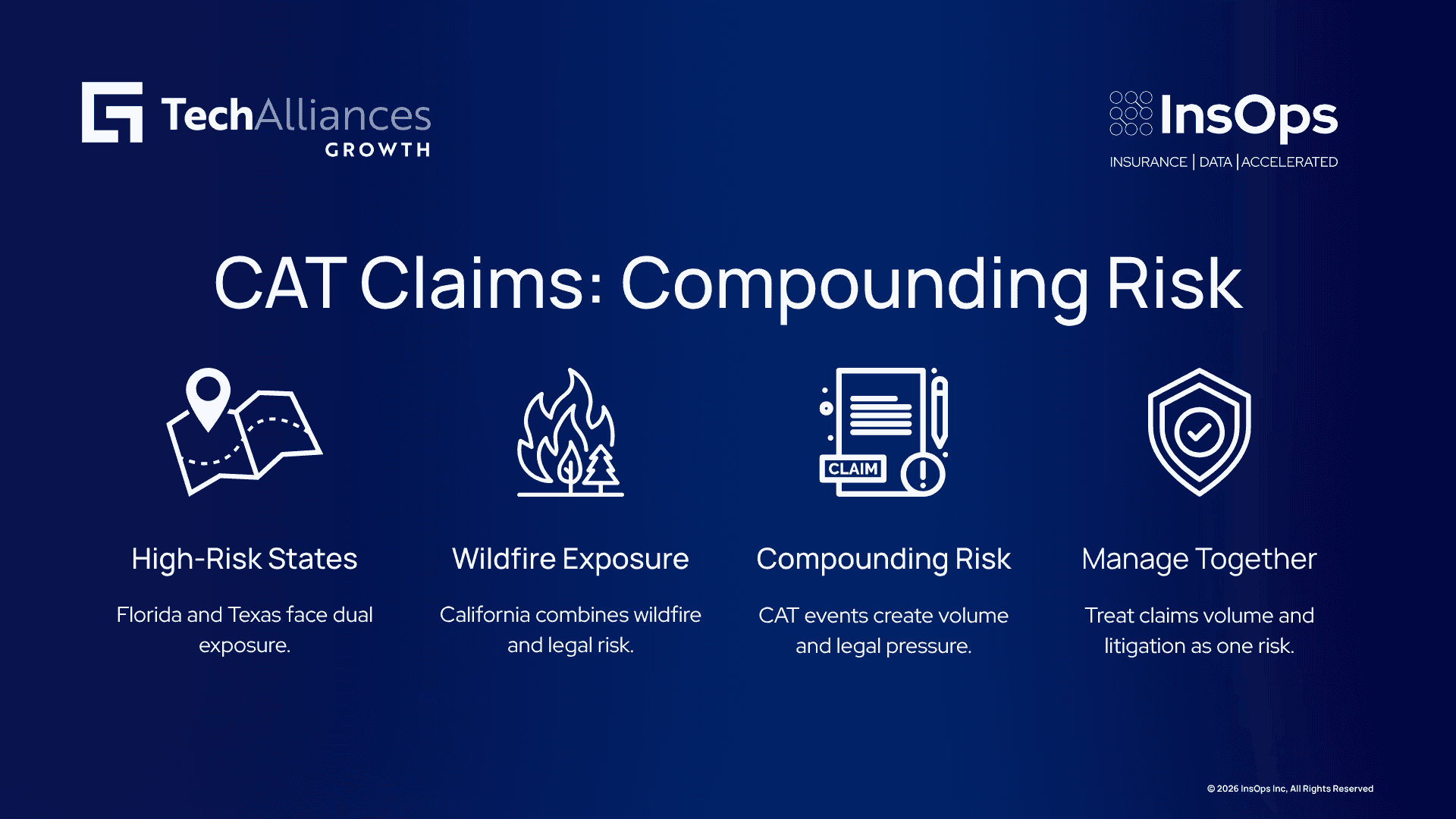
This isn't a coincidence of timing. It's a compounding risk. A single hurricane or wildfire event generates thousands of claims at once, and when that event lands in a litigation-hostile state, claims teams face volume and legal exposure simultaneously rather than one at a time.
Treating these as two separate risks, a volume problem and a legal problem, understates the real exposure. They need to be managed together.
What Claims Teams Can Do
Treat Venue as a Reserving Input
Venue shouldn't be a detail that surfaces only once a case reaches litigation. Building state-level litigation risk into reserving and triage decisions from the start gives claims teams a more accurate picture of exposure before costs escalate.
Flag High-Risk Claims Early
Historical case patterns, prior verdicts in a given venue, and known reform activity all signal which claims are more likely to escalate. Flagging high-risk claims early, before a claim reaches a plaintiff's attorney, gives adjusters a real window to intervene.
How InsOps Helps
InsOps builds an insurance-trained AI that assists with identifying claims carrying elevated litigation risk. LiLa, our insurance-trained LLM, reduces litigation risk by analyzing case patterns and claim history to surface high-risk claims. A person reviews and validates every flagged claim before any handling decision is finalized.
LiLa runs inside your own environment, so PII and PHI never leave controlled infrastructure. It understands insurance domain logic, data relationships, and regulatory requirements, unlike a generic LLM.
Our Integration Gateway connects to Guidewire ClaimCenter, so flagged claims and their supporting case history flow directly into your existing claims workflow without custom engineering.
If you are evaluating how to manage litigation risk across catastrophe claims without adding manual review burden to your adjusters, contact us to talk through what this could look like for your operation.
Frequently Asked Questions
What is litigation risk in insurance claims?
Litigation risk is the likelihood that a claim escalates into a lawsuit rather than resolving through standard settlement. It depends heavily on state law, court venue, and legal environment, not just the size or complexity of the loss.
Why does litigation risk vary so much by state?
States differ on damage caps, bad faith recognition, venue rules, and litigation funding regulations. These differences change how much leverage a plaintiff's attorney has and how likely a case is to reach trial.
How can claims teams factor geography into claims handling?
Start by building venue and state-level risk data into reserving and triage decisions rather than treating it as a detail that only matters once litigation begins. Historical verdict data and reform activity by state are strong early indicators.
What's a common challenge in managing multi-state litigation risk?
Choice-of-law complexity. When a policyholder, insurer, and claim location span multiple states, it's not always clear which state's law governs the dispute, which complicates early risk assessment.
What metrics indicate rising litigation risk in a state?
Nuclear verdict counts and total award value, whether noneconomic damage caps exist, and recent legislative reform activity are the clearest indicators of a state's litigation environment.
How does InsOps help identify high-risk claims?
LiLa analyzes case patterns and claim history to surface claims with elevated litigation risk. A person reviews and validates every flagged claim before it moves forward, so the assessment supports the adjuster rather than replacing their judgment.
What's a realistic timeline for building state-level litigation risk into claims workflows?
Most claims teams start by mapping their existing claim volume against known high-risk states, which can happen in weeks. Fully integrating that risk signal into reserving and triage workflows typically takes longer, since it touches existing systems and adjuster processes.
Are litigation-hostile states becoming more or less risky over time?
It varies by state. Florida's 2023 tort reform has already reduced litigation activity statewide, while states like California and Texas continue to see rising nuclear verdict activity with less legislative pushback so far.