

Claims organizations already know how to staff up for a catastrophe surge. Most readiness plans cover adjuster panels, system capacity, and communication protocols months in advance.
What most plans miss is treating litigation risk assessment as part of that same plan, instead of a step that gets added later, after claims are already open and disputes have already started.
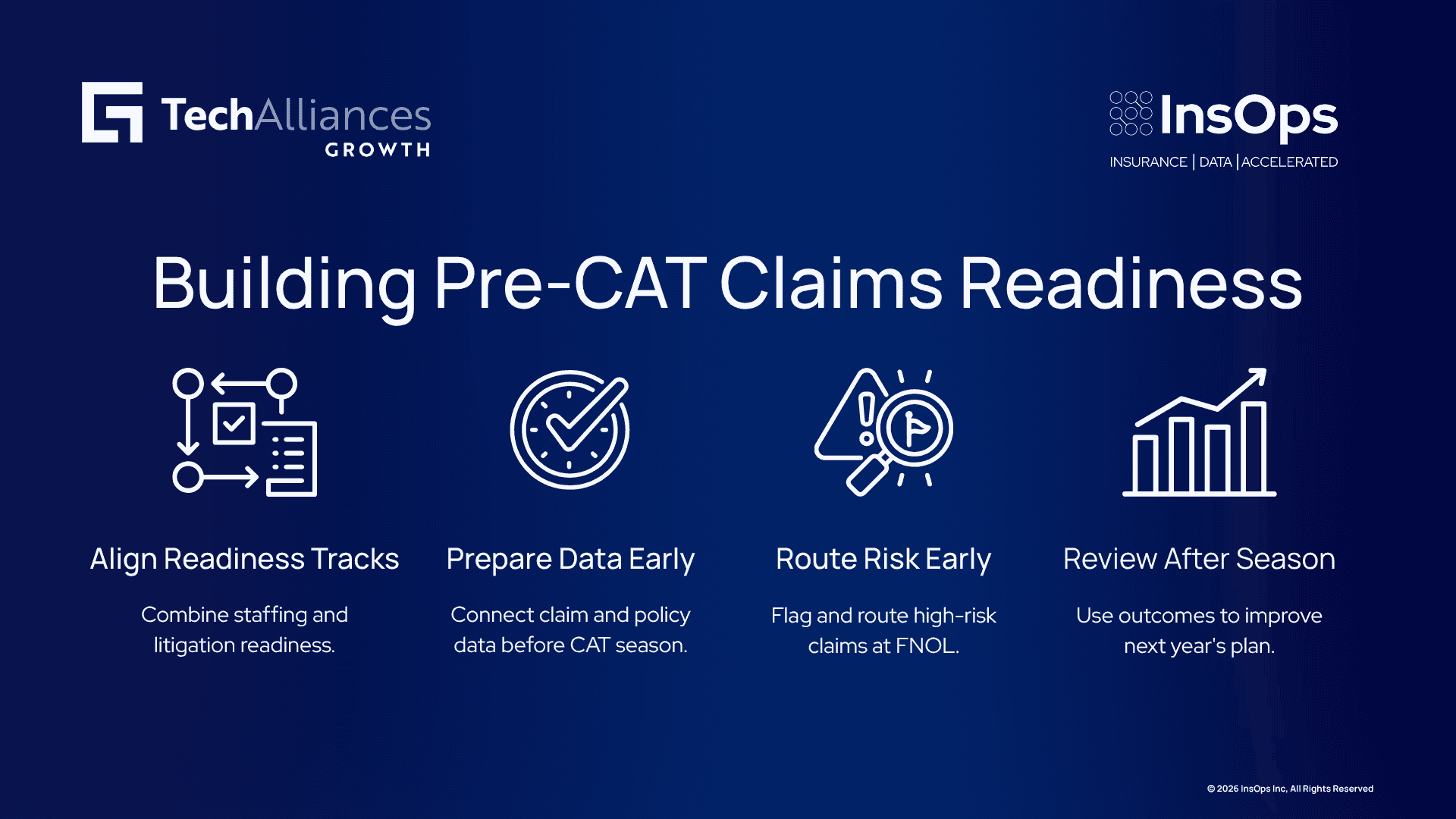
When CAT season is approaching and a claims organization needs to be ready for a sudden volume spike, the goal is not just staffing. It's walking into the season with adjusters deployed, claim data flowing, and high-risk claims flagged before they turn into disputes. This article covers how to build both tracks, staffing and data readiness, and litigation risk readiness, into one pre-CAT plan.
Why Pre-CAT Readiness Plans Need a Litigation Risk Track
What a Traditional Pre-CAT Plan Covers Today
Most pre-CAT plans focus on the operational basics. Risk Management magazine's pre-storm checklist for 2026 recommends reviewing policies and coverage limits, fortifying physical assets, and centralizing key records before storm season begins.
The same guidance recommends testing emergency communication protocols and using insurer-provided modeling tools to track storm paths before landfall. These are staffing and operational readiness steps.
The Gap: Litigation Risk Gets Assessed Too Late
Litigation risk assessment usually happens after a claim is already open, once an attorney has gotten involved or a dispute has already surfaced. An early litigation risk prediction system instead flags high-risk claims as early as first notice of loss, giving adjusters the chance to intervene before a claim escalates.
A pre-CAT plan that only prepares staffing and leaves litigation risk assessment for later is missing half the readiness work. The two need to run on the same timeline.
Staffing and Data Readiness, Before the Season Starts
Confirming Adjuster Capacity Ahead of a Surge
Carriers typically rely on two adjuster pools during a catastrophe surge: staff adjusters who are pre-designated for deployment, and independent adjusters brought in through adjusting firms when volume exceeds staff capacity. Confirming both pools, along with housing, transportation, and equipment logistics, is a readiness step that has to happen before the season starts, not during it.
Data Readiness: Unifying Claim History Before Volume Spikes
Data readiness means the systems adjusters and legal teams need are already connected before a surge, not migrated or mapped mid-event. Claim history, policy data, and prior loss information all need to reach the adjuster's desk at first notice of loss, not days into a claim's life.
Building the Litigation Risk Track Into the Same Plan
A Three-Tier Framework for Litigation Risk
An early litigation risk prediction system can classify claims into three tiers, each tied to a specific next action: high risk claims escalate to legal or senior adjusters, moderate risk claims get monitored with targeted flags, and low risk claims proceed through the standard workflow.
This tiering only works if it's built into the plan before the season starts. Assigning risk tiers after volume has already spiked defeats the purpose.
What Data Feeds the Risk Tier at First Notice of Loss
An effective litigation risk system ingests both structured data, such as claim history, injury or damage type, and attorney involvement, and unstructured data, such as adjuster notes and claimant narratives.
Note on data: right now, there isn't a recently published statistic tying a specific percentage reduction in litigation costs to this kind of early flagging that meets a 12-18 month recency standard. The mechanism above is well documented. The dollar-figure outcome is not, at least not with a current source, so this article describes the mechanism rather than attaching an unsupported number to it.
Where Staffing Readiness and Litigation Readiness Meet
Workstream | What It Covers | When It Runs |
|---|---|---|
Staffing and data readiness | Confirming adjuster panels, staging logistics, unifying claim and policy data | Pre-season, reviewed annually |
Litigation risk readiness | Building the three-tier risk framework and connecting the data that feeds it at first notice of loss | Set up pre-season, then live during the surge |
Both tracks need to be in place before the first claim comes in. Treating them as two separate projects, on two separate timelines, is what creates the gap this article opened with.
Running the Plan During an Active CAT Event
How the Risk Tiers Route Claims in Practice
Once claim volume hits during an active event, the three-tier framework routes high-risk claims to senior adjusters or legal specialists first, while low-risk claims move through the standard workflow without added friction. This only works if the tiering was already built into the intake process before the event started.
Watching for Reallocation Lag
Surge events strain staffing in predictable ways. In at least one documented case outside the US, a major flood event required insurers to reallocate claims handlers from other branches, and that reallocation took one to two weeks to organize, during which initial claim volume backed up.
This example is from the Indian insurance market, not a US carrier statistic, but the underlying reallocation lag is a dynamic any pre-CAT plan should account for regardless of market.
Reviewing and Updating the Plan After Season
Post-Season Review
After the season ends, the plan needs a review of which claims escalated to litigation despite being flagged low risk, and which high-risk flags turned out to be accurate. This review is what keeps the three-tier framework calibrated for the next season.
Updating the Plan for Next Season
Every gap found in the post-season review, whether it's a staffing shortfall or a missed litigation flag, should become a specific line item in next year's plan. A pre-CAT readiness plan that doesn't change year to year isn't being reviewed.
How InsOps Helps
InsOps assists claims teams in reducing litigation risk by analyzing case patterns and claim history to surface high-risk claims. LiLa, our insurance-trained AI, runs inside your own environment, so PII and PHI never leave controlled infrastructure. A person reviews and validates every flagged claim before any action is taken.
Our Integration Gateway connects to Guidewire ClaimCenter, so the claim and policy data feeding a litigation risk review flows in directly, without custom engineering to unify it first.
If you're evaluating how to connect staffing readiness and litigation risk assessment into one pre-CAT plan without adding new compliance or data-exposure risk, contact us to talk through what this could look like for your operation.
Frequently Asked Questions
What is a pre-CAT claims readiness plan?
It's a plan claims organizations build before catastrophe season that covers staffing and data readiness, such as adjuster panels and system capacity, alongside litigation risk assessment, so both are ready before claim volume spikes.
Why does litigation risk need to be part of CAT readiness planning, not a separate process?
Litigation risk assessment set up after claims are already open misses the window to intervene early. Flagging risk at first notice of loss, before a surge hits, gives adjusters time to route high-risk claims to the right handler from the start.
How do you build a three-tier litigation risk framework into a CAT plan?
Define what data feeds the framework (claim history, injury or damage type, attorney involvement signals), decide what action each tier triggers (escalate, monitor, or standard workflow), and confirm the data is connected and visible to adjusters before the season starts, not after volume hits.
What's the biggest challenge in staffing a CAT surge team on short notice?
Reallocating claims handlers from other parts of the organization isn't instant, and documented surge events show that lag is exactly when initial claim volume tends to back up.
What should claims leaders track to know if their litigation risk flagging is working?
Track how many claims flagged high risk actually escalated to litigation, and how many flagged low risk escalated anyway. That comparison, reviewed after each season, shows whether the risk tiers are calibrated correctly.
How does AI assist with litigation risk flagging without replacing adjuster judgment?
The system surfaces a risk tier and the data behind it. The adjuster or legal specialist still reviews the flagged claim and decides what to do next. The system doesn't resolve or approve anything on its own.
How long does it take to stand up a combined staffing and litigation risk readiness plan?
Staffing readiness (adjuster panels, logistics) typically follows a plan a carrier already runs annually. Adding a litigation risk track means confirming the data connections that feed it, which is the longer-lead item and should start well before the season, not during pre-season staffing reviews alone.