

When a claims team is already looking at AI-based litigation risk scoring, the real question isn't whether it works. It's how the score gets built, and whether a person still has final say before anything happens to a claim.
Litigation spending patterns have shifted enough in the past few years that more claims teams are asking how litigation risk scoring actually functions, not just whether it exists. Verdict sizes have climbed at the same time, raising the stakes for catching risk early.
This article walks through the mechanism behind litigation risk scoring, what the data shows about its impact, and exactly where human review still sits in the process.
Why Litigation Risk Is Becoming a Bigger Problem for Claims Teams
Auto and trucking litigation now accounts for 33% of carrier litigation spending, up from 24% in 2023, according to the 2026 CLM Litigation Management Study. It has overtaken general liability as the single largest litigation spending driver.
At the same time, the median nuclear verdict against corporate defendants climbed to $51 million in 2024, up from $44 million in 2023, according to Marathon Strategies. Even mid-severity claims now carry outsized tail risk in adverse venues.
The cost isn't evenly distributed
Not every claim carries the same litigation exposure. A small number of files drive most of the cost, which is exactly why identifying them early matters more than managing litigation after it starts.
Traditional review catches risk too late
Legacy claims processes typically assess litigation propensity through periodic manual review, often after an attorney has already entered the picture. By that point, the window to intervene has narrowed considerably.
What Is a Litigation Risk Index, and How Is It Built?
A litigation risk index is a composite score that estimates how likely a claim is to escalate into represented or litigated status, built from claim-level signals rather than a single data point.
The signals that go into the score
Injury type, claimant history, adjuster notes, and jurisdiction are the core inputs cited across current litigation risk models. Each signal contributes to the score independently, and the score updates as new information enters the file.
Why jurisdiction carries extra weight
Venue outcomes vary significantly, and plaintiff strategy differs by region. A composite score that ignores jurisdiction risks under-flagging claims in venues with a documented history of high verdicts.
How Does an AI-Assisted Claims Process Actually Flag a High-Risk File?
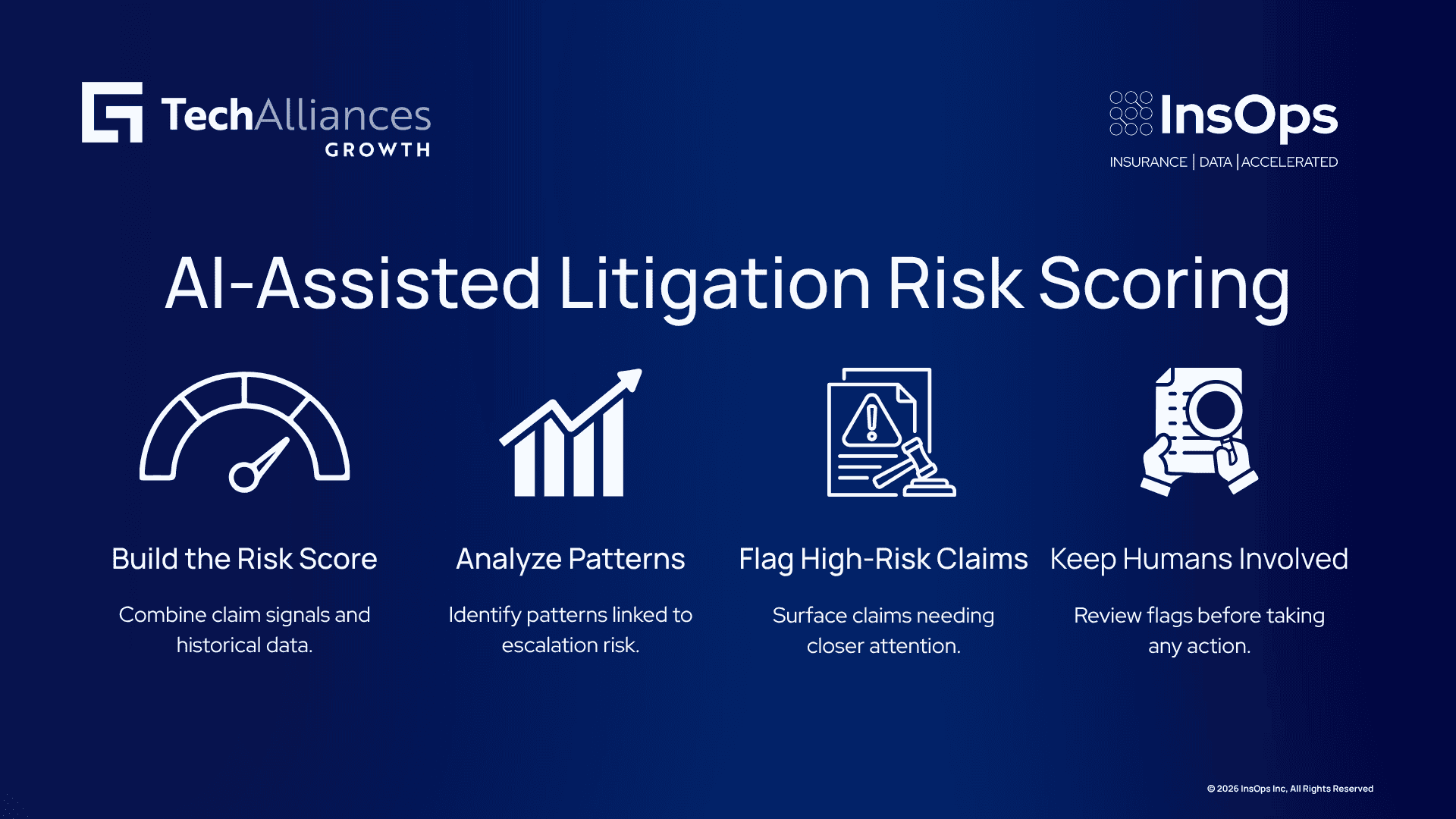
Litigation risk scoring works by continuously analyzing case patterns and claim history, then surfacing the claims most likely to escalate so a person can act before an attorney gets involved.
Pattern analysis runs on real claim history, not assumptions
The scoring model draws on historical claim outcomes, not a generic industry template. This is what allows it to reflect the specific patterns in an organization's own claim history rather than an average across the whole market.
Flagging happens early, not at the point of escalation
A file gets flagged at the earliest point the pattern becomes visible, which can be well before a claimant retains an attorney. Early flagging is what creates the window for proactive intervention.
Does AI Actually Reduce Litigation Costs? What the Data Shows
A mean of 87% of non-workers'-comp litigated claims settle, against a verdict rate of just 2.9%, according to the 2026 CLM Litigation Management Study. That gap shows settlement strategy, not trial outcomes, is where most of the value in litigation management actually sits.
Settlement quality matters more than avoiding trial
Since the overwhelming majority of litigated claims settle rather than go to verdict, the leverage point isn't avoiding trial. It's identifying which claims should be settled earlier, and on what terms, before costs compound.
Verdict rates have been falling, not rising
The mean verdict rate fell from 5.9% in the 2023 study to 2.9% today. That decline reflects an industry-wide shift toward negotiated resolution, independent of any single technology vendor.
Where Does a Person Still Have to Review the Score?
A litigation risk score is an input to a decision, not the decision itself. Every flagged claim still requires a person to review the file, confirm the flag makes sense given the specific facts, and decide what happens next.
Review happens before any action, not after
The point of human review is to catch cases where the score doesn't match the reality of the file, whether that's a data gap, an unusual fact pattern, or context the model couldn't see. That check happens before any resource gets reassigned or any escalation occurs, not as a formality afterward.
The Three-Step Logic Behind AI Litigation Risk Scoring: Pattern, Flag, Review
Most litigation risk scoring approaches, regardless of vendor, follow the same underlying logic once you strip away the marketing language:
Step | What happens | Who's involved |
|---|---|---|
Pattern | The system analyzes case patterns and claim history across the claim's data points | Automated analysis of structured and unstructured claim data |
Flag | Claims matching high-risk patterns are surfaced for attention | Automated flagging, no action taken yet |
Review | A person evaluates the flagged claim and decides on next steps | Adjuster or claims professional, human judgment required |
The value of this logic isn't in any single step. It's in keeping all three connected, so pattern analysis feeds directly into a person's workflow instead of sitting in a separate tool someone has to remember to check.
How InsOps Helps
InsOps builds an insurance-trained AI that follows exactly this pattern, flag, review logic. It assists adjusters by analyzing case patterns and claim history to surface high-risk claims early, so nothing waits for a periodic manual review cycle.
LiLa, our insurance-trained LLM, runs inside your own environment, so PII and PHI never leave controlled infrastructure. A person reviews and validates every flagged claim before any action is taken.
Our Integration Gateway connects to Guidewire ClaimCenter and related systems, so claim history and case data flow directly into the scoring process without custom engineering.
If you're evaluating how to catch litigation risk earlier without adding another disconnected tool to your adjusters' workflow, contact us to talk through what this could look like for your operation.
Frequently Asked Questions
What is a Litigation Risk Index?
It's a composite score that estimates how likely a claim is to escalate into litigation, built from signals like injury type, claimant history, adjuster notes, and jurisdiction.
Why do insurance claims end up in litigation?
Claims typically move toward litigation when attorney representation enters the picture, often driven by policy limit demands, claimant dissatisfaction with early handling, or complex injury and liability questions.
What are red flags for a high-risk claim?
Common signals include delayed reporting, inconsistent accounts of the incident, early or unusual attorney involvement, and claim characteristics that historically correlate with escalation in a given jurisdiction.
How can adjusters tell early if a claim is headed toward an attorney getting involved?
By tracking the same signals a litigation risk score uses: injury type, claimant history, jurisdiction, and patterns in adjuster notes, rather than waiting for representation to become explicit.
Does AI actually reduce litigation costs on claims?
The value shows up less in avoiding trial and more in earlier, better-informed settlement decisions, since the vast majority of litigated claims resolve through negotiation rather than verdict.
What role does a human still play if AI is flagging litigation risk?
A person reviews every flagged claim before any action is taken. The score surfaces a claim for attention; a person decides what happens to it.
What should an adjuster do differently once a claim is flagged high litigation risk?
Review the specific factors driving the flag, confirm they match the actual file, and decide whether the claim needs earlier settlement outreach, specialized handling, or closer reserve monitoring.
How much does litigation actually cost insurers compared to settling early?
Verdict sizes have grown substantially in recent years, which is a large part of why identifying litigation risk before a case reaches trial has become more valuable than it used to be.