

When a bodily injury claim comes in, the medical record grows fast. What starts as a few pages from an emergency room visit can turn into a file spanning multiple providers, specialists, and months of treatment history. Reading through that file for the details that predict litigation is slow work, and it doesn't get faster just because the caseload does.
This article covers the specific medical record patterns that tend to predict litigation risk, how AI-assisted review surfaces those patterns earlier in the claim lifecycle, and where a person still needs to make the call.
Why Medical Records Are the Center of Litigation Risk in Injury Claims
Reviewing a single medical record set of 500 or more pages can take four to eight hours per case. That's the reality facing claims and legal teams working bodily injury files today.
The volume isn't the only problem. Records arrive from different providers, in different formats, and often out of order. A pre-existing condition mentioned once on page 12 might not get connected to a diagnosis restated on page 400, simply because no one read both pages back to back.
This is where litigation risk quietly builds. The patterns that matter most rarely show up as a single dramatic finding. They show up as small inconsistencies spread across a file that took hours to read once, and that no one has time to read twice.
The Injury Record Patterns That Predict Litigation Risk
Insurance-trained AI can assist claims teams by analyzing case patterns and claim history in medical records to surface high-risk claims before they escalate.
Five categories of pattern show up consistently across injury claims that end up in litigation.
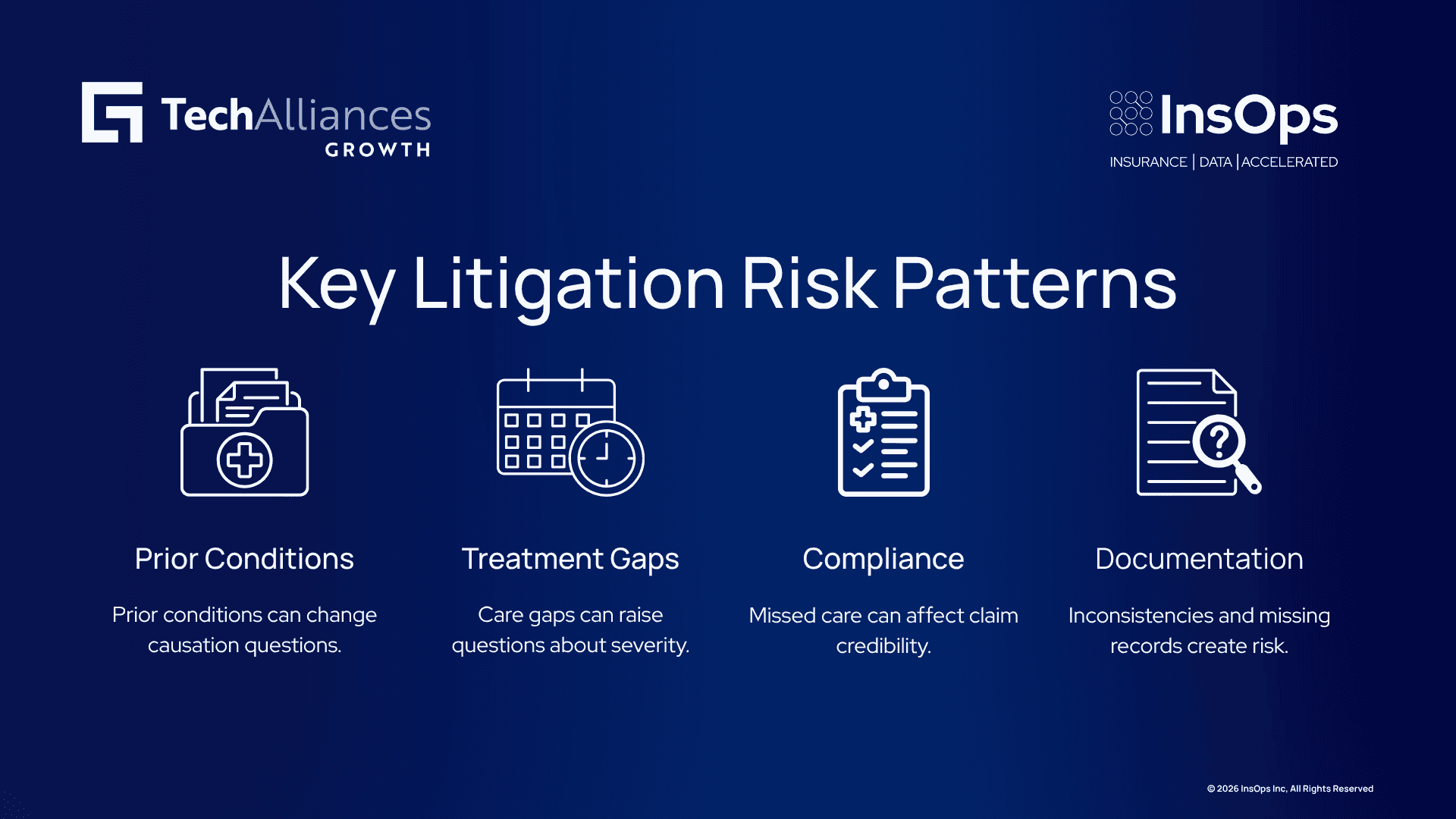
Pre-existing condition mentions. A prior diagnosis, imaging study, or treatment involving the same body region can shift the causation argument entirely, whether or not the current injury is genuinely related.
Unexplained treatment gaps. A break in care of even a few weeks raises questions about whether the injury was as serious as claimed, even when there's a legitimate reason for the gap.
Non-compliance with a treatment plan. A missed referral, an unfilled prescription, or a skipped physical therapy session can affect how credible the rest of the claim looks.
Inconsistencies between providers. An emergency department note, a specialist's report, and a physical therapist's assessment can describe the same injury differently, simply because each provider is focused on a different part of the picture.
Missing or incomplete documentation. A referenced imaging study with no accompanying report, or a provider mentioned during intake who never shows up in the retrieved records, can leave a hole in the file that surfaces at the worst possible time.
None of these five categories are hidden or unusual. What makes them hard to catch is volume, not obscurity, they're buried in files that are too long to read closely more than once.
How AI-Assisted Review Surfaces These Patterns Earlier
Finding these patterns earlier comes down to changing when they get found, not just how. A structured approach breaks the work into three passes.
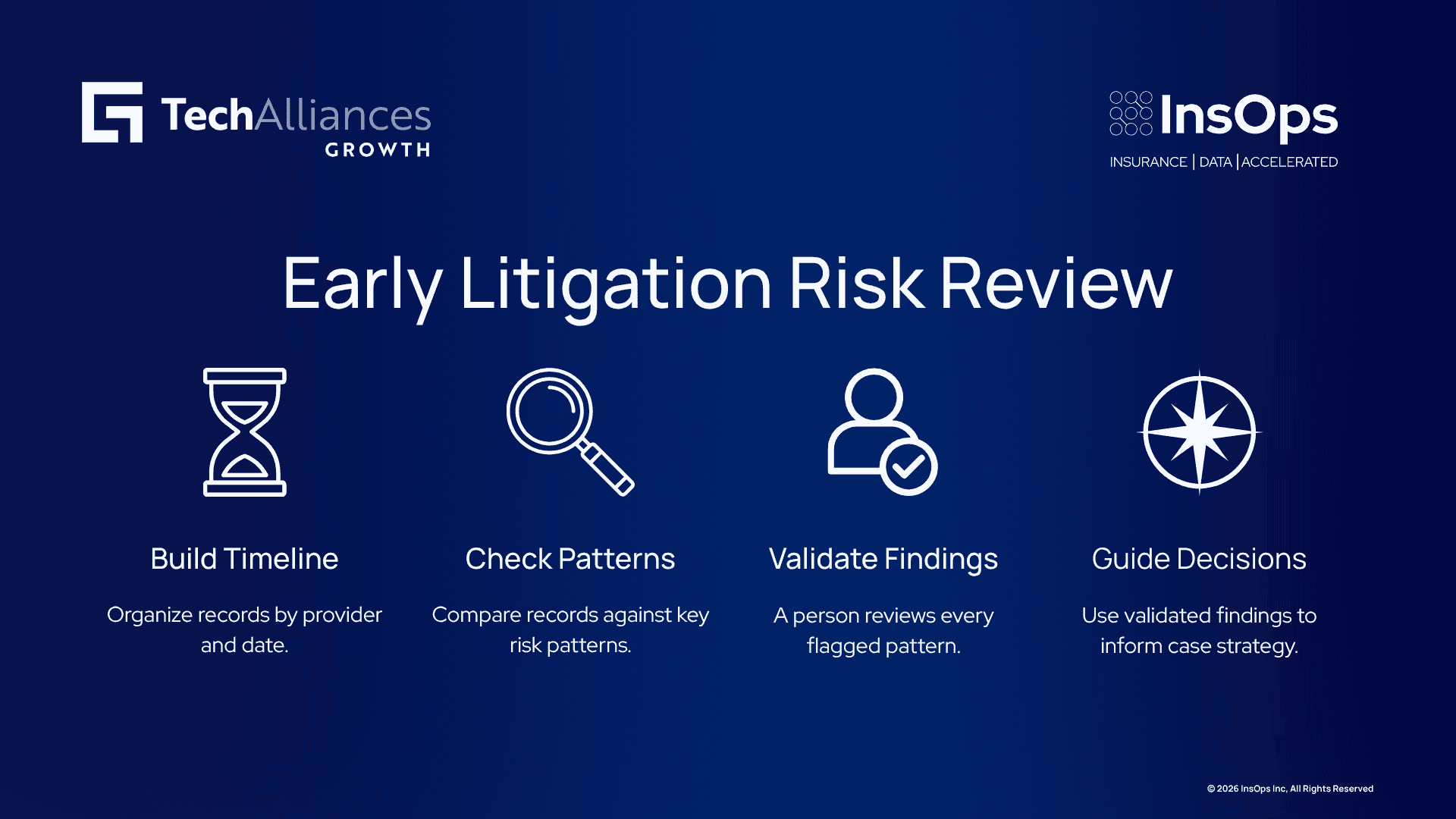
Timeline pass. The record gets organized chronologically by provider and date, so the sequence of treatment is visible at a glance instead of scattered across hundreds of pages in the order they were received.
Pattern pass. The organized record gets checked against the five pattern categories described above.
Adjuster pass. A person reviews and validates every flagged pattern before it informs a reserve or litigation-risk decision. This step isn't a formality, it's where judgment about context, credibility, and case strategy actually happens.
The first two passes are where AI-assisted tools add the most value, since they're the parts of the job that scale with page count instead of with expertise. The third pass is where the adjuster's experience still does the real work.
What the Data Shows on Litigation Risk Reduction
AI-enabled claims management has already shown measurable results in reducing legal involvement. In workers' compensation claims specifically, AI-enabled claims management reduced legal engagement in lost-time claims by 15%, resulting in roughly a 5% reduction in overall claims costs.
That reduction matters because once an attorney becomes involved in a claim, timelines tend to stretch and costs tend to climb. Catching the patterns that predict litigation earlier in the process, while there's still time to intervene, is what drives a result like this.
It's worth being specific about scope here: this figure comes from workers' compensation, lost-time claims specifically, not injury claims broadly. The mechanism, catching risk signals early enough to act on them, generalizes. The exact number doesn't necessarily carry over to other claim types.
Where Human Review Still Matters
None of this replaces the adjuster. Every flagged pattern still needs a person to weigh context that a document alone can't capture, why a treatment gap happened, whether a provider inconsistency is meaningful or just a difference in clinical focus, whether a pre-existing condition actually affects causation in this specific case.
Data handling matters here too. Medical records contain some of the most sensitive information a claims file can hold, so any tool touching that data needs to keep it inside the carrier's own controlled environment rather than sending it out to a general-purpose system.
The goal of AI-assisted review isn't to make the decision. It's to make sure the adjuster is looking at the right pages sooner, with enough time left to act on what's there.
How InsOps Helps
InsOps builds an insurance-trained AI that assists with litigation risk analysis. LiLa, our insurance-trained LLM, runs inside your own environment, so PII and PHI never leave controlled infrastructure. A person reviews and validates every flagged pattern before it informs a reserve or litigation-risk decision.
Our Integration Gateway connects to Guidewire ClaimCenter and related systems, so claim and document data flows directly into your existing workflow without custom engineering.
LiLa is built to reduce litigation risk by analyzing case patterns and claim history to surface high-risk claims, so your team can act on what the record shows earlier in the process, not after discovery.
If you're evaluating how to catch litigation-risk signals in medical records without adding headcount or exposing sensitive data to a generic system, contact us to talk through what this could look like for your operation.
Frequently Asked Questions
What is medical records analysis for litigation risk?
It's the process of reviewing a claimant's medical record for specific patterns, like pre-existing conditions, treatment gaps, and inconsistencies between providers, that tend to predict whether a claim will involve an attorney.
Why does litigation risk in injury claims matter to a claims team?
Once an attorney becomes involved in a claim, timelines typically stretch and costs typically increase. Spotting the risk signals earlier gives a team more room to intervene before that happens.
How do claims teams put AI-assisted medical record review into practice?
The most effective approach organizes the record chronologically first, checks it against known risk patterns second, and routes every flagged pattern to an adjuster for review before it affects any reserve or strategy decision.
What's the biggest challenge in reviewing large medical record files manually?
Volume. Large record sets take real hours to review by hand, and the patterns that matter most are often spread across pages that never get read side by side.
What specific patterns should adjusters watch for in a medical record?
A prior diagnosis in the same body region, a break in treatment, a skipped appointment or unfilled prescription, differing accounts between providers, and a gap in the paper trail itself. See the pattern breakdown above for how each one plays out in practice.
Does AI-assisted review replace an adjuster's judgment?
No. AI-assisted tools can organize a record and flag patterns worth a closer look, but a person still needs to review and validate each one before it factors into a reserve or litigation-risk decision.
Does using AI on medical records create new privacy or compliance risk?
It depends on where the data goes. A tool that keeps PII and PHI inside the carrier's own environment, rather than sending it to a general-purpose external system, avoids adding new exposure.
What's a realistic timeline for adopting this kind of review process?
It varies by carrier size and existing systems. The clearest first step is identifying where medical record review currently creates the biggest bottleneck and starting there rather than attempting a full rollout at once.