

When claims teams need to identify which open claims may be more likely to escalate into litigation, the challenge is finding the signals buried across claims history, case notes, and other claim information. AI-assisted analysis can surface those patterns so claims professionals can focus their review on the claims that warrant closer attention.
Litigation risk prediction is not about letting AI decide whether a claim will become a lawsuit. It is about using historical patterns and current claim data to identify signals that may indicate higher risk, then giving a claims professional the context needed to review those claims earlier.
What Is Litigation-Risk Prediction in Insurance?
Litigation-risk prediction uses historical claims and case patterns to identify characteristics associated with claims that escalate into disputes or litigation.
For an insurer, the useful output is not simply a score. It is a risk signal that helps a claims professional understand which claims may deserve closer review and what factors contributed to that signal.
This distinction matters because litigation is influenced by multiple factors. Injury severity, claim complexity, jurisdiction, claimant behavior, coverage questions, documentation, and prior case patterns can all affect how a claim develops.
AI can examine these factors across large volumes of claims data much faster than a person reviewing files one at a time. The claims professional still evaluates the individual claim and determines what action, if any, is appropriate.
How Does AI Predict Litigation Risk From Claims Data?
AI predicts litigation risk by comparing information from current claims with patterns found in historical claims and cases.
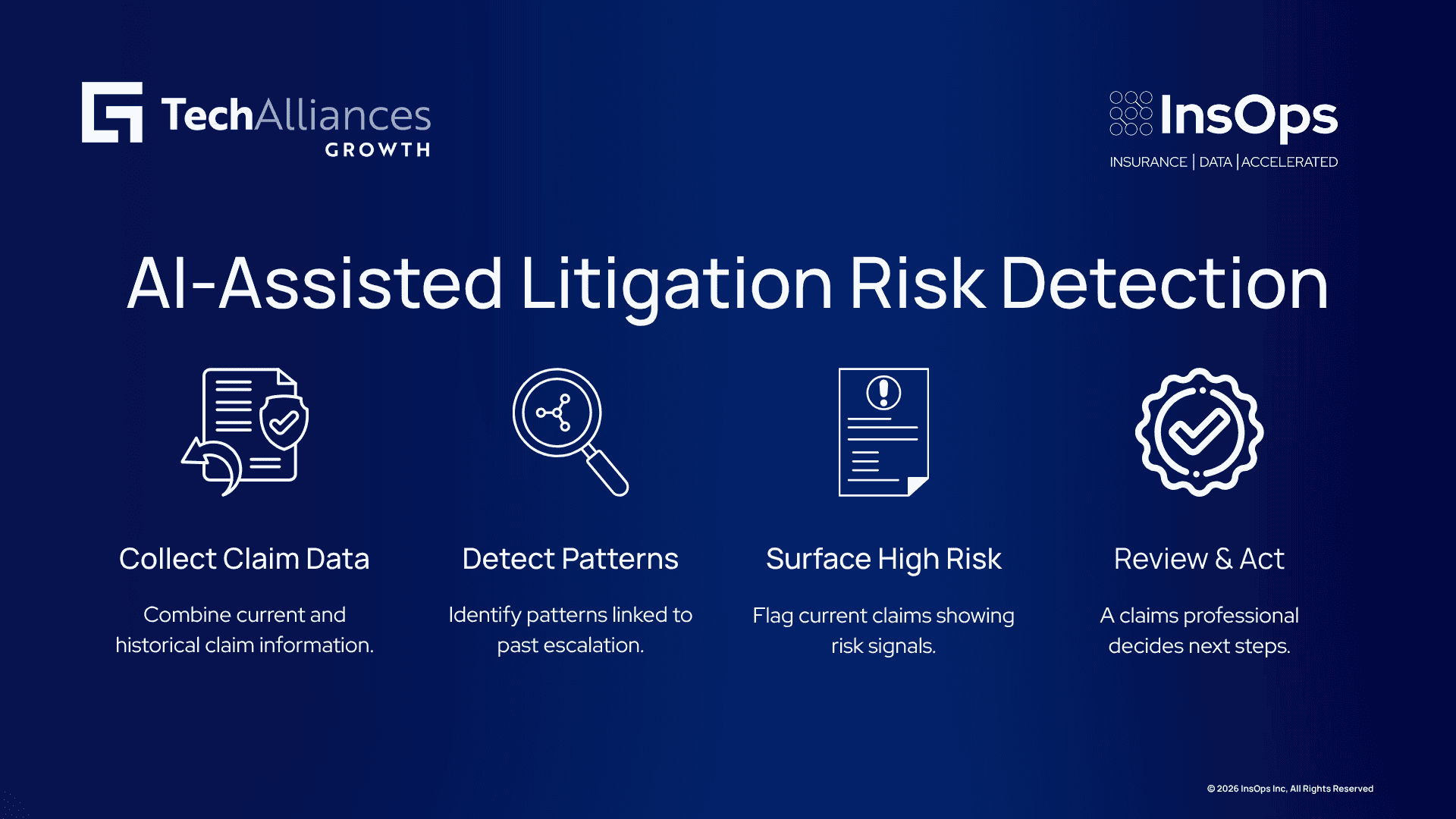
A typical process can be broken into five steps:
Collect: Bring together relevant historical and current claims information.
Detect: Identify recurring patterns associated with claims that previously escalated.
Surface: Apply those patterns to current claims and flag potential high-risk cases.
Review: Give a claims professional the relevant risk signals and supporting claim information to evaluate.
Act: The claims professional determines the appropriate next step based on the complete claim context.
This approach turns historical claims data into a review signal rather than treating the model's output as a final decision.
Industry research describes a similar use of AI and machine learning for identifying claims that may be more likely to litigate based on early risk indicators. The practical value is in surfacing those indicators while there is still time for a human to investigate and respond.
What Claims Data Can Reveal About Litigation Risk?
Claims data can contain useful litigation-risk signals in both structured and unstructured information.
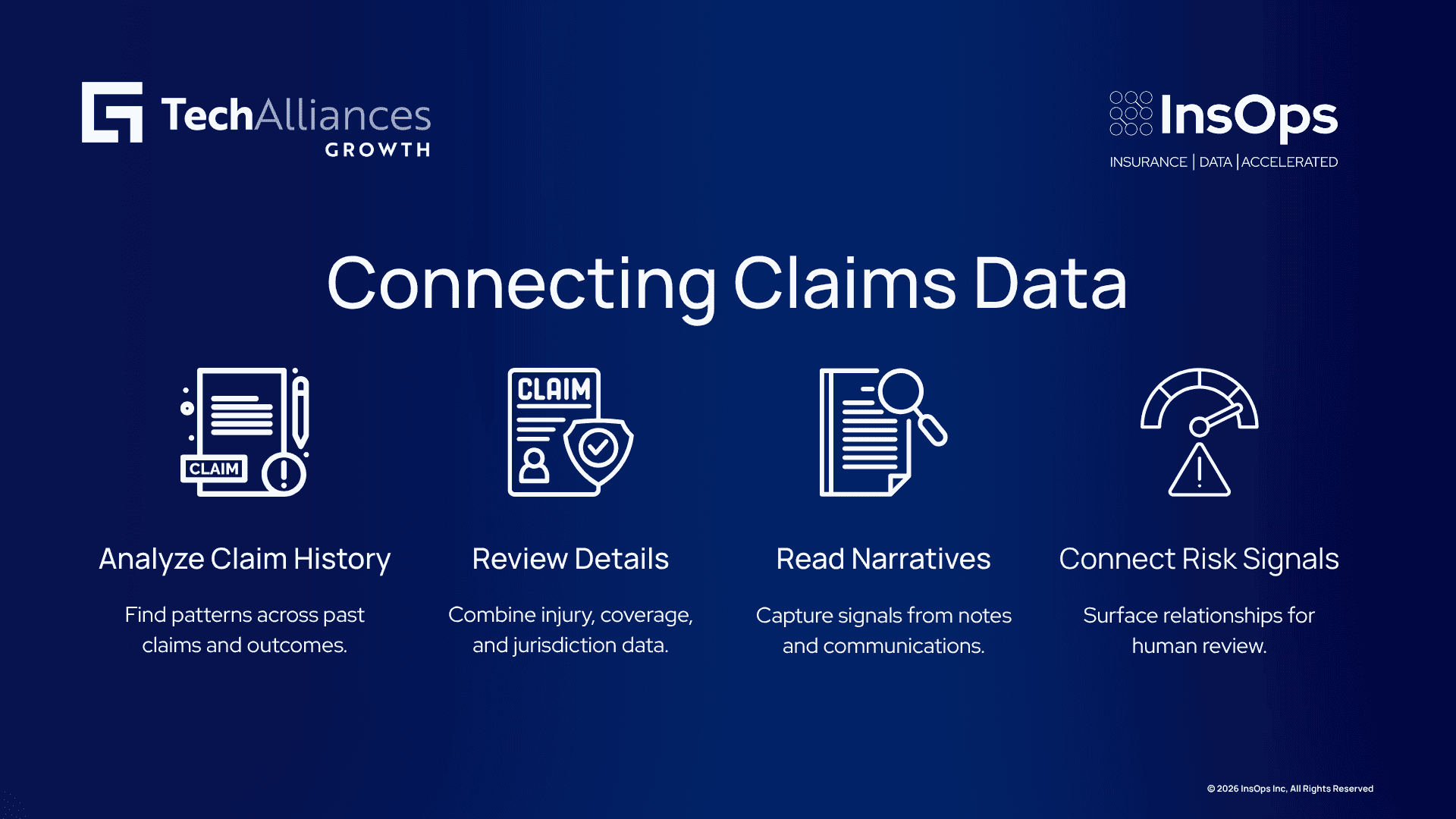
Claim history can reveal recurring patterns across previous losses, claim characteristics, and outcomes. Looking at those relationships can help identify whether a current claim resembles cases that previously developed into disputes.
Claim details provide additional context. Injury type and severity, loss characteristics, coverage information, jurisdiction, and the number or complexity of parties involved can all contribute to the overall picture.
Claim notes and narratives can contain signals that structured fields do not capture. Adjuster observations, claimant communications, correspondence, and other narrative information may reveal changes or complications that are difficult to identify through individual data fields.
The important point is that no single field determines litigation risk. The value comes from looking at relationships across the claim.
For example, a claim may not appear unusual when viewed through one field alone. But when its injury characteristics, claim history, jurisdiction, and narrative information are considered together, the combination may resemble patterns found in previously litigated claims.
AI-assisted analysis can surface those relationships for human review.
How Does a Litigation-Risk Score Become Actionable?
A litigation-risk score becomes useful when it gives a claims professional enough context to decide what deserves attention.
A score without explanation creates another question: Why was this claim flagged?
A more useful analysis surfaces the underlying patterns alongside the risk signal. That might include similarities to historical claims, changes in claim circumstances, relevant claim characteristics, or other factors that contributed to the signal.
The claims professional can then review the underlying file, validate the information, and determine the appropriate response.
That response could mean prioritizing a claim for additional review, investigating missing information, involving an experienced claims professional, or considering whether an earlier discussion with the claimant or another party is appropriate.
The AI does not make that decision. It helps the person responsible for the claim see relevant information earlier.
This human-in-the-loop approach is also consistent with current insurance AI guidance. The NAIC emphasizes that insurers remain responsible for decisions made using AI systems and that human review and oversight remain important. The IAIS likewise highlights governance, accountability, transparency, explainability, and human oversight when AI is used in insurance.
What Does It Take to Put Litigation-Risk AI Into Production?
A useful litigation-risk system needs more than a predictive model.
First, the underlying data needs to be accessible. Claims information may be spread across structured claim records, historical systems, documents, correspondence, and notes.
Second, the AI needs to understand the insurance context. A generic analysis of text can identify words and phrases, but useful claims analysis depends on understanding how those details relate to insurance processes and claim structures.
Third, the output needs to be explainable enough for a claims professional to evaluate. A risk signal should lead back to information that can be reviewed rather than becoming an unexplained instruction.
Finally, sensitive claims information needs appropriate controls. Claims files can contain personally identifiable information and, depending on the line of business, protected health information. Keeping that information within the insurer's controlled environment can be an important part of the deployment model.
How InsOps Helps
InsOps uses LiLa, its insurance-trained AI, to assist insurers with claims data analysis. LiLa can analyze case patterns and claim history to surface high-risk claims, giving claims professionals a way to identify potential litigation-risk signals earlier.
LiLa runs inside the insurer's own environment, so sensitive claims data remains within controlled infrastructure. Its insurance-specific understanding is designed around insurance data relationships, claims structures, and regulatory requirements rather than general-purpose language processing.
The goal is to give claims teams a clearer view of the information already contained in their claim files. A person reviews and validates the AI's findings before they inform the claim-handling process.
InsOps is building toward broader AI-assisted claims analysis across the claim lifecycle. If you are evaluating how insurance-trained AI could help your team surface litigation-risk signals from claims data, contact InsOps to discuss what this could look like for your operation.
Frequently Asked Questions
What Is Litigation-Risk Prediction in Insurance?
Litigation-risk prediction uses historical claims and case patterns to identify current claims that may have characteristics associated with litigation. AI can surface those patterns for review, while the claims professional remains responsible for evaluating the individual claim and deciding what to do next.
How Does AI Predict Litigation Risk From Claims Data?
AI analyzes structured and unstructured claims information, identifies patterns in historical cases, and compares those patterns with current claims. The resulting risk signal can help claims professionals identify cases that warrant closer review.
What Claims Data Can Reveal About Litigation Risk?
Claim history, injury characteristics, jurisdiction, coverage information, claim complexity, adjuster notes, claimant communications, and other claim-file information can contribute to litigation-risk analysis. The strongest signals generally come from relationships among multiple pieces of information rather than one field alone.
How Does a Litigation-Risk Score Become Actionable?
A score becomes actionable when the claims professional can review the factors behind it and evaluate the underlying claim. The AI surfaces a signal and supporting context; the claims professional determines the appropriate response.
What Does It Take to Put Litigation-Risk AI Into Production?
Production use requires accessible claims data, insurance-specific understanding, explainable outputs, appropriate human oversight, and controls for sensitive information. The system also needs to fit into the insurer's existing claims environment.