

A workers compensation claim can pull in medical records from dozens of providers, in as many formats. A bodily injury claim can arrive as a three-thousand-page file the morning it lands on an adjuster's desk.
Once records like these are involved, review can stretch well past the timeline of a simple claim. Much of that added time goes into manually reading, sorting, and cross-referencing documents against policy terms.
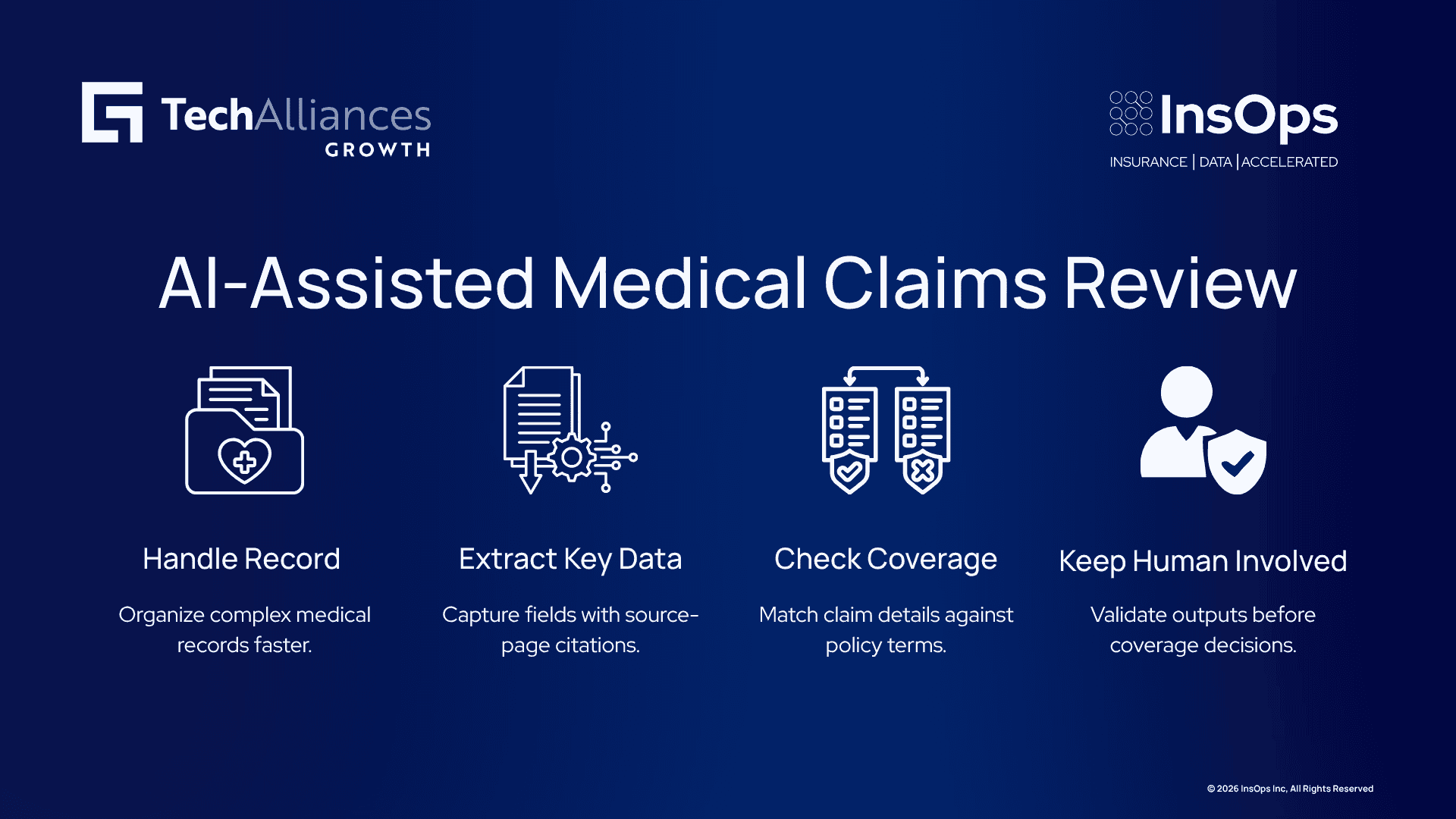
This article covers how AI-assisted extraction and coverage analysis actually works for claims teams handling medical-record-heavy files, where human review still has to sit in that process, and what to evaluate before piloting a platform.
What Slows Down Medical Record Review Today
Claims teams handle an enormous volume of documents over the course of a single file. Medical records, physician reports, independent medical examinations, billing statements, and legal correspondence all pile into one claim.
Even when documents are digitized, they often get siloed into different parts of a patient's file instead of being treated as one connected record.
Multi-Provider, Multi-Format Volume
A complex workers compensation claim can contain medical records from more than twenty providers spanning a decade. Each provider uses its own format, its own terminology, and its own filing conventions.
General document platforms can misclassify an independent medical exam report as a billing statement, or miss a work-status note buried inside a physician's narrative.
Review Timelines and State Deadlines
The time an insurer takes to review medical records depends on state regulations, case complexity, and internal workload. In standard cases, review generally takes 30 to 60 days from submission.
More complex cases involving severe injuries or high-value claims can extend to 60 to 90 days or longer. Some states require insurers to acknowledge, investigate, and decide within 30 to 45 days.
What Manual Review Misses at Volume
Reviewers working under time pressure are more likely to miss documents, misfile records, or fail to catch duplicates across a large file. Manual extraction of clinical data, dates, and details requires reading each page by hand.
This process also tends to leave no structured record of what was reviewed, when, and how, which creates exposure when claims decisions are later challenged.
What AI-Assisted Extraction Actually Does
AI-assisted extraction turns a stack of PDFs, faxes, and handwritten notes into structured, validated data. The workflow looks simple from the outside but involves real complexity: documents get classified by type, key fields get pulled, and results get checked before they reach a person.
Document Types and Fields Handled
A claims-focused extraction tool can capture patient demographics, provider information, diagnosis and procedure codes, dates of service, and treatment details from medical records, physician statements, and claim forms.
Document Type | Common Fields Extracted |
|---|---|
Medical records | Diagnoses, treatments, provider notes, dates of service |
Physician statements | Work status, functional limitations, causation notes |
Billing statements | Itemized charges, procedure codes, payment amounts |
Claim forms | Patient ID, policy number, provider NPI, coverage details |
Structured, Source-Linked Output
Speed alone is not the standard that matters here. A medical record summary that arrives quickly but cannot point back to where a fact came from is less useful than a slower summary that can.
The output that holds up, whether to a claims manager or to opposing counsel, is one where every extracted data point traces to a specific page in the original document.
Coverage Cross-Reference Against Policy Terms
Beyond extraction, this kind of tool can cross-reference claim details against the specific terms in a policy, checking that a diagnosis, treatment, or provider falls within what the policy actually covers.
This step surfaces coverage questions early, before a claim moves further down the workflow.
Where Human Review Still Has to Sit
Regulators are moving toward requiring human review of AI-assisted coverage determinations, not treating it as optional.
The Regulatory Trend Toward Mandatory Human Review
Indiana's House Bill 1271, enacted March 4, 2026, prohibits insurers from using AI as the sole basis to downcode a claim on medical necessity grounds unless a human has first reviewed the medical record.
Louisiana has advanced legislation that would require independent judgment from a human utilization reviewer before any adverse coverage determination, with a physician sign-off required on denials. If passed, it would apply to new policies starting January 1, 2027.
Compliance Checklist for Claims Document AI
Security should be a buying criterion, not an afterthought, when evaluating any platform that touches protected health information.
Requirement | Why It Matters |
|---|---|
HIPAA compliance with signed BAA | Protects PHI through ingestion, processing, and storage |
SOC 2 Type II certification | Demonstrates audited controls over time, not a single point in time |
Data usage policy | Confirms claims data is not used to train open models without permission |
Data residency controls | Ensures records stay within approved geographic regions |
Human review and audit trails | Supports defensible decisions and regulatory compliance |
What Human-in-the-Loop Means in Practice
Human-in-the-loop is not a caveat added to satisfy a compliance checkbox. It is a workflow step: the AI extracts and flags, a person confirms before anything moves forward.
That structure matters most exactly where the stakes are highest, on coverage determinations and denials, not on routine data entry.
Evaluating an AI-Assisted Claims Documentation Platform
Different claims organizations need different things from a documentation tool. The table below breaks down where AI assists and where a person still has to act.
Task | Manual Approach | AI-Assisted Approach | Human Sign-Off |
|---|---|---|---|
Intake and classification | Reviewer sorts and files each document | Documents auto-classified and routed | Reviewer confirms classification on exceptions |
Medical record extraction | Reviewer reads and transcribes key fields | Fields extracted with source-page citation | Reviewer validates extracted data |
Coverage cross-reference | Reviewer checks claim against policy manually | Claim details matched against policy terms automatically | Reviewer confirms coverage determination |
Final decision | Reviewer decides and documents | AI surfaces a recommendation with supporting evidence | Reviewer makes and signs off on the final call |
Integration Considerations
A documentation tool that cannot connect to an existing claims management or policy administration system just pushes the manual work further down the line.
Look for pre-built connectors to the platforms already in use, rather than a tool that requires custom engineering to plug in.
Questions to Ask a Vendor Before Piloting
Before committing to a platform, ask whether it is trained on insurance-relevant documents specifically, whether a human QA layer sits before output reaches an adjuster, and what the turnaround time is on a file with several thousand pages.
Request a pilot on your own document types. Accuracy on a clean test set says less than accuracy on your actual production documents.
How InsOps Helps
InsOps builds an insurance-trained AI that assists with medical record extraction and coverage cross-reference. LiLa, our insurance-trained LLM, runs inside your own environment, so PHI never leaves controlled infrastructure. A person reviews and validates every extraction and coverage flag before it affects a claim decision.
Our Integration Gateway connects to Guidewire ClaimCenter and other core systems, so extracted data flows directly into your existing workflow without custom engineering.
If you are evaluating how to handle medical-record-heavy claims at scale without adding compliance or data-exposure risk, contact us to talk through what this could look like for your operation.
Frequently Asked Questions
What is AI-assisted medical record extraction for claims?
It is the use of AI to read medical records, physician statements, and claim forms, and pull structured fields like diagnoses, treatment dates, and provider information into a claims system, with a person validating the output.
Why does manual medical record review take so long?
Complex, medical-record-heavy claims take substantially longer than simpler ones. Reviewers have to read multi-provider documentation by hand and cross-check it against policy terms and state deadlines, and each added provider or document type extends that timeline further.
How does AI-assisted extraction work with a claims management system?
A connector maps extracted fields directly into the claims or policy administration system already in use, so data flows into the existing workflow instead of requiring a separate tool or manual re-entry.
What's the biggest challenge in extracting data from medical records at scale?
Volume and inconsistency. A single complex claim can involve records from twenty or more providers, each with different formats and terminology, which general document tools often misclassify.
What should I look for in a claims document AI vendor?
Medical specificity for insurance documents, a human QA layer before output reaches an adjuster, HIPAA compliance with a signed BAA, SOC 2 Type II certification, and a turnaround SLA tested against your own document types.
Does AI make coverage decisions on its own?
No. States including Indiana and Louisiana now require or are moving toward requiring a human to review a medical record before AI-assisted output can affect a coverage or denial decision.
How long does it take to pilot an AI-assisted extraction tool?
Most evaluations start with a real file, often in the thousand-to-five-thousand-page range, run through the platform so a claims team can check the output against its own standards before a wider rollout.