

Claims adjusters spend roughly a third to 40% of their time on documentation. Carriers have been pitching AI as the fix for years now.
But 2026 delivered an inconvenient data point. Glassdoor found that 98% of claims-adjuster reviews mentioning AI are negative, the highest rate of any occupation the platform studied, well above the 53% cross-industry average.
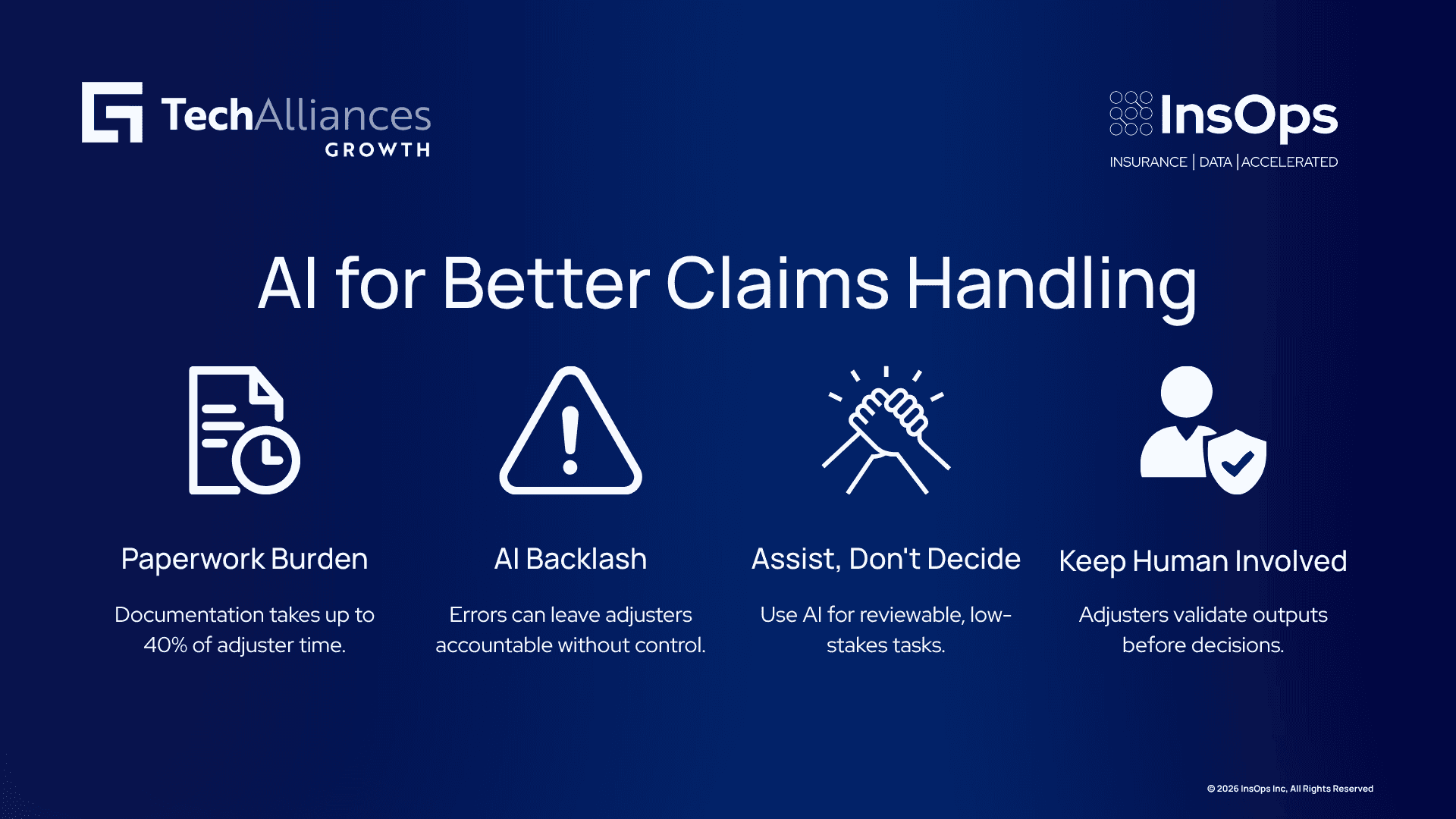
This article covers what's actually driving that backlash, what separates a tool adjusters tolerate from one they reject, and how modern adjusters are using AI in practice once the hype gets stripped away.
The Paperwork Problem Is Real
Documentation isn't a minor drag on an adjuster's day. It's a defining feature of the job.
How Much Time Documentation Actually Takes
Staff and independent adjusters manage caseloads of 150 to 200 active claims and spend roughly 40% of their time on documentation. Every phone call, field inspection, and decision point has to appear in the claim file.
Estimates vary by source, with some putting administrative work closer to a third of an adjuster's time. Either way, it's the single largest category of work outside direct claim handling.
Why This Keeps Getting Worse, Not Better
The Bureau of Labor Statistics projects a 5% decline in adjuster employment from 2024 to 2034, roughly 18,900 fewer jobs. Claim volume isn't shrinking to match.
Fewer adjusters, similar documentation demands. That gap is exactly what AI vendors have been pitching a solution for.
Why Adjusters Are Pushing Back
The pitch hasn't landed the way carriers expected.
The Glassdoor Data
Glassdoor's analysis, covering June 2025 through May 2026, confirms this isn't a fringe complaint. It's the most AI-critical workforce segment currently on record, well ahead of every other occupation the platform measured.
What Adjusters Are Actually Describing
The complaints go beyond learning a new interface. One adjuster described AI systems misclassifying claims during initial loss reporting, the stage where an insurer first gathers accident or loss details.
When AI gets it wrong, the customer usually doesn't know a system was involved. They assume the adjuster made the mistake, and the adjuster absorbs the blame for an error they didn't make and often couldn't have caught in time.
AI Fatigue and Forced Adoption Tracking
Some adjusters report their employers tracking individual AI usage as a performance metric. That turns a productivity tool into something closer to surveillance.
One claims executive summed up the frustration directly: AI can be useful, but it shouldn't be given the final say. It's a tool, not a decision-maker.
What Separates a Tool That Works From One That Doesn't
The difference isn't the technology. It's how the rollout measures success and where the line sits between assist and decide.
The Correction-Time Framework
A rollout that only reports "claims touched by AI" and never "minutes spent correcting AI" is measuring the wrong thing. Every correction is skilled time spent fixing an error, plus a reputational hit when the customer blames the adjuster instead of the system.
Before mandating a tool, the more useful number is net time saved after correction time, not the gross automation rate.
Good Fit vs. Poor Fit for AI
Good Fit for AI | Poor Fit for AI |
|---|---|
Summarizing long claim files | Coverage conclusions |
Organizing notes and timelines | Causation determinations |
Comparing documents for inconsistencies | Repair or settlement recommendations |
Drafting communications for review | Final claim decisions |
Bounded, low-stakes tasks (routine extensions) | Anything requiring judgment under ambiguity |
The pattern holds across sources: AI works when it flags something for a person to check, and fails when it's trusted to decide on its own.
Accountability Without Authority
This is the core failure mode. Adjusters are held responsible for AI-generated output they didn't create.
In many rollouts, they weren't given real authority to override or correct that output before it reached a customer. That mismatch, responsibility without control, is a large part of what's driving the 98% figure.
What Modern Adjusters Actually Do With AI Now
Strip away the failed rollouts, and there's a working pattern underneath.
Reviewable Tasks That Work
AI is useful for summarizing files before they move to a supervisor or attorney, organizing notes, comparing documents, building timelines, drafting communications, and flagging information that needs a closer look.
The adjuster reviews every line before anything goes into the claim file. AI shouldn't add facts, causes of loss, coverage conclusions, or repair recommendations on its own.
What Stays Human
Investigation, coverage reasoning, interviewing, negotiation, and difficult conversations aren't going anywhere. If anything, they're becoming more central to the job, not less, as the routine parts get pulled out.
The Legal Exposure Angle
There's a liability dimension too. When AI materially influences a claim decision, that decision becomes discoverable, including the model's configuration, training data, override rates, and internal guidance on how staff were told to use it.
The more a claim decision looks like an adjuster simply confirming an AI recommendation, the more exposure a carrier has if that decision is challenged as unreasonable.
How InsOps Helps
InsOps builds an insurance-trained AI designed around the exact failure mode driving adjuster backlash right now. LiLa, our insurance-trained LLM, assists with document review and flags issues for a person to check. It does not make coverage or payout decisions on its own.
LiLa runs inside your own environment, so claims data never leaves controlled infrastructure. A person reviews and validates every flag before it reaches a customer or a claim file.
If you're evaluating an AI rollout and want to avoid becoming another data point in the adjuster-backlash story, contact us to talk through what a properly scoped approach could look like for your operation.
Frequently Asked Questions
How much time do claims adjusters spend on paperwork?
Roughly a third to 40% of their time, depending on the source, across a typical caseload of 150 to 200 active claims.
Why are so many claims adjusters unhappy with AI at work?
A 2026 Glassdoor analysis found adjuster reviews mentioning AI were the most negative of any occupation studied. Adjusters describe misclassified claims, hallucinated summaries, and being blamed for AI errors they didn't make.
What should AI handle vs. what should stay with the adjuster?
AI works well for summarizing files, organizing notes, comparing documents, and drafting communications for review. Coverage conclusions, causation determinations, and final decisions should stay with the adjuster.
Does AI create legal risk if it influences a claim decision?
Yes. When AI materially influences a decision, that decision becomes discoverable, including how the tool was configured and how staff were instructed to use it, which can expose a carrier to bad-faith arguments if the decision is later challenged.
What does "correction time" mean and why does it matter?
It's the time an adjuster spends fixing AI-generated errors before they reach a customer or a claim file. A rollout that only tracks automation rate and ignores correction time is measuring the wrong thing.
Can AI replace claims adjusters?
No. AI is replacing specific repetitive tasks inside the job, mainly documentation, not the judgment, negotiation, and investigation work that defines the role.
How should a claims operation measure whether an AI rollout is actually working?
Track net time saved after correction time, not just the number of claims an AI tool touched. Pair that with direct adjuster feedback, since forced adoption without input is a documented driver of the current backlash.