

When you manage workers' compensation claims across multiple states, each claim travels through different regulatory systems. California requires employers to report injuries to their insurer within five days, then the insurer files with the state within ten business days using a specific form and classification code system. Florida requires the employer to report within seven days and uses different forms and codes. Texas requires the employer to report within eight days and uses yet another schema.
When claim data flows from one state system to another without alignment, forms get rejected, deadlines get missed, and your team faces compliance audits. This isn't a coordination problem. It's a data problem.
This article explains what data alignment is, why it matters, what happens when it fails, and how an insurance-trained AI solves it.
What Is Data Alignment in Multi-State Workers Comp?
Data alignment means standardizing claim information across multiple jurisdictions so that a single claim can flow through different state systems without errors, rejections, or compliance violations. Each state defines forms, deadlines, benefit structures, and classification codes differently. When an employer or TPA handles claims across states, they must align claim data to each state's requirements before filing.
Why Data Alignment Fails
Data alignment fails for three reasons: complexity, visibility, and scale.
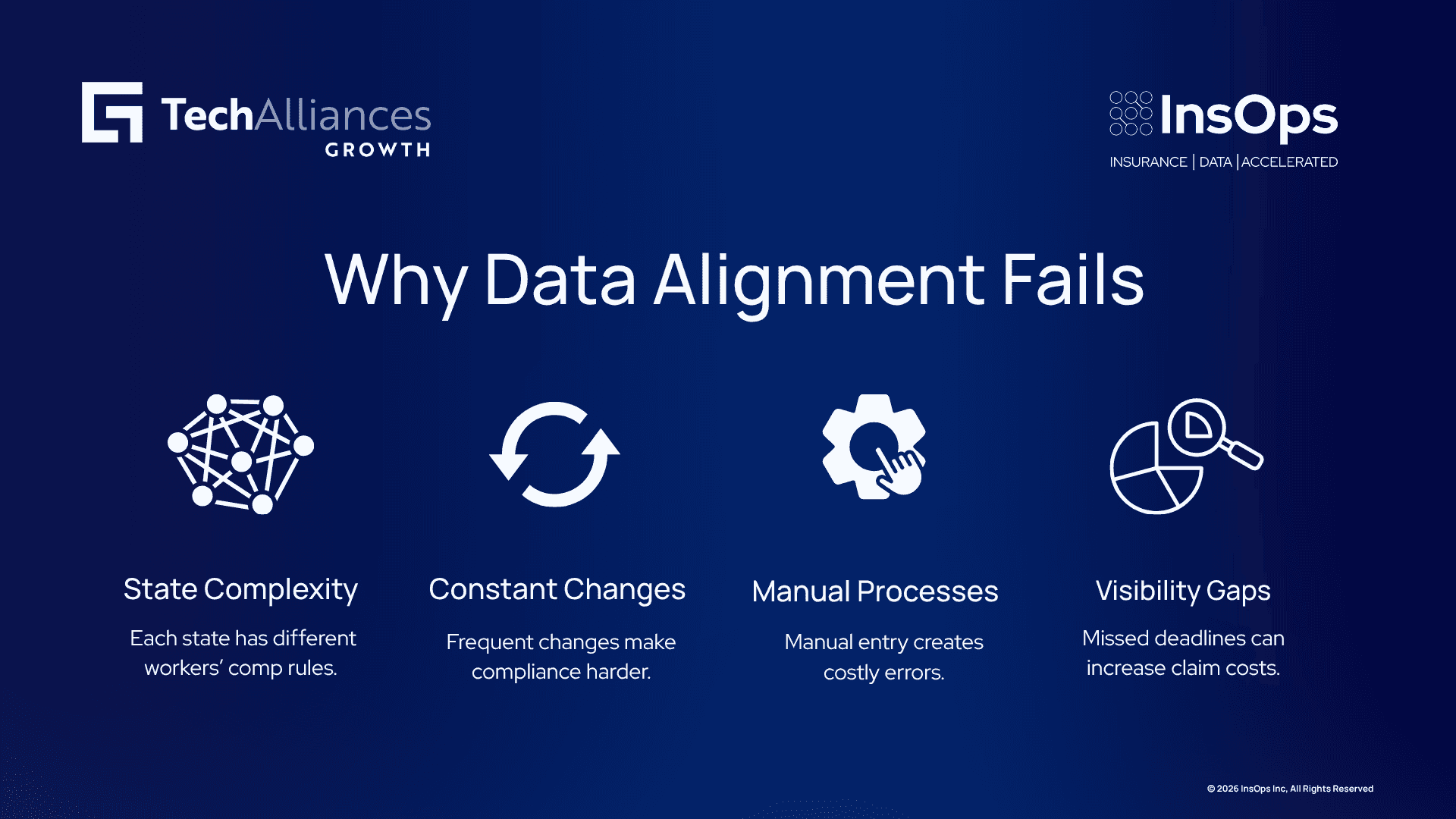
There is no central federal standard for workers' comp. Each state writes its own statutes, sets benefit levels, defines covered injuries, and prescribes the forms and deadlines. According to NCCI's 2025 Legislative and Regulatory Trends Report, states introduced hundreds of workers' compensation bills during the most recent legislative session, covering topics from mental health parity to independent contractor classification. When your team manages claims in ten or more states, tracking changes multiplies. A missed form revision in one jurisdiction could mean a rejected filing or a compliance audit finding.
Many multi-state employers and TPAs still use manual processes. A claims adjuster receives a claim, copies information into state-specific forms, and files manually. This works for one or two states. At five or more states, manual processes generate handoff errors. The insurance industry has a well-documented adjuster shortage. Turnover is high. When an adjuster handling 150 claims misses the window for early medical intervention on yours, your claim costs go up and you have no visibility into why.
Concrete Example: One Claim Across Three States
To show how data alignment fails, here's a realistic multi-state scenario.
An employee works remotely, was hired in Illinois, gets injured in Wisconsin while traveling on business, and has a medical provider in Minnesota. Three states potentially have jurisdiction. Each has different rules.
Requirement | Illinois | Wisconsin | Minnesota |
|---|---|---|---|
FROI Deadline | 15 days | 15 days | 10 days (to insurer); 14 days to state |
Medical Provider Choice | Employer-designated provider required | Employee can choose OR employer-designated | Employee can choose |
First Report Form | IL Form (specific version) | WI Form (specific version) | MN Form (specific version) |
Injury Codes | NCCI + IL add-ons | NCCI + WI add-ons | NCCI + MN add-ons |
Benefit Calculation | Based on IL average weekly wage formula | Based on WI average weekly wage formula | Based on MN average weekly wage formula |
Without data alignment, the adjuster receives the claim from the employer, sees the employee is from Illinois, and files using the Illinois form, Illinois deadline, and Illinois wage calculation. The Wisconsin state system rejects the filing because it doesn't match Wisconsin schema. The claim is refiled. Time is lost. The injured employee waits for benefits. The employer faces compliance exposure.
The Compliance Risks of Poor Data Alignment
Data misalignment creates regulatory and financial exposure.
Rejected forms don't just waste time. They delay benefits to injured employees and trigger state inquiries. Long delays can prejudice claims, shifting liability and cost to the employer. Kentucky implemented CPAS (Compliance Automation System) in 2025 to catch late filings. FROI late filings dropped from 1.67% in October 2024 to 0.43% in July 2025. This shows states are tightening enforcement.
States audit workers' comp claim files for compliance. California's DWC conducts Profile Audit Reviews (PAR) for all adjusting locations at least once every five years, measuring five areas: timely payment of indemnity, timeliness of disability benefits, payment of permanent disability or death benefits, late subsequent payments, and medical documentation. Files that fail audit standards result in mandatory repayment of unpaid compensation, administrative penalties for violations, and potential expansion to Full Compliance Audits.
Your experience modification factor (E-Mod) is calculated by NCCI and state rating bureaus based on your claim history and safety record. A higher E-Mod means higher premiums. Misaligned data inflates claim reserves, making claims appear more expensive than they are, which affects your E-Mod calculation. In multi-state operations, E-Mod is calculated separately for each state, but claims and payroll data must be reported accurately to NCCI in each jurisdiction. Misalignment creates reporting errors, which distorts your E-Mod. Maryland and New Hampshire 2026 Outlook data show that while premium rates declined, E-Mod severity is rising due to increased medical utilization. This means a poorly managed claim hits your E-Mod harder than ever.
How InsOps Solves Data Alignment
InsOps solves data alignment through an AI-assisted workflow that automates what TPAs handle manually.
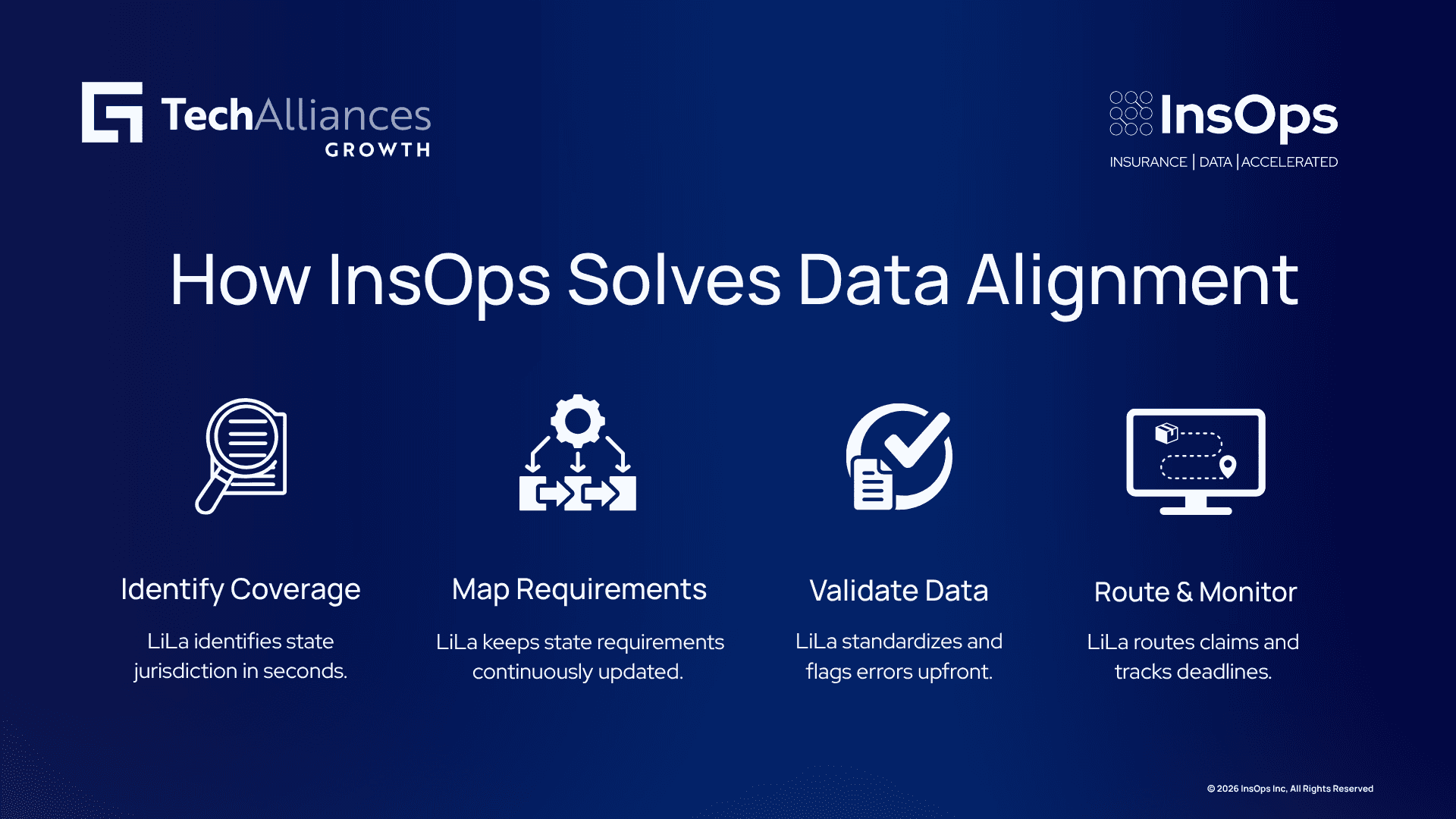
Step 1: Identify State Coverage Needs: LiLa analyzes the claim intake and automatically identifies which states have jurisdiction based on injury location, employee residence, and employer domicile. It flags monopolistic states (Washington, Ohio, North Dakota, Wyoming) that require separate state fund coverage. Unlike manual TPA processes, this happens in seconds, not hours.
Step 2: Map State-Specific Requirements: LiLa accesses continuously-updated profiles of each state's forms, deadlines, benefit structures, classification codes, and fee schedules. Traditional TPAs maintain these manually in spreadsheets and update them reactively when states issue changes. InsOps updates automatically, so you're never working with outdated requirements.
Step 3: Standardize and Validate Claim Data: LiLa converts incoming claim data into a standardized format and runs validation checks against each state's schema in real time. It flags mismatches for human review before filing. TPAs do this after rejection, creating delays and reprocessing work. InsOps catches errors upfront.
Step 4: Route to Correct State System: LiLa determines primary jurisdiction and routes the claim to the correct state system with the state-specific form, deadline, and schema. The Integration Gateway connects directly to Guidewire and major platforms, eliminating manual filing. Most TPAs require adjusters to manually select the state and fill forms.
Step 5: Monitor and Alert: LiLa tracks filing deadlines, monitors acceptance/rejection status, and flags regulatory changes. A human validates every mapping before deployment, ensuring accuracy without the bottleneck of manual oversight.
Why LiLa is the better option: Speed (claim moves through alignment in minutes, not days), accuracy (human-in-the-loop catches errors before filing, not after rejection), scale (handles regulatory updates automatically across all states), and focus (your team investigates claims instead of wrestling with forms).
Audit Your Own Multi-State Workflow
Use this diagnostic tool to assess whether your current operation has data alignment gaps.
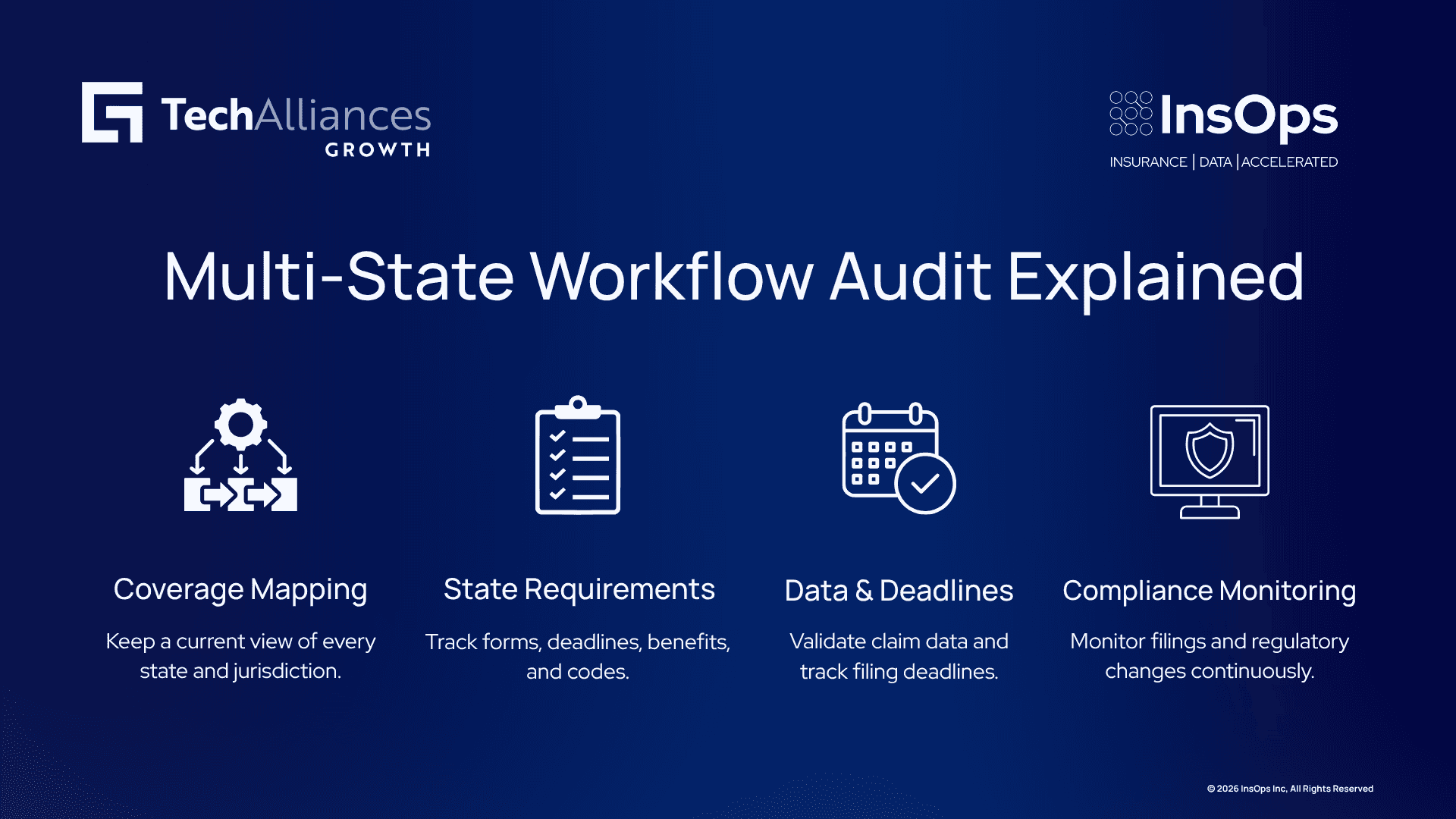
Coverage Mapping: Do you have a documented list of all states where you have employees, operations, or potential jurisdiction? Is it current? When was it last updated?
State Requirements Documentation: Do you maintain a profile of form versions, filing deadlines, benefit structures, and codes for each state? Is it updated quarterly or when states issue changes?
Data Validation Process: Before filing claims, do you verify that claim data matches each state's schema? Or do you file first and fix rejections after?
Deadline Tracking: Do you have a centralized calendar tracking all filing deadlines for all states and claim types (FROI, SROI, medical reports)? Or are these tracked manually by individual adjusters?
Compliance Monitoring: After filing, do you monitor for acceptance or rejection? Do you track whether subsequent filings are meeting state-specific deadlines?
Regulatory Monitoring: Who monitors state legislative and regulatory changes for each state you operate in? How often do they update your processes?
If you answer "no" or "not sure" to more than two questions, data alignment is likely a gap in your operation.
Conclusion: AI is the Clear Path Forward to Fixing Data Alignment Issues
InsOps builds an insurance-trained AI that assists with data mapping and transformation across insurance systems. LiLa, our insurance-trained LLM, understands insurance domain logic, state-specific requirements, and claim data relationships in a way that generic AI models don't.
Our Integration Gateway connects directly to Guidewire systems (PolicyCenter, ClaimCenter, BillingCenter, UnderwritingCenter) and automatically maps claim data from incoming sources into Guidewire schemas. A person reviews and validates every mapping before deployment.
In multi-state workers' comp operations, claim data flows through multiple jurisdictions. Our Integration Gateway assists by standardizing claim data across state systems, validating it against each state's requirements, and ensuring it flows into Guidewire without custom engineering. Because LiLa runs inside your own environment, PII and PHI never leave your controlled infrastructure. This is critical in workers' comp, where claim data includes medical records and wage information.
InsOps migrates legacy data into Guidewire and keeps it flowing in real time.
If you are evaluating how to standardize claim data across multiple states without rebuilding your processes, contact us to talk through what this could look like for your operation.
Frequently Asked Questions
What exactly is data alignment in workers' compensation?
Data alignment means standardizing claim information across multiple state jurisdictions so that one claim can flow through different state systems without errors or rejections. Each state has different forms, filing deadlines, and claim classification codes. Data alignment translates claim information into formats each state requires.
Why does data alignment matter for multi-state employers?
Without data alignment, forms get rejected, deadlines get missed, and compliance audits surface errors. Each rejection delays benefits to injured employees, creates reprocessing work, and can prejudice claims, shifting liability to the employer. Poor data alignment also inflates claim reserves, which affects your Experience Modification Factor (E-Mod) calculation.
How do I know if my operation has a data alignment problem?
Use the diagnostic checklist in the audit section. If you answer "no" or "unsure" to more than two questions (e.g., Do you validate claim data before filing? Do you track all state deadlines centrally?), you likely have gaps. Another indicator: claims are rejected for form or data mismatches, or you miss state filing deadlines.
What are the main compliance risks of poor data alignment?
Three main risks: (1) Rejected filings delay benefits and create reprocessing work, (2) State audits surface compliance violations and result in penalties and mandatory repayment, (3) Misaligned data inflates claim reserves, affecting your E-Mod and next year's premiums.
How long does it take to audit my multi-state workflow for data alignment gaps?
The diagnostic checklist takes 30–60 minutes to complete with your current team. Identifying root causes and gaps typically takes one to two weeks if you have a dedicated compliance person. Fixing gaps depends on your current infrastructure and scale.
What's the relationship between data alignment and Experience Modification Factor (E-Mod)?
Your E-Mod is calculated by NCCI based on your claim history and payroll data reported to rating bureaus in each state. Misaligned claim data inflates reserves, making claims appear more expensive than they are, which increases your E-Mod. Accurate data alignment ensures your E-Mod reflects your actual claims experience.