

Marketplace and platform underwriting, where Tier 1 carriers expand writing capacity by onboarding partners like Turo, Amazon Lending, and Certainly, is becoming table stakes for competitive carriers. But scaling it hits a single constraint: data integration engineering.
Each partner sends data in a proprietary structure. Each core system instance expects a different schema. Engineering teams must manually map every field, test every scenario, and validate every integration before go-live. That's 3–6 months per partner, and it compounds with each new partnership.
This article explains why partner onboarding takes so long, how modern solutions break the bottleneck, and how to accelerate onboarding from months to weeks without introducing new risk.
Why Marketplace and Platform Underwriting Matters Now
The Economics of Partnership Models
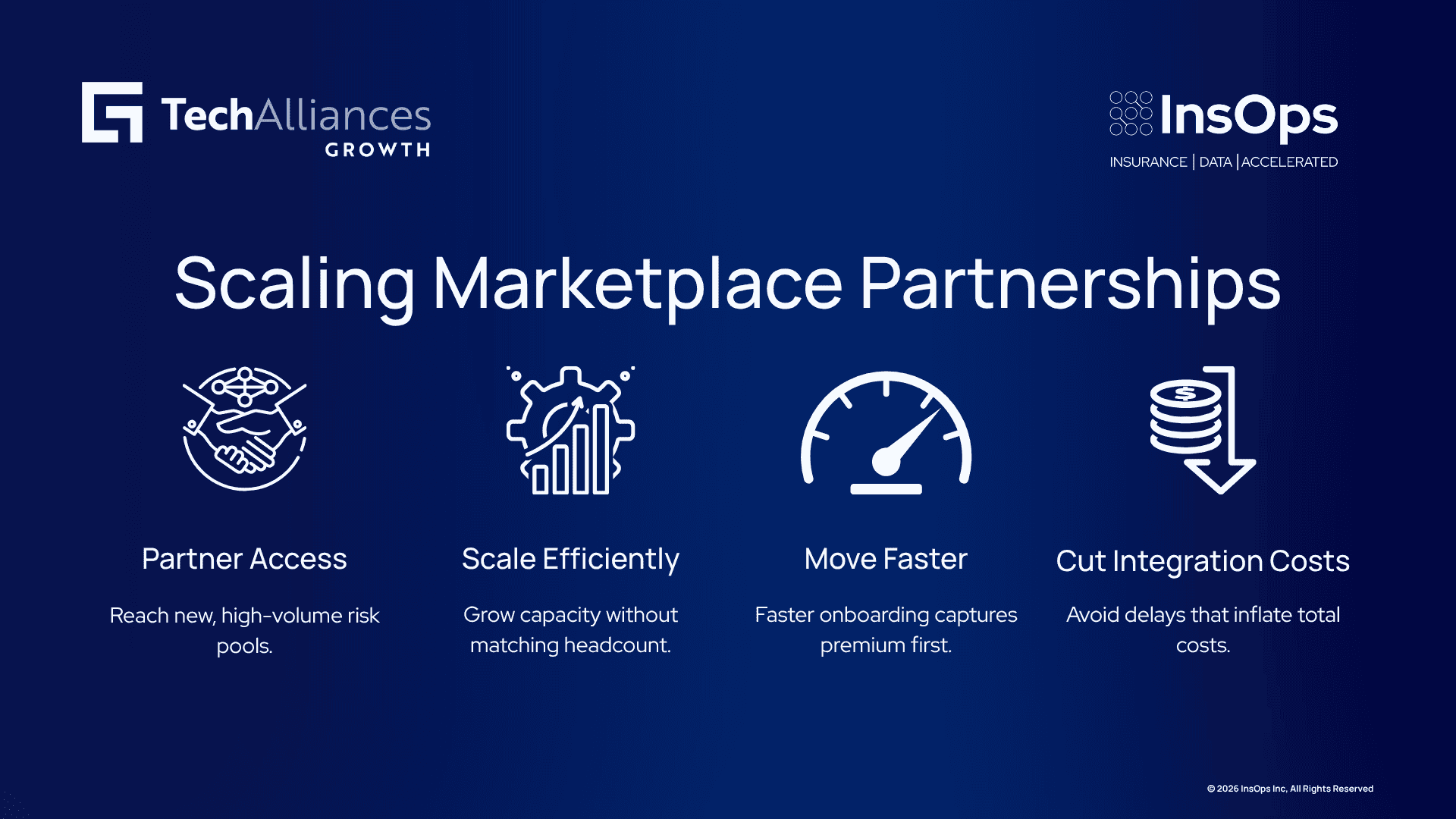
Non-standard risk is growing faster than traditional lines. Marketplace and platform partners give you access to risk pools you couldn't reach before. A partnership with Turo expands your peer-to-peer auto exposure. Amazon Lending gives you SMB commercial risk. Certainly brings specialty homeowner volume. Each partnership is high-margin, high-volume business.
Partnership underwriting means higher writing capacity without proportional headcount increase. You leverage the partner's risk evaluation and distribution; you handle underwriting and claims. The capital and operational footprint scale more efficiently than traditional underwriting teams.
The Scaling Imperative
Carriers with 1–2 active partnerships are losing ground to competitors with 5–10. Each new partner accelerates growth. The question shifts from "Can we onboard this partner?" to "How fast can we do it?"
Speed is competitive. If it takes you 6 months to onboard a partner and your competitor does it in 6 weeks, they capture that premium volume first. First-mover advantage in partnership models is real.
The Hidden Cost of Slow Onboarding
Delays cost money. Every month a partnership sits in engineering limbo is premium not written, opportunity cost of engineering effort diverted from other projects, and competitive risk.
When integration timelines exceed expectations, total cost of ownership balloons. Carriers that accept 180-day integration timelines find their TCO runs 40–60% higher than planned. The issue is not whether to onboard partners. The issue is how to scale onboarding without adding headcount or delaying core system work.
The Three-Part Bottleneck: Why 3–6 Months?
Data Structure Mismatch
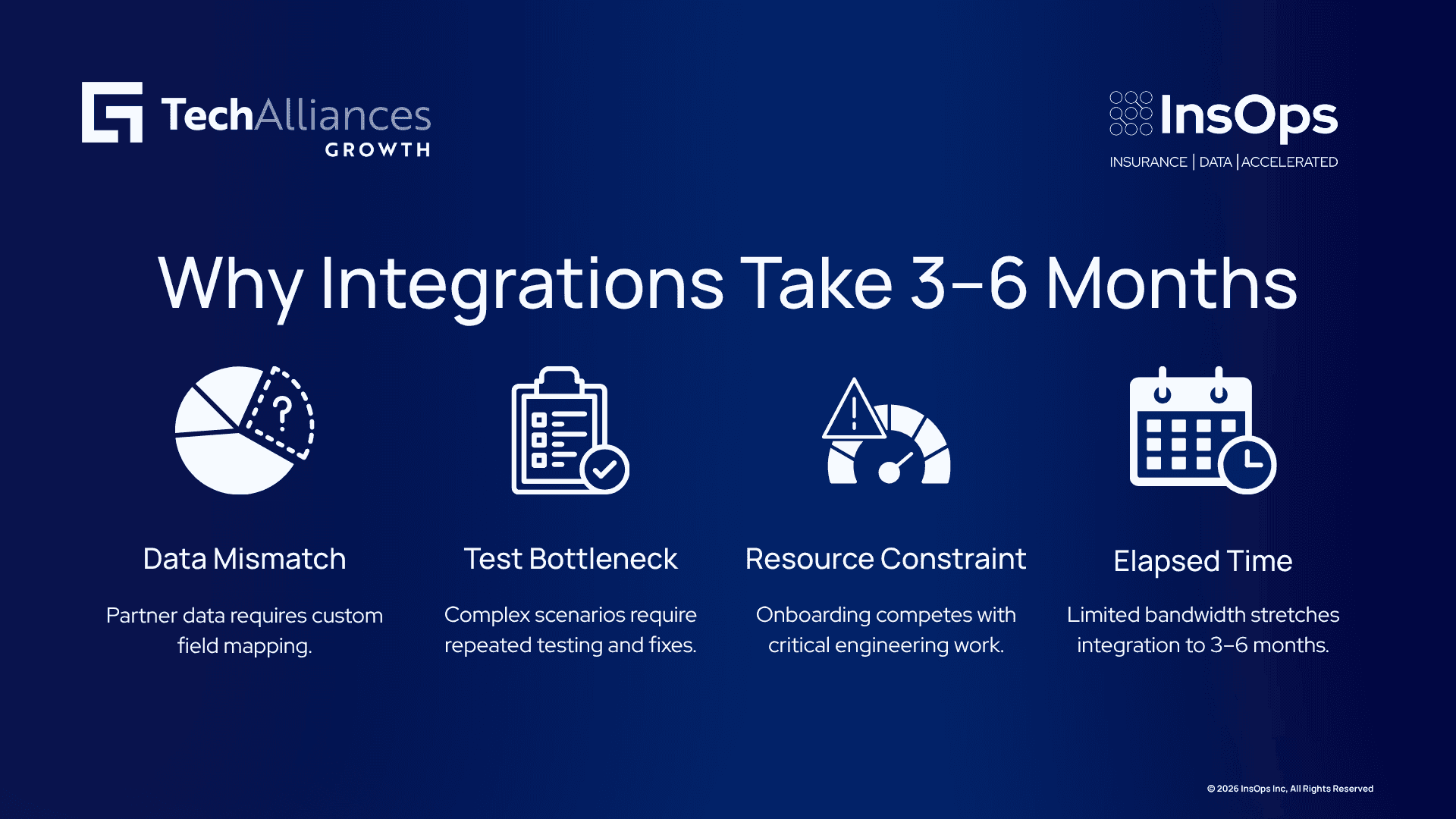
Each partner sends data in a different structure. Turo includes vehicle-specific fields (mileage, value at quote, driver safety rating). Amazon Lending includes business metrics (revenue, years in operation, employee count). Your Guidewire PolicyCenter expects specific field mappings for UnderwritingCenter and BillingCenter.
ACORD is the industry standard for insurance data, but every carrier implements it differently. A field mandatory in one carrier's Guidewire instance is optional in another. Mapping one partner's data to your Guidewire schema is not a copy operation. It requires understanding the insurance domain logic, the data relationships, and the regulatory requirements that govern each field.
For the first partner, this mapping analysis, documentation, and configuration typically takes 4–8 weeks.
Testing and Validation Bottleneck
After mapping is configured, integration must be tested. What if a policy has no vehicle? What if a borrower has no business history? What if a partner sends a duplicate record or a field is missing? Each scenario creates a test case. Each failed test triggers a feedback loop: identify the error, update the mapping, retest, validate.
Testing phase runs 4–8 weeks for the first partner, depending on data quality and schema complexity. A second partner undergoes the same testing rigor. Knowledge from the first partnership doesn't automatically transfer.
Competing Priorities and Resource Constraints
Integration engineering doesn't happen in isolation. Your team is managing bug fixes, security patches, regulatory compliance work, and core system maintenance. Partner onboarding competes for engineering bandwidth.
A carrier supporting 5–10 partnerships has limited engineering resources. Partner onboarding work slips on the roadmap. Calendar time exceeds technical time. The result: 3–6 months of elapsed time, but only 8–16 weeks of actual engineering work, spread across other priorities.
How AI-Powered Mapping Breaks the Bottleneck
Modern solutions break the bottleneck at the data mapping stage. Instead of manual schema mapping per partner, an insurance-trained AI analyzes partner data structures, suggests Guidewire mappings, learns from corrections, and validates every mapping before deployment. A person reviews every decision.
Auto-Mapping: The Intelligence Layer
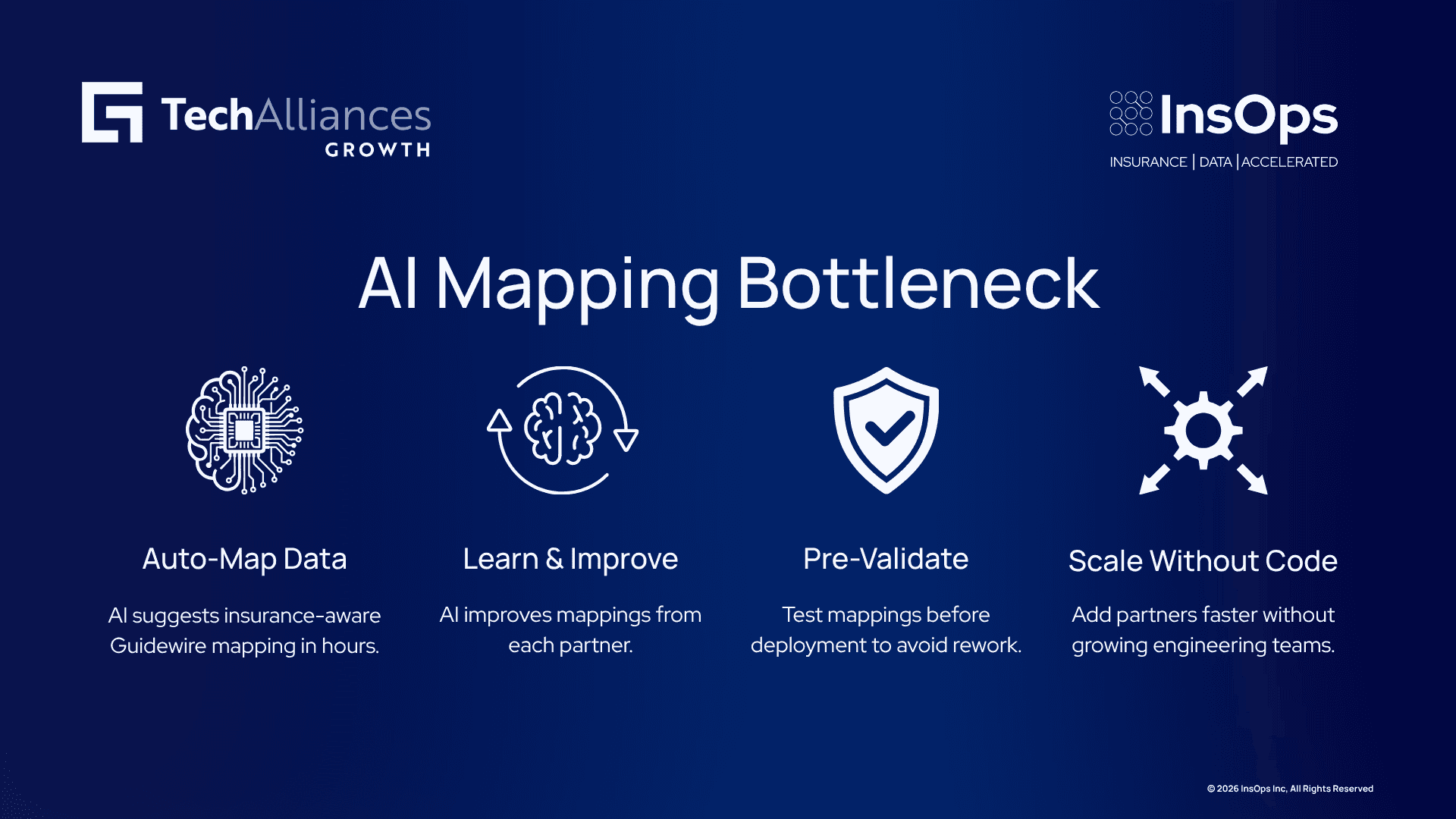
Insurance-trained AI like LiLa understands the domain: insurance entities (insured, risk, vehicle, claims history), relationships, and regulatory requirements. It analyzes a partner's payload structure and suggests Guidewire schema mappings in hours instead of weeks.
For example, the model recognizes that vehicle_value_at_quote should map to covered_auto_vehicle_value, and that this mapping requires respecting underwriting logic and compliance requirements across multiple Guidewire modules. Traditional schema mapping tools treat this as generic data translation. Insurance-trained AI treats it as a domain problem.
Learning from Corrections: The Efficiency Multiplier
When a person validates a mapping and identifies an error—"this field should be excluded," "this needs a unit conversion," "this requires a compliance check"—the model learns that correction.
On the second partner, the model applies those learned corrections to similar fields. On the third, fourth, and fifth partner, improvements compound. The model requires fewer corrections because it learned from prior partnerships. Traditional approaches restart with each partner. No knowledge transfers.
Pre-Validation Before Deployment: Eliminating Rework Cycles
Traditional integration tests mappings in production or staging. Errors surface after deployment, causing rollbacks and rework that add 4–8 weeks to the timeline.
AI-assisted mapping validates against Guidewire schema and tests on historical partner data before go-live. A person reviews every validation. The result: confidence before deployment, no surprise mismatches in production, faster time to business value.
No Code Per Partner: Scaling Without Engineering Overhead
Once the mapping is validated, data flows without custom connectors, webhooks, or ongoing engineering maintenance. A fifth partner doesn't require a new developer or contractor.
Scaling from 1 partner to 5 to 10 doesn't multiply headcount. Compare the timelines. Traditional approach: 3–6 months per partner × 5 partners equals 15–30 months of elapsed time, plus ongoing maintenance work. AI-assisted approach: 4–8 weeks for the first partner, 1–3 weeks for each subsequent partner. Five partners in total: 8–15 weeks. The engineering team doesn't grow. The capability does.
The Financial Impact
Timeline Compression
Traditional model: 3–6 months per partner. Onboarding five partners takes 15–30 months.
AI-assisted model: 4–8 weeks for the first partner, 1–3 weeks per subsequent partner. The same five partners can be onboarded in 8–15 weeks, depending on data quality and schema complexity.
The financial impact is immediate. Each month of integration delay costs you premium revenue not written, competitive position lost to faster-moving competitors, and engineering capacity diverted from strategic work. Premium economics improve significantly when onboarding moves from months to weeks.
Cost Per Partner
Traditional approach: $50K–$150K per partner in engineering costs, testing, validation, and documentation.
Platform-based approach: First partner includes platform cost; marginal cost for each subsequent partner approaches zero.
Five-partner scenario: Traditional engineering costs total $250K–$750K. Platform approach requires initial platform investment but near-zero marginal cost per additional partner. The economics improve as your partnership portfolio grows.
Engineering Resource Reallocation
Engineering team, traditionally: 1–2 FTE per partnership, tied up in integration work for 3–6 months.
With AI-assisted mapping: Same team is reallocated to strategic initiatives. New underwriting rules. Claims automation. Fraud detection. Innovation work that differentiates your platform.
Indirect benefit: Reduced technical debt from rushed integration work. Faster time to market for other capabilities. Engineering capacity becomes a growth lever, not a constraint.
Guidewire-Specific Considerations
PolicyCenter and UnderwritingCenter Integration Complexity
Guidewire PolicyCenter is the underwriting and policy entry point; UnderwritingCenter is the underwriter workbench. Partner data must map to PolicyCenter submission intake, approval workflows, and rating engines.
Each Guidewire instance has custom rules, appetite logic, and data validation that differ from carrier to carrier. Scaling partner onboarding requires automating the mapping without losing domain logic.
The bottleneck is not Guidewire itself. It's the manual schema mapping between partner data formats and Guidewire's expected structure, repeated for each partner and each instance.
What to Look for in a Solution
When evaluating solutions for partner onboarding at scale, prioritize:
Pre-built Guidewire connectors for PolicyCenter, UnderwritingCenter, BillingCenter, and related modules. AI that understands insurance domain logic, not generic data mapping. Human-in-the-loop validation: a person reviews every mapping before it flows into production. Data stays in your environment; no third-party exposure or data residency risk. Integration that works with your existing Guidewire instance without custom modules or forking.
Solutions that treat this as an engineering problem will always be constrained by your engineering capacity. Solutions that treat this as a domain problem can scale without proportional headcount increase.
How InsOps Helps
Marketplace and platform partnerships are no longer optional for competitive Tier 1 carriers. The constraint is not the opportunity; it's the speed and cost of onboarding. Engineering bottlenecks in data mapping don't have to define your scaling capacity.
Modern solutions, specifically insurance-trained AI with human-in-the-loop validation, break the 3–6 month cycle and unlock the ability to scale partnerships without proportional engineering overhead. The result is faster premium capture, better capital efficiency, and engineering capacity redirected to strategic initiatives that differentiate your business.
InsOps builds an insurance-trained AI that assists with data mapping and integration. Our Integration Gateway connects to Guidewire PolicyCenter, ClaimCenter, BillingCenter, UnderwritingCenter, PricingCenter, and Quoting Services, automating the mapping of partner data payloads into your Guidewire schema without custom connectors per partner.
Our AI analyzes partner data structures, suggests schema mappings, and learns from corrections. A person reviews and validates every mapping before it flows into your system. This combination of AI speed and human judgment eliminates both manual tedium and the risk of algorithmic blind spots.
Our platform runs inside your environment, so partner data never leaves your controlled infrastructure. Our AI understands insurance domain logic, data relationships, and regulatory requirements (NAIC, HIPAA, GDPR) in ways generic LLMs cannot. Your Guidewire instance stays stable. You onboard partners in weeks instead of months. Your engineering team focuses on strategic work, not custom integration maintenance.
If you're evaluating how to scale marketplace partnerships without custom engineering per partner, contact us to discuss what this could look like for your operation.
Frequently Asked Questions
What exactly is marketplace and platform underwriting?
It's a distribution model where Tier 1 carriers partner with marketplace platforms (Turo for peer-to-peer auto, Amazon Lending for SMB commercial) or specialized underwriting platforms to expand writing capacity into non-standard risk pools. The carrier retains underwriting authority and risk; the platform provides distribution and risk evaluation support.
Why does this matter for my underwriting operations?
Partnership underwriting allows you to scale without proportional headcount increase and enter new risk pools that competitors are also pursuing. The constraint is not whether to do it; the constraint is speed and cost of onboarding new partners. Faster onboarding means faster premium capture.
What's involved in onboarding a new marketplace partner?
Typically three stages. Data structure analysis and schema mapping takes 4–8 weeks. Integration testing and validation takes 4–8 weeks. Compliance review and go-live prep takes 2–4 weeks. The first partner takes longest; subsequent partners reuse mapping logic, reducing time to 1–3 weeks each. Exact timeline depends on data quality, schema complexity, and your team's validation capacity.
What's the biggest bottleneck in partner onboarding?
Data mapping. Each partner structures data differently; each Guidewire instance expects different schema. Manual mapping is tedious, error-prone, and doesn't transfer knowledge to the next partner. This is where AI-powered mapping delivers the most value, and where delays typically occur.
How do I know if partner onboarding is working?
Track time from partnership agreement to first premium written. Track integration engineering FTE hours per partner. Track rework cycles during testing. Track cost per partner. Successful implementations see significant reduction in time and cost per partner after the first onboarding; the extent depends on solution architecture and team expertise.
How does AI-assisted data mapping work, and how is it different from manual mapping?
Manual mapping is human-intensive, takes weeks per partner, and restarts with each new partnership. AI-assisted mapping analyzes partner data structures, suggests Guidewire schema mappings, learns from corrections, and validates mappings before deployment. A person reviews every mapping. The result: faster iteration, knowledge carryover to subsequent partners, and higher confidence before go-live.
How long does it actually take to see results?
AI-assisted approaches can accelerate first partner onboarding to 4–8 weeks, with subsequent partners onboarding in 1–3 weeks each. Actual timeline depends on data quality, schema complexity, and your team's capacity for validation. Premium starts flowing once integration is validated and go-live approval is granted.
What about compliance and data security with partner integrations?
The solution runs inside your environment; partner data never leaves your controlled infrastructure. Every mapping is validated by a person before deployment. Compliance (NAIC, HIPAA, GDPR) is baked into the domain logic, so regulatory requirements are respected by default, not bolted on afterward.