

When a claims leader notices that incomplete intake data keeps forcing re-contacts, reserve corrections, and reopened files, the pattern is not random. Each gap traces back to the same moment: first notice of loss.
A missing field at FNOL does not disappear. It resurfaces weeks later as a callback, a wrong reserve, or a line in a claims file that opposing counsel reads differently than the adjuster who wrote it. This article walks through how a data gap at intake becomes litigation exposure, which fields and moments matter most, and where a person still has to review the result before anything moves forward.
What Counts as Incomplete FNOL Data
Incomplete FNOL data is not limited to a blank field on a form. It includes information that arrived but was never captured in a structured, usable way: a detail mentioned on a phone call and never logged, a photo attached to an email that never got linked to the claim record, a policy number read aloud and mistyped.
Every piece of missing intake data has to be re-collected later, at cost, with delay, and often with friction for the person who already gave that information once.
Structured digital channels catch some of this by requiring fields before submission. Phone intake catches almost none of it unless the agent follows a strict script every time, on every call, regardless of volume.
How a Data Gap Becomes a Litigation Problem
The path from a missing field to a legal exposure point runs through three linked stages, not one dramatic failure.
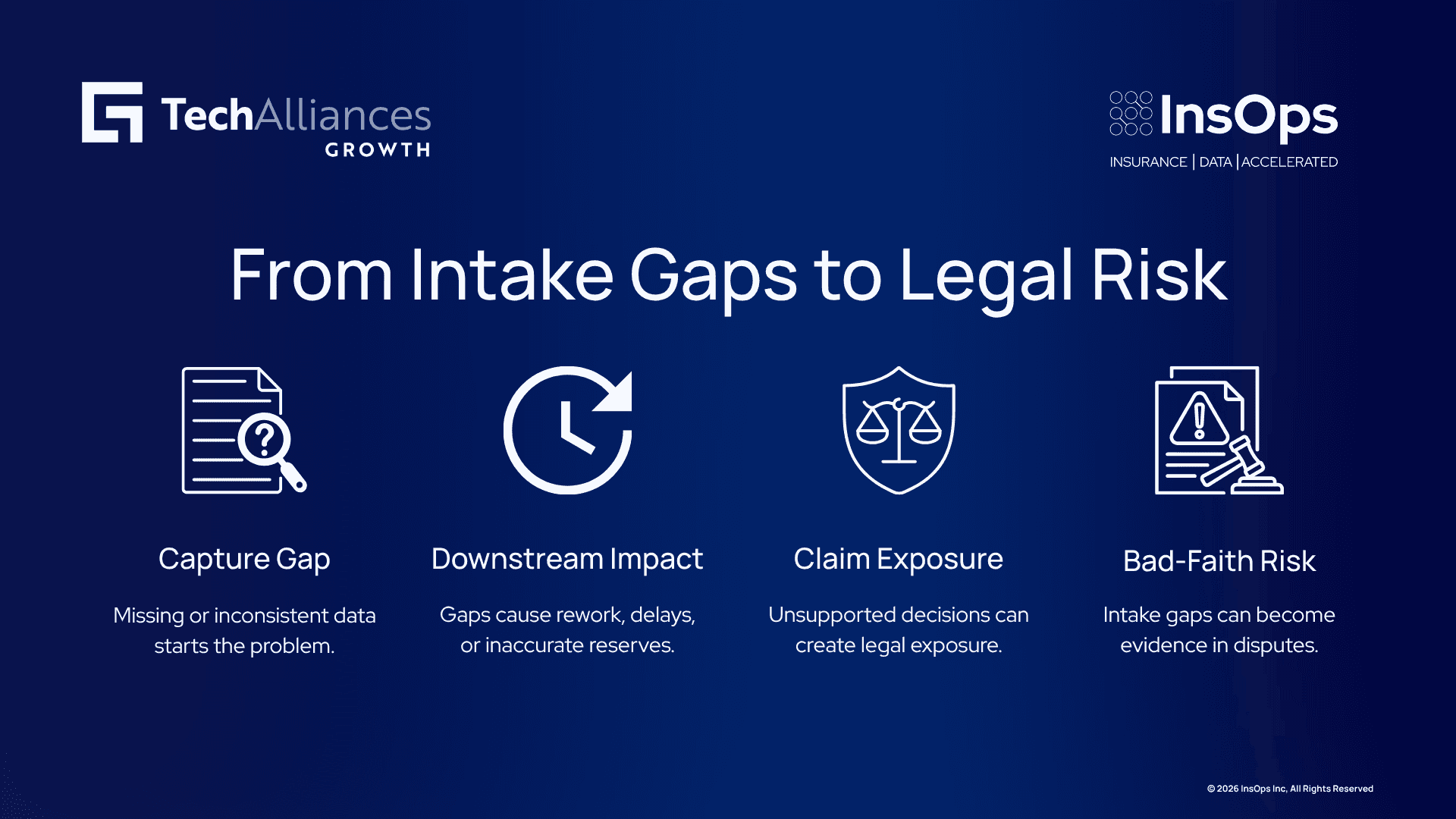
Capture gap. A required field is missing or inconsistent at first notice of loss. This happens most often on phone and email channels, where structure depends on the person capturing the data rather than the form itself.
Downstream compounding. The gap forces a re-contact call, delays the start of investigation, or produces an inaccurate initial reserve. A claim with an incomplete intake record is routinely reopened for supplemental information, which is itself one of the most expensive FNOL failure modes because it consumes intake resources twice.
Exposure point. A delayed or unsupported claim decision becomes part of the claims file, and claims files are discoverable. Failure to acknowledge a notice of loss promptly has been used as evidence of bad-faith claims handling in multiple jurisdictions. The gap that started as a missing phone number ends up read back to the insurer in a deposition. This same pattern of buried risk signals shows up again later in the claim lifecycle, not just at intake.
The Fields and Moments That Matter Most
Not every field carries equal weight. Four intake-stage metrics show where the risk actually concentrates.
Metric | What it measures | Why it matters for litigation risk |
|---|---|---|
Time to acknowledgment | How fast the claimant is told their notice was received | Delayed acknowledgment is treated as evidence of poor-faith handling in some jurisdictions |
Classification accuracy | Whether the claim was routed and reserved correctly the first time | Misclassification creates a reserve error and a process error that surfaces later |
Intake completeness rate | The share of FNOL records with every mandatory field filled | Low completeness signals a channel or training gap, not a one-off mistake |
Re-open rate | How often a claim gets reopened for missing information after investigation starts | The most expensive failure mode, since it means the file was worked twice |
Litigation rate itself is tracked as a named claims-operations KPI alongside cycle time, leakage rate, and reopened claim rate. Treating litigation rate as something to monitor, not just something to defend against after a suit is filed, is what connects intake quality to legal exposure directly instead of treating them as separate problems.
Documentation as Your Legal Record, Not Just an Operational One
A claims file is not just a working document for the adjuster. It is the record that gets read back in a dispute, a regulatory inquiry, or a bad-faith allegation.
Contemporaneous notes, written at the time an action happens, are far more credible in a dispute than notes reconstructed hours or days later. A complete audit trail, timestamped from FNOL to closure, is the adjuster's primary protection when a claim is challenged.
Incomplete intake data breaks this chain at the earliest possible point. If the file cannot show what was known and when, it cannot show that the claim was handled reasonably, regardless of how the rest of the file was managed.
Where Automation Fits, and Where a Person Still Has To
Structured intake with field validation can catch a missing field the moment it goes unfilled, before the claim ever moves downstream. That is a mechanical check, not a judgment call, and it works the same way every time regardless of call volume or agent experience.
Flagging a gap is different from deciding what to do about it. Whether a missing field changes the claim's classification, reserve, or urgency is a judgment an adjuster makes, not something a system resolves on its own. The value of catching the gap early is that it reaches a person's desk sooner, with the specific missing piece already identified, instead of surfacing weeks later as a reopened file.
How InsOps Helps
InsOps builds an insurance-trained AI that assists with intake data validation. LiLa, our insurance-trained LLM, checks incoming FNOL data against the fields a claim actually needs, and flags what is missing or inconsistent for a person to review before the claim moves forward. LiLa runs inside your own environment, so PII and PHI never leave controlled infrastructure.
Our Integration Gateway connects to Guidewire ClaimCenter, so flagged intake data flows directly into your existing claims workflow without custom engineering.
If you are evaluating how to reduce the downstream cost of incomplete intake without adding new tools your team has to learn from scratch, contact us to talk through what this could look like for your operation.
Frequently Asked Questions
What is FNOL in insurance?
First Notice of Loss is the formal term for the initial report a policyholder or claimant makes to notify an insurer that a covered loss has occurred. It is the trigger point for the entire claims process.
Why does incomplete FNOL data matter?
Every missing field has to be re-collected later, at cost and with delay. That re-collection is what drives the re-contact calls, reserve corrections, and reopened files described above.
How does incomplete claim data increase litigation risk?
A capture gap at intake delays investigation or produces an inaccurate reserve. Because claims files are discoverable, that same delay or inaccuracy is what a claimant's attorney points to when arguing the insurer handled the file unreasonably.
What specific FNOL fields matter most for avoiding bad-faith litigation risk?
Time to acknowledgment, classification accuracy, intake completeness rate, and re-open rate are the four intake-stage metrics most directly tied to downstream legal exposure, since each one reflects whether the file can show it was handled promptly and correctly from the start.
What is a re-open rate and why does it matter?
Re-open rate tracks how often supplemental information has to be collected after investigation already started. A high rate points to a specific channel or training gap upstream, usually the same gap driving the re-contact and reserve problems described above.
How do insurers connect data quality metrics to litigation rate as a KPI?
Instead of treating legal exposure as a separate, after-the-fact concern, claims operations put litigation rate on the same dashboard as the intake metrics that feed it, so a rise in one prompts a look at the others.
Can better intake tooling actually lower litigation rate?
Structured intake with field validation catches missing information at the point of capture, before it can compound into a delayed investigation or an inaccurate reserve. Whether that reduces litigation rate at a given insurer depends on how consistently the flagged gaps get reviewed and resolved by adjusters.
How does InsOps help with FNOL data quality?
LiLa checks incoming intake data against required fields and flags gaps for a person to review before the claim moves forward, with the review happening inside the insurer's own environment so sensitive data never leaves controlled infrastructure.