

When a claims operations lead is ready to build or evaluate a validation layer that catches incomplete intake before a claim reaches an adjuster, the first real question isn't whether to build one. It's what the system should actually check, and what it should leave alone.
This article walks through the specific checks a validation layer should run, where flagging ends and adjuster judgment begins, and how a well-designed flag should reach a person's desk so it speeds up the file instead of just adding another alert to ignore.
What a Validation System Should Actually Check
A claims intake validation system runs a defined set of checks against every incoming file before it moves forward. The claim clears completeness checks, a policy match, and a duplicate check before it advances to anyone's queue.
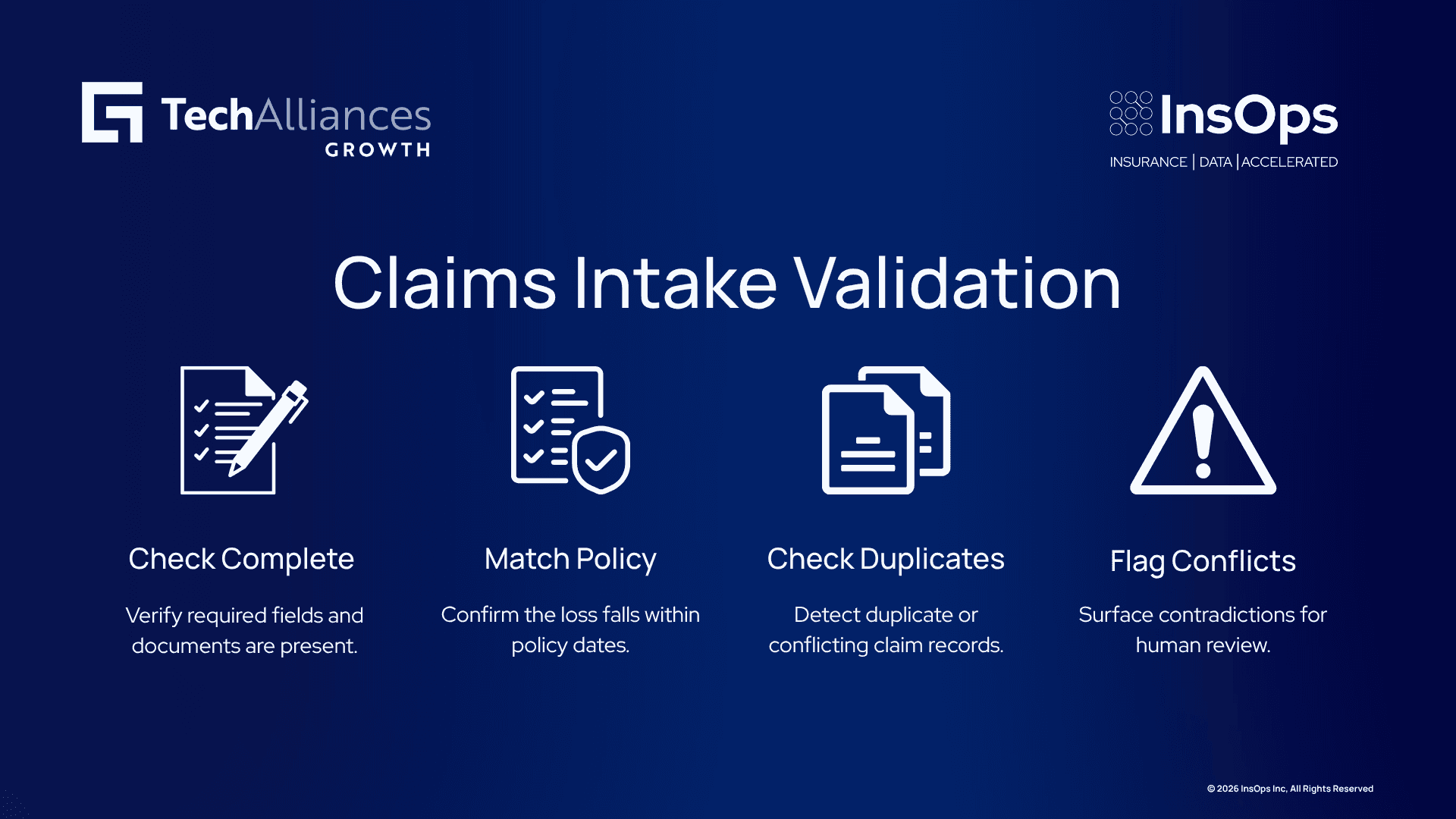
Those checks operate on structure, not judgment. Required fields, document dates, whether the loss date falls inside the policy period, and whether two documents contradict each other are the kind of things a rules engine can confirm without interpreting anything.
That distinction matters for how you design the system. A completeness check either passes or fails. A contradiction between two documents gets flagged for a person to interpret, not resolved by the system guessing which document is right.
How Validation Fits Into the Larger Intake Pipeline
Validation is one stage in a longer chain, not a standalone tool bolted onto the front of claims handling. Intake ingests the submission, classification labels each document, validation confirms the file is complete and consistent, and adjudication tests eligibility against policy terms once validation clears.
Clean cases that pass every stage can move to straight-through resolution without a person touching them. Cases that fail a check at any point route to exception handling, where a reviewer picks up the file with a summary of what tripped and why.
Pipeline stage | What it does |
|---|---|
Intake | Accepts the submission across whatever channel it arrived on |
Classification | Identifies and labels each document type |
Validation | Confirms completeness, consistency, and policy match |
Adjudication | Tests eligibility and confirms benefits against policy terms |
Exception handling | Routes flagged or incomplete cases to a reviewer with context attached |
Seeing validation as one link in this chain changes how you scope it. A validation layer built in isolation, disconnected from classification on one side and exception handling on the other, ends up duplicating checks or missing the handoff that makes a flag actionable in the first place.
Where Validation Ends and Adjuster Judgment Begins
The clearest way to describe this boundary: the system may capture, verify, extract, validate, classify, route, and inform. It may not decide coverage, liability, or payout.
Call this the flag-then-judge model. The system's job is the mechanical check, applied the same way to every file regardless of volume. A required field is either present or it isn't. A policy number either matches a record or it doesn't.
What the system doesn't do is decide what a gap means for the claim. Whether a missing document changes classification, whether a date discrepancy signals a real problem or a typo, whether the file needs a senior adjuster, those are judgment calls that stay with the person reviewing the flag.
What Happens When a Contradiction Shows Up, Not Just a Blank Field
A blank field is the easy case. A contradiction between two documents is the harder one, and it's where a validation system's design actually gets tested.
In one documented example, a repair estimate dated before the reported loss date triggers a conflict flag. The system stops there. It doesn't confront the claimant, and it doesn't pick which document to believe. The file routes to review with the contradiction documented.
That routing choice is deliberate. A system that tried to resolve the contradiction on its own would be making a judgment call it isn't built to make. Flagging the conflict and stepping back is the correct behavior, even though it's the less impressive-sounding one.
Why the Audit Trail Matters as Much as the Flag
A flag that isn't logged is a flag that can't be defended later. Every extraction, rule, and decision a validation system runs should be logged and replayable, since a regulator or internal examiner may eventually ask how a specific claim was handled.
That requirement shapes a few concrete design choices. Claim creation should be idempotent, so a claimant who reports the same loss twice on two channels doesn't produce two competing records. Every check the system runs should be logged with its inputs and outputs, and deterministic steps, like a policy-period or duplicate-claim check, should stay deterministic rather than left to a model's judgment call.
There's a regulatory backdrop to this too. Insurance regulators increasingly expect a written governance program for AI systems that support decisions in regulated claims practices, covering how the system is tested, monitored, and documented, whether the insurer built it or bought it from a vendor. A validation layer without a clean audit trail makes that kind of program much harder to demonstrate.
Designing the Flag So the Adjuster Can Act on It Fast
A flag is only useful if it saves the adjuster time instead of creating another thing to investigate from scratch. Flagged cases should route to a reviewer with the context already assembled, so the adjuster starts with a decision to make rather than a file to rebuild.
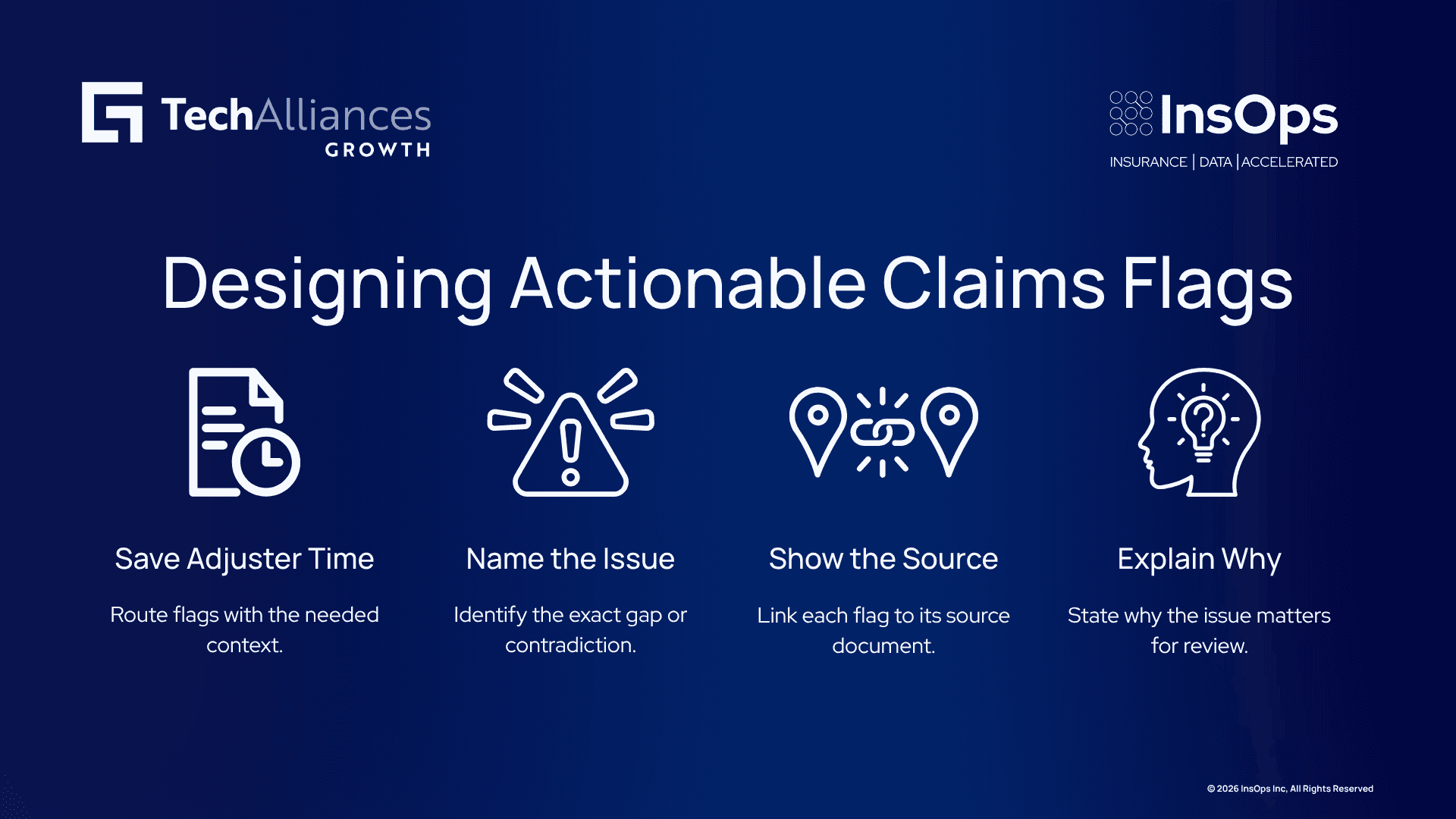
That means a well-designed flag names the specific missing field or the specific contradiction, points to the source document it came from, and states why it matters, not just that something looks off.
A system that says "review needed" without saying what to review pushes the work back onto the adjuster instead of removing it. The whole value of validation collapses if the flag itself has to be investigated before anyone can act on it.
The quality of that flag depends heavily on how the underlying checks are built. A purely manual process depends on whoever is reading the file that day, careful readers catch more, tired or rushed ones catch less, and neither approach scales predictably. Fixed, script-based checks run fast on templated inputs but tend to break the moment a document looks unfamiliar, kicking the whole file back to a person with no explanation attached.
A validation layer built to read context, not just match a template, is what makes it possible to name the specific gap instead of just rejecting anything that doesn't fit the expected shape. That's the difference between a flag that says "field 14 is missing" and one that says "review needed" with no further detail.
What Stays Out of Scope for a Validation Layer
A validation system checks structure. It does not set a reserve, determine coverage, or decide liability, and it shouldn't be designed to drift toward any of those, even as its checks get more sophisticated.
That boundary holds regardless of how confident a flag is. A high-confidence flag still goes to a person. The system's job ends at surfacing the gap clearly. Everything downstream of that, what the gap means and what to do about it, belongs to the adjuster.
How InsOps Helps
InsOps builds an insurance-trained AI that assists with intake data validation. LiLa, our insurance-trained LLM, checks incoming FNOL data against the fields a claim actually needs and flags what is missing or inconsistent, with a person reviewing every flag before the claim moves forward. LiLa runs inside your own environment, so PII and PHI never leave controlled infrastructure.
Our Integration Gateway connects to Guidewire ClaimCenter, so flagged intake data flows directly into your existing claims workflow without custom engineering.
If you are evaluating what a validation layer should check before it reaches your adjusters, contact us to talk through what this could look like for your operation.
Frequently Asked Questions
What does claims intake validation actually check?
A validation system runs completeness checks, a policy match, duplicate detection, and date-logic checks against every incoming file, confirming structure rather than interpreting content.
Does an intake validation system decide anything, or just flag?
It flags. The mechanical check is the system's job; deciding what a gap means for the claim's classification, reserve, or coverage stays with the person reviewing it.
What's the difference between validation and adjudication in claims?
Validation confirms that a claim file is complete and internally consistent. Adjudication tests eligibility and confirms benefits against policy terms. Validation happens first, and a claim only reaches adjudication once it clears those structural checks.
How does flagging missing information change what an adjuster sees first?
Instead of opening a file and discovering gaps on their own, the adjuster opens one where the missing piece is already named and sourced, turning the first few minutes into a decision instead of a hunt.
What happens when validation finds a contradiction instead of a blank field?
It routes to review rather than getting resolved automatically. Choosing between two conflicting documents is exactly the kind of judgment call a validation layer is built to hand off, not make itself.
Should validation rules run before or after policy verification?
Structural checks like malformed fields or a missing document typically run first, since a claim that can't be matched to a policy at all doesn't need further checking yet. Policy status and coverage-period checks follow once the basic structure of the file is confirmed.
How is intake validation different from full claims automation?
Validation is one stage inside a broader automation pipeline. Full claims automation can span classification, adjudication, and straight-through processing for clean cases; validation specifically covers the completeness and consistency checks a file passes through before it advances to the next stage.
How does InsOps help with claims intake validation?
LiLa checks incoming intake data against required fields and flags gaps or inconsistencies for a person to review before the claim moves forward, with the review happening inside the insurer's own environment so sensitive data never leaves controlled infrastructure.