

A claims operations lead hears the same suggestion in almost every planning meeting now: just use ChatGPT. It sounds like the fast, cheap way to speed up document review, triage, and correspondence.
The problem shows up the first time that tool touches a real claim file. Generic AI was never trained to read insurance-specific language, and it was never built to keep claims data inside your own environment.
This article walks through exactly what a general-purpose model misses in P&C claims work, gives you a concrete framework for testing any AI tool against those gaps, and explains where human review still has to sit in the process either way.
Why "Just Use ChatGPT" Doesn't Hold Up for P&C Claims
Generic AI models are trained on broad web data, so they often misread industry terms like loss runs, endorsements, or premium waivers that insurance-trained AI is built to understand.
That gap is not cosmetic. A model that misreads "loss run" as a generic financial term will misread the document behind it too, whether that's a subrogation demand, a reservation of rights letter, or a repair estimate.
Insurance-specific AI tools recognize this vocabulary because they train specifically on P&C data, not general internet text.
The Three-Gap Test for Generic AI in Claims
Before adopting any AI tool for claims work, check it against three gaps that keep showing up in generic AI deployments.
Gap | What to check | Why it matters |
|---|---|---|
Domain-language gap | Does it correctly parse insurance-specific terms and document types (loss runs, ACORD forms, reservation of rights letters)? | A model that misreads the term misreads the document behind it |
Data-residency gap | Does claims data (PII, PHI, policy details) leave your own environment to reach the model? | Claims files routinely contain regulated personal and health information |
Human-review gap | Does a person review the output before it's acted on, or does the tool act on its own? | Insurance decisions carry regulatory and customer-trust consequences that a model can't be accountable for |
Any AI tool that fails one of these three checks needs a closer look before it touches a real claim file, regardless of how capable it seems in a demo.
Where the Data-Residency Gap Shows Up in Claims Work
Claims data carries privacy rules that mean sensitive information should stay inside an insurer's own environment. That requirement is why vendors typically deploy insurance-trained AI inside the customer's own infrastructure, rather than routing claims data out to a third-party model.
A claim file can include a claimant's name, contact details, medical records, and financial information in a single document. Sending that file to a general-purpose AI tool means that data leaves your infrastructure and enters a system you don't control.
This is the specific gap to check first with any vendor: ask directly where the model runs and whether raw claims data ever leaves your environment to get an answer.
Why Human-in-the-Loop Still Matters, Even With a Domain-Trained Model
Domain training closes the language and reasoning gaps. It does not remove the need for a person to review the result before it's acted on.
Consumers themselves are cautious about this. According to Insurity's 2026 AI in Insurance Report, most surveyed consumers aren't ready to hand claims decisions fully to AI: just 22% would accept AI filing a claim on their behalf, and only 16% would trust it to renew or cancel a policy without a person involved.
That survey covered general insurance consumers, not claims professionals specifically. Still, it points to the same conclusion claims teams should already be operating on: AI can assist with a task, but a person should be the one who finalizes it.
A domain-trained model can draft a coverage summary, flag a discrepancy, or surface a related prior claim. Whether that output gets acted on should stay a human decision.
What to Check Before Choosing Any Claims AI Tool
Run any vendor through this short list before you commit a workflow to their tool.
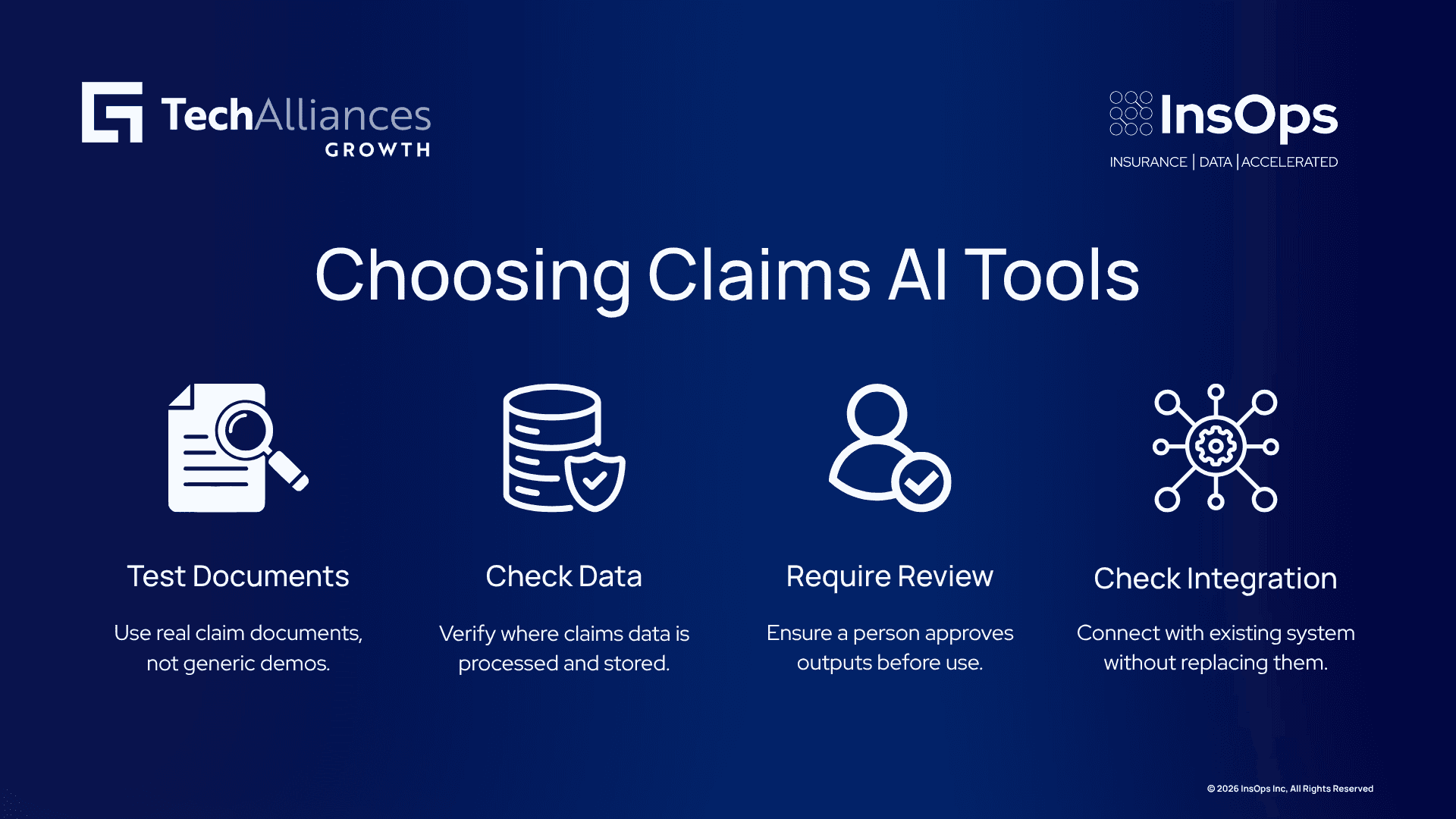
Ask for a specific example of how the model handles a document type you actually process, not a generic demo.
Confirm in writing where claims data is processed and whether it ever leaves your own environment.
Confirm a person reviews and approves the output before it's used, not after.
Ask whether adopting the tool requires replacing your existing claims system, such as Guidewire ClaimCenter, or whether it connects into what you already run.
On that last point: adopting a claims AI tool does not have to mean ripping out your core system. The more common pattern is a tool that connects into your existing claims platform rather than replacing it.
How InsOps Helps
InsOps builds an insurance-trained AI that assists with claims data tasks like extracting and validating information from documents. LiLa, our insurance-trained LLM, runs inside your own environment, so PII and PHI never leave controlled infrastructure.
A person reviews and validates every extraction or recommendation before it's finalized. LiLa does not file, approve, or resolve a claim on its own.
Our Integration Gateway connects to Guidewire ClaimCenter, PolicyCenter, BillingCenter, and other Guidewire systems, so claims data flows directly into your existing workflow without custom engineering or a system replacement.
If you are evaluating how to close the domain-language, data-residency, and human-review gaps in your claims process without taking on new compliance risk, contact us to talk through what this could look like for your operation.
Frequently Asked Questions
Should insurance companies use generic generative AI tools like ChatGPT?
For claims data specifically, generic tools carry two risks: misreading insurance-specific terminology and sending regulated data outside your own environment. Insurance-trained AI is built to close both gaps.
Does my data leave my environment?
It depends on the tool. Insurance-trained AI deployed inside your own infrastructure processes claims data without it leaving your controlled environment. Confirm this directly with any vendor before adopting their tool.
Why does generic AI fall short in insurance claims?
Generic models train on broad web data instead of insurance-specific documents, so they tend to misread the precise, industry-specific vocabulary a claim file depends on.
How is insurance-trained AI different from generic AI?
It's trained specifically on insurance-relevant data and document types, so it recognizes P&C terminology and document structures that a general-purpose model only encounters incidentally.
Why do claims need domain-trained AI instead of general AI?
Claims documents (medical records, repair estimates, police reports, coverage letters) each carry specific formats and terminology. A model trained on general text is more likely to misread that context than one trained specifically on it.
Does AI claims processing require replacing our Guidewire or Duck Creek core?
Not necessarily. Claims AI tools commonly connect into an existing platform like Guidewire ClaimCenter rather than replacing it, through direct system integration.
What does generic AI get wrong about insurance?
It's most likely to get insurance-specific terminology and document types wrong, since general-purpose training data only touches the industry's language incidentally rather than treating it as a specialized domain.