

Litigated claims cost roughly four times more than non-litigated claims. Extended medical treatment, longer indemnity periods, and legal costs all stack on top of one another once an attorney gets involved.
Most claims teams still treat litigation as something that happens to a claim, not something they can see coming. By the time a demand letter arrives, the window for a cheaper resolution has usually already closed.
For claims operations leaders, that timing gap is the real cost driver. It isn't that litigation itself is unpredictable, it's that the warning signs are already sitting in the file long before anyone acts on them.
This article lays out a 30 day, three phase structure for spotting litigation risk earlier and intervening before a claim escalates, using signals most claims teams already have on hand.
Why Litigation Risk Is a Timing Problem
Litigation doesn't appear out of nowhere. It builds up over the life of a claim, through delays, unclear communication, and signals that go unnoticed in the day to day volume of a claims desk.
That means the real opportunity isn't predicting litigation with certainty. It's catching the early signals soon enough to still change the outcome.
The cost gap between litigated and non-litigated claims
The cost difference between litigated and non-litigated claims comes from three compounding factors: more medical treatment, longer indemnity periods, and legal fees layered on top of the original claim cost.
None of those factors are fixed. Each one grows the longer a claim sits without proactive handling.
Where the signal actually lives
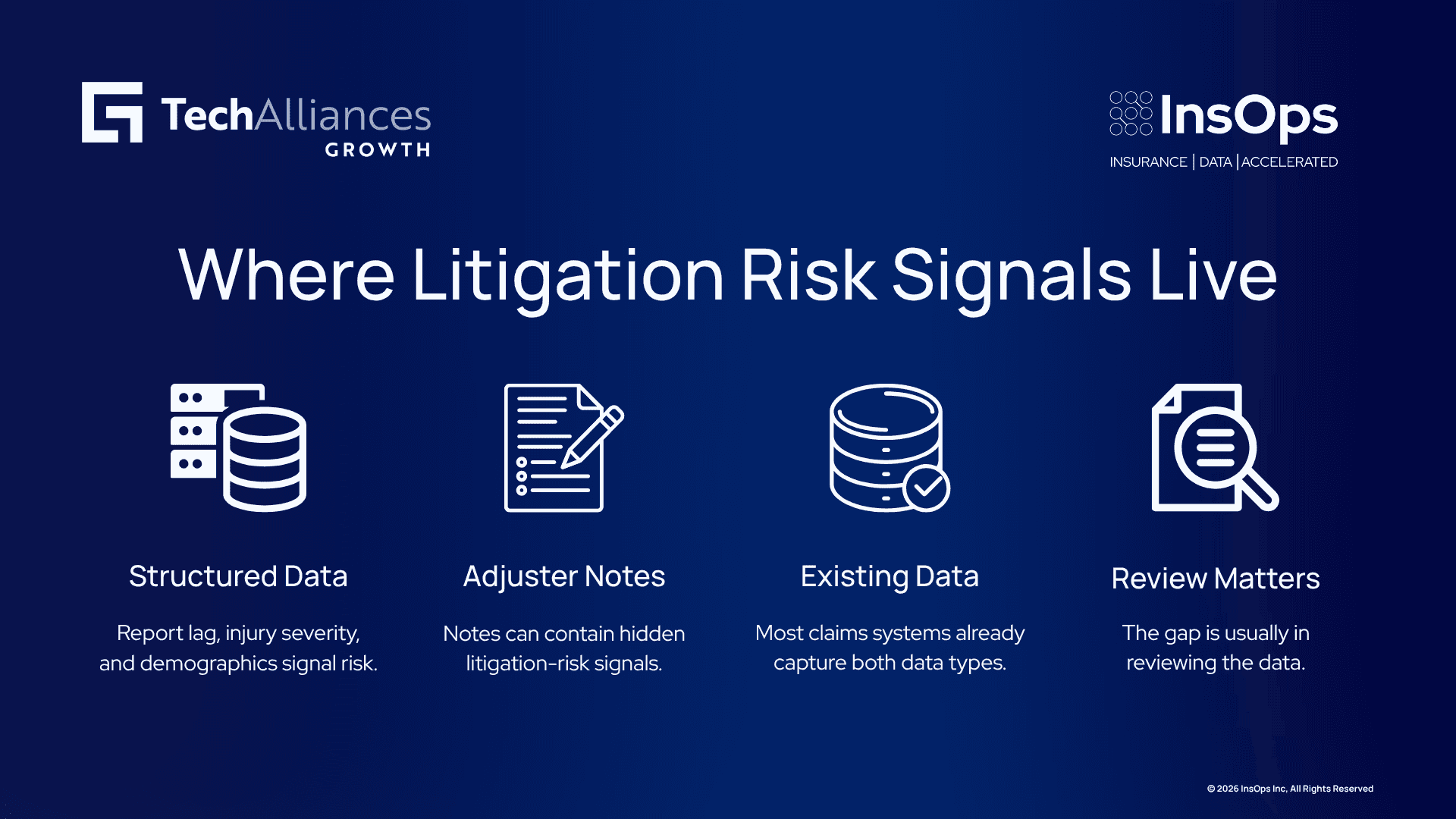
Two kinds of data carry litigation risk signal: structured claim data (report lag, injury severity, claimant demographics) and unstructured data buried in adjuster notes.
Most claims systems already capture both. The gap is usually in review, not collection.
Why volume makes this harder
A single adjuster reviewing ten or fifteen open claims can reasonably keep track of which ones feel off. That instinct breaks down at higher volume.
Once a desk carries fifty or eighty open files, the early warning signs stop standing out on their own. They get buried in the same queue as everything else.
This is why a structured, time-bound process matters more as claim volume grows. Instinct alone doesn't scale, but a defined signal set and a review cadence do.
Days 1-10: Establish the Signal Set
The first ten days are about deciding what to watch, not building new infrastructure.
Structured indicators worth tracking
Report lag (the gap between the incident date and the claim being reported), injury severity, and claimant demographics are commonly cited signal categories across claims litigation research and vendor tooling.
Start by pulling these three fields into a simple weekly view, even manually, before investing in anything more sophisticated.
Unstructured indicators in adjuster notes
Adjuster notes often contain the earliest warning signs: mentions of attorney contact, frustration with delays, or ambiguity about coverage or fault.
If no automated tooling exists yet, a simple keyword flag list reviewed weekly by a supervisor can surface most of this.
Days 11-20: Route and Intervene
Spotting risk only matters if it changes how a claim gets handled.
Assigning flagged claims to the right resource
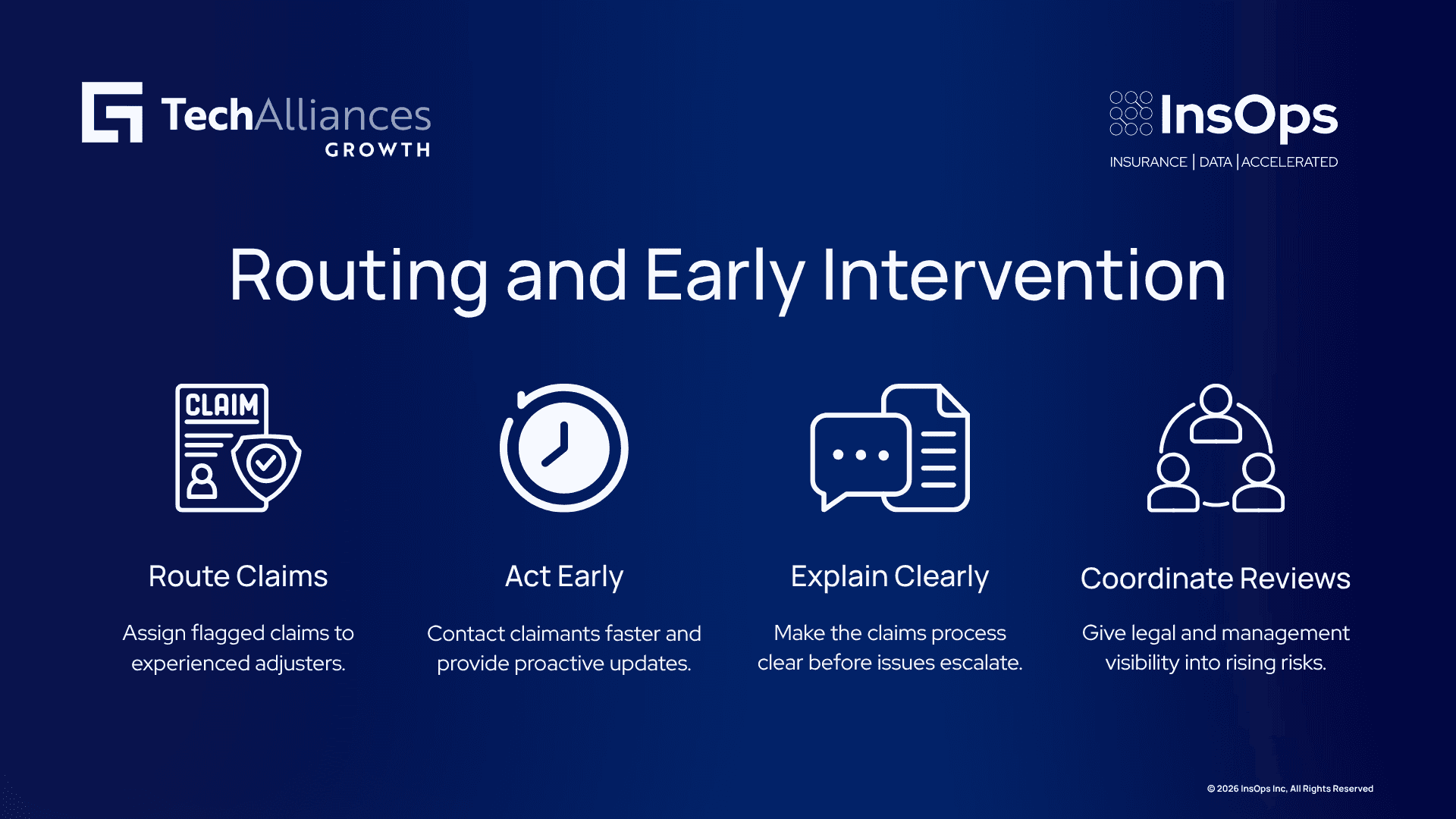
Claims flagged as higher risk should move to adjusters with more capacity and experience, not stay in the same queue as everything else.
This is a workload decision as much as a skill decision. Overloaded adjusters can't give a flagged claim the attention it needs.
What early intervention looks like
Concretely, early intervention means faster claimant contact, clearer explanation of the claims process, and proactive updates before the claimant has to ask.
None of this requires new technology. It requires making flagged claims visibly different in how they're worked.
Coordinating with legal and management
Flagged claims shouldn't sit only with the assigned adjuster. Legal counsel and claims management need visibility into which files are trending toward litigation and why.
A short weekly review, even fifteen minutes, gives legal a chance to weigh in before a claim hardens into a dispute rather than after.
This coordination step is often the piece that gets skipped under time pressure. Skipping it is usually what turns a manageable file into an expensive one.
Days 21-30: Monitor, Validate, Refine
The last ten days close the loop on whether the first two phases actually worked.
Tracking outcomes on flagged claims
Track how many flagged claims moved toward resolution versus how many still escalated. That ratio is the real measure of whether the signal set is working.
Adjusting the signal set
Use what the first cycle shows to tighten or loosen the signal set. Some indicators will prove noisy, others will prove more predictive than expected.
This is meant to repeat every 30 days, not run once as a project.
Common Pitfalls in Litigation Risk Programs
Over-flagging and under-flagging
Flagging too many claims causes alert fatigue, and adjusters start ignoring flags altogether. Flagging too few misses the claims that actually needed early attention.
The right balance usually takes more than one 30 day cycle to find.
Treating it as a one-time project
A litigation risk process that isn't reviewed and adjusted regularly drifts out of date as claim mix, jurisdictions, and legal trends shift.
Build the 30 day cycle in as a recurring operating rhythm, not a one-time initiative.
Skipping the feedback loop back to adjusters
A signal set that only feeds a dashboard doesn't change behavior. Adjusters need to see, in plain terms, which of their flagged claims actually needed the extra attention and which didn't.
Without that feedback, the program becomes something that happens to adjusters rather than something they participate in shaping. Engagement drops, and so does the quality of the underlying signal.
How InsOps Helps
InsOps builds an insurance-trained AI that assists claims teams with surfacing litigation risk earlier. Specifically, InsOps helps reduce litigation risk by analyzing case patterns and claim history to surface high-risk claims. A person reviews and validates every flagged claim before any action is taken.
LiLa, our insurance-trained LLM, runs inside your own environment, so PII and PHI never leave controlled infrastructure. It's built to understand insurance domain logic and regulatory context, not treat every claim the same way a generic model would.
Our Integration Gateway connects to Guidewire ClaimCenter and related systems, so claim data flows directly into your litigation risk review without custom engineering.
If you are evaluating how to catch litigation risk earlier without adding headcount or replacing your core claims system, contact us to talk through what this could look like for your operation.
For a deeper look at claim file signals that predict litigation, see How to Surface Litigation Risk Before Claims Escalate. For related guidance on managing sudden intake spikes, see When Claim Volume Spikes: A Practical Guide to Insurance Claims Triage.
Frequently Asked Questions
What is litigation risk in insurance claims?
Litigation risk is the likelihood that a claim will escalate to attorney involvement or a lawsuit rather than resolving through standard claims handling.
Why does litigation add so much cost to a claim?
Once an attorney is involved, costs compound through extended medical treatment, longer indemnity periods, and legal fees. See the cost figure cited near the top of this article for the specific multiplier.
How do claims teams identify litigation risk early?
By tracking structured signals like report lag, injury severity, and claimant demographics alongside unstructured signals in adjuster notes, then reviewing both on a regular cycle. The review cadence matters as much as the signals themselves, since a good signal set reviewed once a quarter still misses the early window.
What's a realistic timeline for standing up a litigation risk process?
A 30 day cycle works well as a starting structure: ten days to define signals, ten days to route and intervene on flagged claims, and ten days to monitor and refine.
What are common mistakes when flagging claims for litigation risk?
Over-flagging causes alert fatigue and adjusters start ignoring flags. Under-flagging misses claims that needed early attention. Treating the process as a one-time project instead of a recurring cycle is another common mistake, and so is failing to close the loop with adjusters on which flags actually turned out to matter.
How does InsOps assist with litigation risk detection?
InsOps analyzes case patterns and claim history to surface high-risk claims, with a person reviewing and validating every flagged claim before action is taken. The goal is to give adjusters an earlier, clearer view into which files need attention, not to remove their judgment from the process.
What should I track to know if this is working?
Track the ratio of flagged claims that moved toward resolution versus claims that still escalated to litigation. That ratio is the clearest signal of whether the process is working.