

Some commercial carriers now return a quote in two to four hours. Others still take days for the same class of business. The gap is not usually underwriting judgment.
It is what happens before an underwriter ever opens the file. Submissions arrive as PDFs and emails, get rekeyed by hand, and sit in a queue while someone chases missing information. By the time a person makes a pricing decision, most of the SLA has already been spent.
This article breaks down where commercial quote time actually goes, what carriers closing the gap are doing differently, and whether hitting a 2-4 hour SLA requires replacing your core system.
Where Commercial Quote Time Actually Goes
Quoting a commercial risk moves through three stages: intake, validation and mapping, and underwriter review. Most conversations about "speeding up quoting" jump straight to the third stage, the underwriter's decision. That is usually not where the time is going.
The table below breaks the process into those three stages and names what actually happens at each one.
Stage | What happens | Where delay concentrates |
|---|---|---|
Intake | A submission arrives as a PDF, email, or web form, often missing data | Manual rekeying, back-and-forth to fill gaps |
Validation & mapping | Extracted data gets checked and routed into the core system | Format mismatches, duplicate entry across systems |
Underwriter review | A person evaluates risk and sets price | Fast once complete data reaches the underwriter |
Intake Is Where Submissions Stall First
A submission that arrives complete and structured moves quickly. One that arrives as a scanned PDF with missing fields does not. Someone on the carrier or wholesaler side has to read it, rekey what's missing, and often call or email back to get an answer. Each round trip adds a day, sometimes more.
Validation and Mapping Compound the Delay
Even a complete submission has to be checked against the receiving system's structure before an underwriter can use it. If that mapping is manual, the same data gets typed a second time, and small formatting mismatches between source and destination create rework. This stage rarely gets attention in conversations about quote speed, but it sits directly between intake and the underwriter.
Why the Underwriter Usually Isn't the Bottleneck
It's tempting to assume a 2-4 hour SLA means underwriters are working faster. In most of the carriers closing this gap, that's not the mechanism. The underwriter's job, evaluating risk and setting a price, doesn't get faster just because a carrier adds AI tools to the workflow. What changes is how quickly complete, structured data reaches that underwriter in the first place.
This distinction matters for how a carrier should approach the problem. If leadership assumes the fix is "make underwriters faster," the natural response is more underwriting tools or headcount. If the actual bottleneck sits upstream, in intake and mapping, that response won't move the SLA much. Diagnosing which stage actually holds the delay has to come before choosing a fix.
Why Does It Take So Long to Get a Commercial Quote?
The short answer: most of the delay happens before underwriting starts, not during it. A submission that arrives incomplete forces a cycle of clarifying emails and phone calls before anyone can price the risk, and that cycle plays out before an underwriter is even in a position to make a call.
That sequencing matters. Catching a missing field before it reaches an underwriter's desk is a different problem than catching it after, and it's the difference between a same-day clarification and a multi-day round trip.
What Carriers Hitting 2-4 Hour SLAs Are Actually Doing
In July 2026, Applied Systems announced a submissionless commercial insurance capability built on Cytora, with Travelers as its first participating carrier. The capability identifies renewals across an agency's portfolio inside Applied Epic and delivers a renewal quote before the agency initiates remarketing. Cytora digitizes the risk data already sitting in Applied Epic and routes it directly to the carrier's quoting service, so the quote comes back inside the same management system the agency already uses.
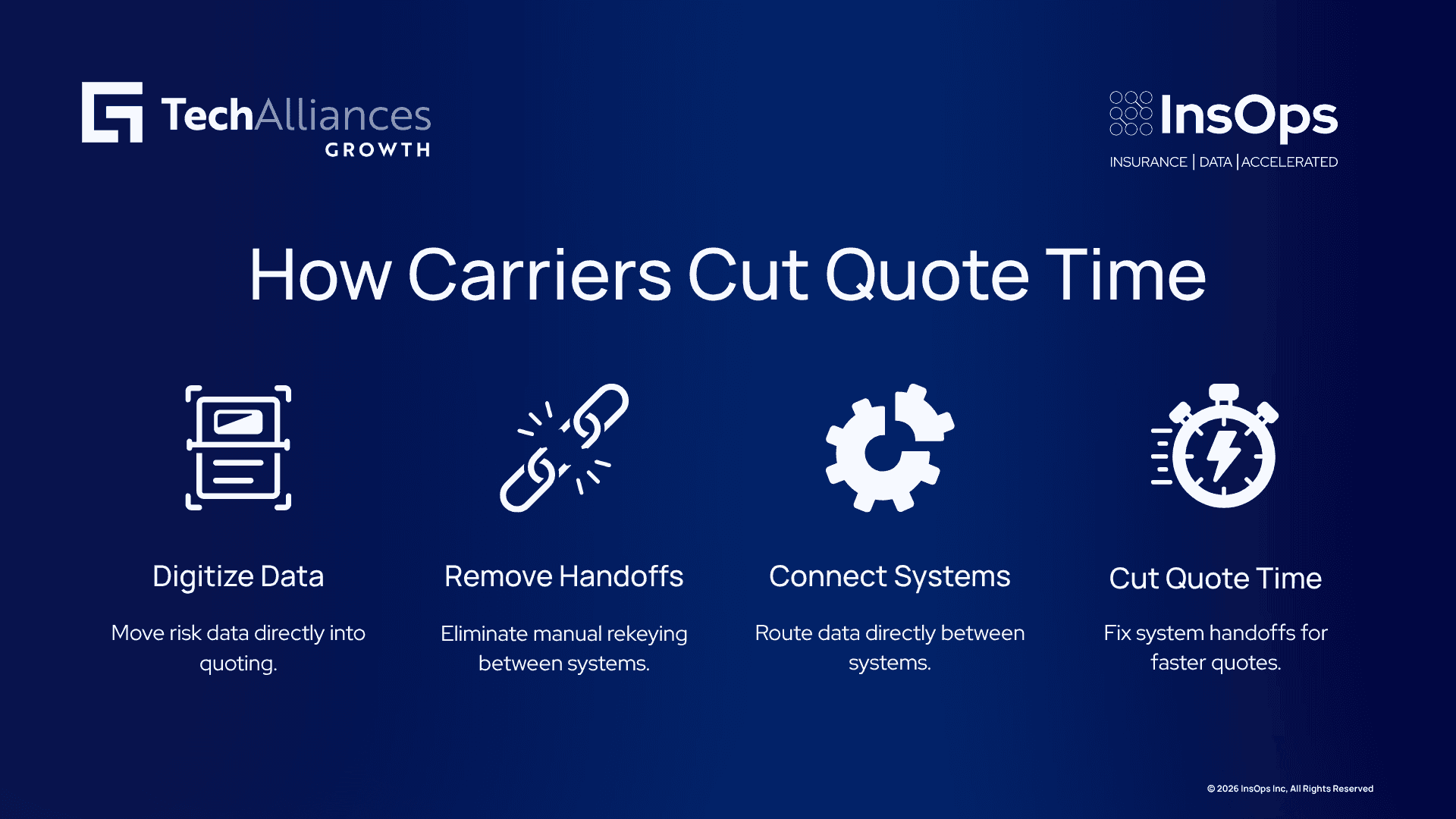
The mechanism worth noting is not "AI" in the abstract. It's that the risk data never gets rekeyed by a person moving it from one system to another. It moves from the agency management system to the carrier's quoting service directly, which is what collapses the intake and mapping stages that usually eat most of the SLA.
The Pattern, Not Just the Example
Travelers and Applied Systems is one instance of a broader pattern: carriers closing the SLA gap are not making underwriters faster. They are removing the manual handoff between where risk data lives and where the quoting system needs it.
This pattern also explains why some carriers have tried to speed up quoting without much success. Adding staff to a manual intake process makes it somewhat faster, but it doesn't remove the rekeying step itself, it just adds more people doing the same rekeying in parallel. The carriers actually reaching a 2-4 hour SLA have removed that step rather than staffed around it.
That distinction also shapes what a realistic timeline looks like. Standing up a new intake or underwriting tool without addressing the handoff between systems tends to produce a smaller, less durable improvement than fixing the connection itself. A carrier evaluating its own SLA should ask which of the two it's actually being offered before investing in either one.
Is This Achievable Without Replacing Your Core System?
For a Tier 1 carrier already running Guidewire PolicyCenter, UnderwritingCenter, PricingCenter, or Quoting Services, the answer does not require a system replacement. The bottleneck sits in the connection between wherever submission data originates and the Guidewire structures that already run underwriting and pricing.
Closing that gap is an integration problem, not a core-replacement problem. The question worth asking internally is narrower than "do we need new underwriting technology." It's "where exactly does our submission data get rekeyed by hand today, and what would it take to route it directly instead."
What to Audit Before Evaluating Any Vendor
Before bringing in any outside tool, it helps to map the current process against the three-stage framework above and mark where a person is retyping data that already exists somewhere else. A few questions make this concrete:
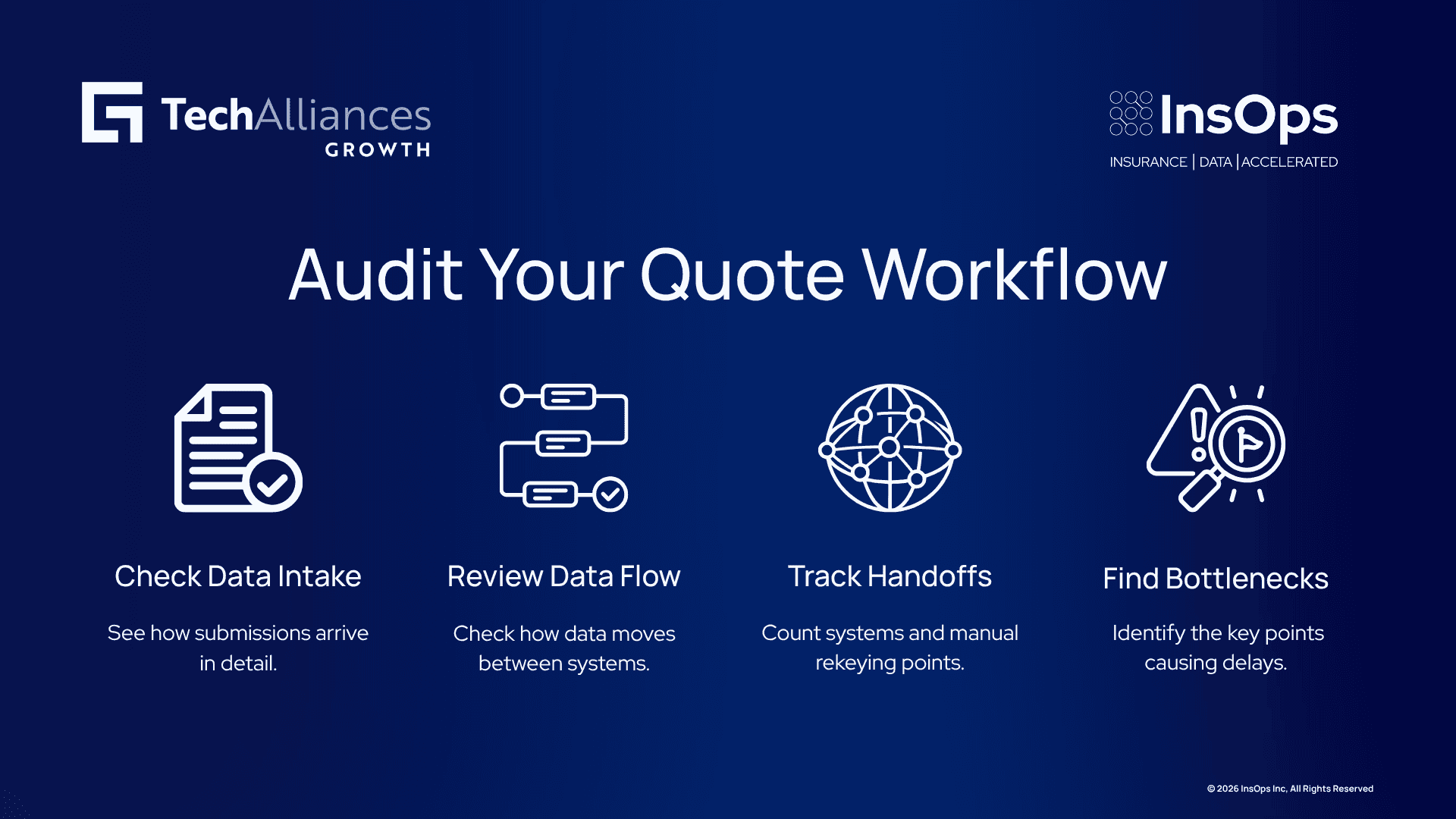
When a submission arrives, does it land as structured data, or as a PDF, email, or form that someone has to read and transcribe?
Once intake is complete, does that data move into PolicyCenter, UnderwritingCenter, PricingCenter, or Quoting Services automatically, or does someone map and re-enter it?
How many separate systems does a single submission's data pass through before an underwriter sees it, and at how many of those handoffs does a person retype something?
Carriers that go through this exercise often find the delay concentrated in one or two specific handoffs rather than spread evenly across the whole process. That's useful, because it means the fix can be scoped narrowly instead of requiring a broad, disruptive change to how underwriting works.
How InsOps Helps
InsOps builds an insurance-trained AI that assists with mapping submission and quoting data into your existing systems. LiLa, our insurance-trained LLM, runs inside your own environment, so PII and PHI never leave controlled infrastructure. A person reviews and validates every mapping before it moves downstream.
Our Integration Gateway connects to Guidewire PolicyCenter, ClaimCenter, BillingCenter, UnderwritingCenter, PricingCenter, and Quoting Services, so submission data flows directly into your underwriting workflow without custom engineering or manual rekeying.
If you are evaluating where your own quote SLA is actually losing time, contact us to talk through what this could look like for your operation.
Frequently Asked Questions
Why does it take so long to get a commercial insurance quote?
Most of the delay happens before an underwriter ever reviews the risk. Incomplete submissions force back-and-forth clarification, and manual rekeying between systems adds time before pricing even starts.
What is a typical insurance quote turnaround time today?
It varies widely by carrier and complexity. Some carriers now return commercial quotes in hours by removing manual handoffs between intake and underwriting, while others still take multiple days for comparable risk.
What's actually causing commercial quote delays?
Delay concentrates in intake and data mapping, not in the underwriter's decision itself. A submission that arrives complete and structured moves through underwriting quickly; one that requires rekeying or clarification does not.
Can a Tier 1 carrier hit a 2-4 hour SLA without replacing Guidewire?
Yes. The bottleneck is typically the connection between where submission data originates and the Guidewire structures already running underwriting and pricing, which is an integration problem rather than a core-system problem.
How does submission data get from a broker's document into an underwriter's screen faster?
By routing extracted data directly into the receiving system instead of having a person retype it. The Travelers and Applied Systems example described above is a working case of exactly this, the manual handoff is what got removed, not the underwriter's review.
Does AI underwriting actually cut turnaround time, or is that marketing?
The underlying mechanism, removing manual rekeying between systems, is real and observable in named integrations like the Travelers and Applied Systems example. The specific time saved depends on how much of a given carrier's delay actually comes from that handoff versus other factors.
How does InsOps assist with quote speed?
InsOps' Integration Gateway maps submission and quoting data directly into Guidewire structures, with a person validating every mapping before it moves downstream. It assists the intake and mapping stages; underwriting judgment stays with your team.
What's a realistic timeline to see SLA improvement?
Improvement depends on how much of your current delay is concentrated in intake and mapping versus underwriting itself. Mapping that out internally first, before evaluating any tool, is the more reliable starting point than assuming a fixed timeline.