

Most commercial insurance quotes take too long, and the delay rarely comes from where operations leaders assume it does.
It is easy to blame underwriter bandwidth or risk complexity. When a quote sits in a queue for days, the instinct is to ask whether the team needs more underwriters, or whether the risk itself was simply hard to price.
The real story is more structural. A recent Capgemini survey of 809 insurance employees found that 57% of underwriters spend the majority of their time on routine tasks, not risk judgment. Accenture's longitudinal underwriting survey found that more than a third of an underwriter's time still goes to non-core activities.
That gap between "time spent" and "time spent underwriting" is where most quote delay actually lives. This article breaks down where quote time goes, stage by stage, why the gap keeps showing up even after teams add new tools, and what to do about it.
Where the Time Actually Goes
Quote delay is rarely one bottleneck. It is a sequence of smaller handoffs, each adding time to a process that competitive carriers now measure in minutes rather than days.
A single slow step rarely explains a multi-day quote. Instead, small delays compound. Two days waiting on missing submission data becomes four days once the file sits in an unprioritized queue, then six once it hits a referral with no service-level expectation attached.
Understanding this compounding effect matters because it changes where a team should look first. Fixing the underwriting review stage alone will not close an 18-hour gap if the surrounding stages are where the hours are actually going.
The submission-to-quote framework
Stage | What happens | Where time is lost |
|---|---|---|
Intake | Submission arrives, often incomplete | Waiting on missing data, manual acknowledgment |
Data entry | Information gets re-entered across systems | Systems don't talk to each other, so staff re-key data by hand |
Triage | Submission enters a queue | First-in-first-out processing, no risk-based prioritization |
Underwriting review | Actual risk assessment happens | This is the only stage that is genuinely underwriting |
Referral | Escalation to a senior underwriter or specialist | No structured routing or service-level expectation |
Delivery | Final quote is assembled and sent | Manual formatting and handoffs back to the broker |
Which of these stages is actually underwriting
Of the six stages above, only one, underwriting review, requires the judgment a licensed underwriter brings to the job. Everything else is administrative movement of data and files.
That distinction matters because it changes how a team should staff and measure its process. Adding underwriters to a queue that is actually stuck in data entry or referral routing does not shorten the queue. It just adds more people waiting on the same broken handoffs.
Capgemini's 2026 survey found that 61% of insurers struggle to improve quote-to-bind conversion, a problem rooted more in process friction than in underwriting skill. When conversion lags, the instinct is often to review pricing or appetite. The more useful question is usually simpler: how many of those lost conversions happened because the quote arrived too late to matter.
A note on intake quality
Intake deserves its own attention because it sets the ceiling on every stage that follows. A submission missing two or three key data points does not just delay intake itself. It creates a bounce-back loop: the file goes out to the broker for clarification, sits in an inbox, comes back partially complete, and repeats.
Teams that measure this bounce-back rate often find it accounts for a disproportionate share of total cycle time, even though no single bounce looks large on its own.
Why the Gap Exists Structurally
Understanding where time goes is only half the picture. The harder question is why these gaps persist even at carriers that have invested in new systems and added staff.
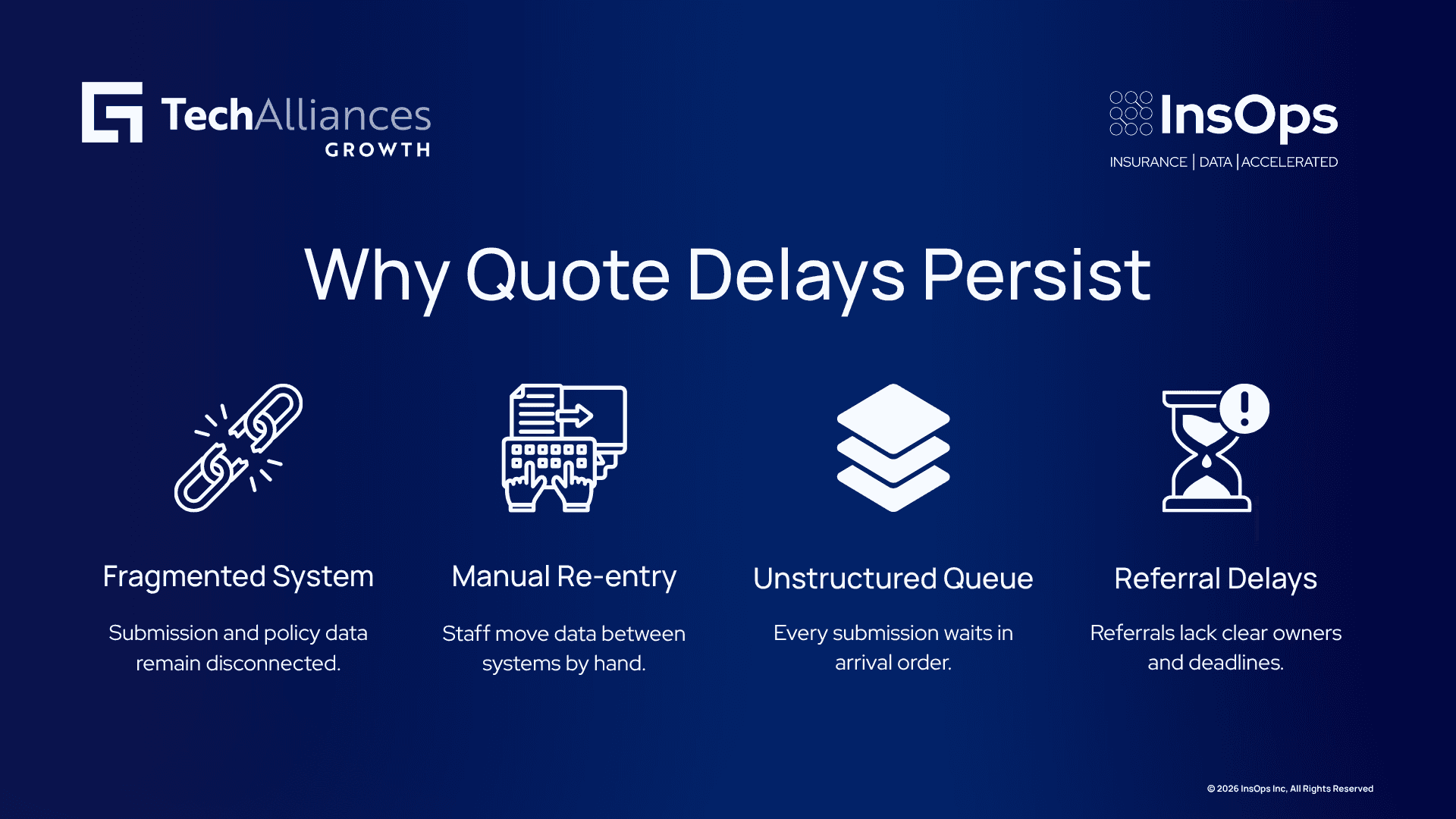
Fragmented systems and manual re-entry
Quote delay and data reconciliation problems usually trace back to the same root cause. Submission data lives in one system, policy data in another, and nothing connects them automatically. This is the same data silo problem that shows up across claims, policy, and billing systems industry-wide.
Staff spend their time moving information between systems instead of evaluating risk. A submission that arrives as a PDF or an email attachment has to be read, interpreted, and typed into a rating or policy system by hand. Each re-entry point is also a place where a typo or a missed field can introduce an error that surfaces later, often during a referral or an audit.
This is not a training problem or a willingness problem. It is a structural one. Until systems share data automatically, someone has to bridge the gap manually, and that bridging work does not scale as submission volume grows.
Queuing without risk-based triage
Submissions typically move through in the order they arrive. A high-value account requiring a few minutes of underwriter judgment can sit in the same queue as a stack of standard risks suited to a faster, rules-based path. This is a sequencing problem, not a capacity problem.
First-in-first-out queuing feels fair on paper. In practice, it treats every submission as equally complex and equally urgent, which is rarely true. A straightforward renewal and a complex new-business submission requiring specialist review end up competing for the same underwriter attention in the order they happened to arrive, not in the order that makes business sense.
Carriers that separate submissions by complexity before they reach an underwriter tend to see faster movement on both ends: simple risks clear quickly, and complex risks get uninterrupted attention instead of being processed in fragments between other files.
Referral loops without structured routing
Risks outside standard appetite get referred to senior underwriters or specialist teams. Without a structured routing process and a clear service-level expectation, these referrals become open-ended waits rather than a defined next step.
A referral without an owner or a deadline tends to sit until someone notices it has gone quiet. That silence is invisible to the broker, who only sees that the quote has not arrived, not why. The absence of a tracked handoff is often the single largest, least visible source of delay in the entire process.
Structured routing does not require eliminating referrals. It requires making sure every referral has a named owner, a target turnaround, and visibility into where it currently sits, so a stuck file gets noticed in hours rather than days.
Why This Matters Beyond Operations
Turnaround shapes which deals a carrier actually sees
Brokers frequently shop the same risk to multiple carriers at once. The first clear, complete quote tends to become the anchor that others get compared against. A slow quote often arrives after the broker's expectations are already set, which forces discounting or leads brokers to place the business elsewhere.
Over time, this changes broker behavior. Carriers that consistently respond slowly get sent fewer submissions, or only the hardest-to-place risks that other carriers already declined. Quote speed is not just an efficiency metric. It shapes the portfolio a carrier ends up with.
This dynamic compounds quietly. A broker does not usually announce that they have stopped sending a carrier certain kinds of business. They simply adjust their routing habits over time, sending the easy, profitable risks to whichever carrier responds fastest and reserving the difficult ones for carriers slow enough that speed was never going to be a factor anyway.
By the time this shift shows up in portfolio quality metrics, it has often been building for months. Turnaround time functions as a leading indicator of portfolio health long before the lagging numbers confirm it.
How to Start Closing the Gap
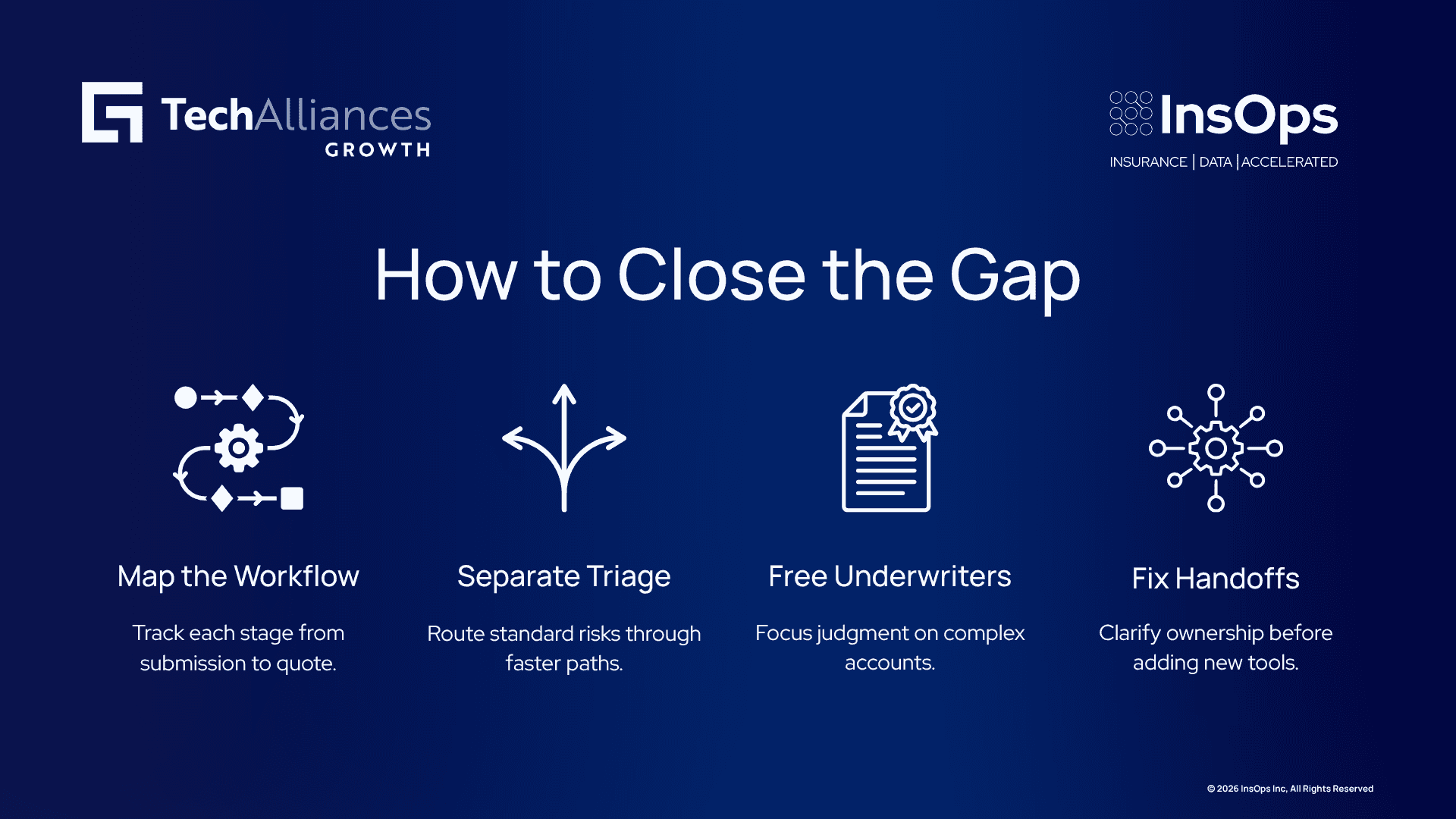
Map the workflow as it actually happens
Before changing anything, track submissions from arrival to quote issuance. Measure cycle time by stage and note the percentage of submissions that bounce backward for missing information. Most teams are surprised by where the time actually concentrates.
This mapping exercise works best when it reflects the process as it is actually run, not as it appears in a workflow diagram from two reorganizations ago. Shadowing a handful of live submissions from intake to quote, and timing each handoff honestly, usually surfaces more insight than a week of meetings about the process.
Separate triage from underwriting judgment
Not every submission needs the same level of review. Standard risks that fit clear appetite rules can move through a faster path, freeing underwriter time for the complex accounts that need it.
This does not mean lowering the bar on standard risks. It means recognizing that a straightforward, well-documented submission within clear appetite does not need the same depth of manual review as a complex or borderline one, and building a process that reflects that difference instead of treating every file identically.
Fix handoffs before adding new tools
New software layered on top of broken handoffs just moves the bottleneck. Clarify who owns each stage, what "done" means at each handoff, and what happens when a file gets stuck, before evaluating any new system.
A common pattern is investing in a faster rating engine or a new intake portal while leaving the referral process and the data re-entry problem untouched. The new tool speeds up one stage and the overall cycle time barely moves, because the gap was never in that stage to begin with.
How InsOps Helps
InsOps builds an insurance-trained AI that assists with mapping and validating data as it moves between systems, one of the biggest sources of the administrative time underwriters lose every week. LiLa, our insurance-trained LLM, runs inside your own environment, so PII and PHI never leave controlled infrastructure. A person reviews and validates every mapping before it is finalized.
Our Integration Gateway connects to Guidewire PolicyCenter, ClaimCenter, and related systems, so submission and policy data flows directly into your workflow without custom engineering.
If you are evaluating how to close the gap between submission and quote without adding new compliance or data-exposure risk, contact us to talk through what this could look like for your operation.
Frequently Asked Questions
Why does a commercial insurance quote take so long?
Most of the delay is administrative, not underwriting judgment. Time gets lost to re-entering data across disconnected systems, first-in-first-out queuing, and referral loops without clear routing.
What percentage of an underwriter's time actually goes to risk assessment?
According to Accenture's longitudinal underwriting survey, more than a third of underwriter time still goes to non-core activities rather than risk assessment itself. The pattern shows up across multiple industry surveys, not just one.
What are the most common causes of quote delay?
Incomplete submission data, manual document handling, first-in-first-out queuing with no risk-based triage, and referral loops without structured routing are the most common causes.
How can an insurer measure where its own delays are happening?
Track every submission from arrival to quote issuance, and measure cycle time at each stage. Pay close attention to how often a file bounces backward for missing information.
Does faster quoting actually change broker behavior?
Yes. Brokers often shop a risk to multiple carriers at once. Carriers that consistently respond slowly tend to get sent fewer submissions over time, or only the hardest-to-place risks.
Should every submission move through the same review process?
No. Standard risks that fit clear appetite rules can move through a faster path, which frees underwriter time for the complex accounts that actually need judgment.
How does InsOps help close this gap?
InsOps assists with mapping and validating data as it moves between systems, with a person reviewing every mapping before it is finalized. LiLa runs inside your own environment, so sensitive data never leaves your infrastructure.
What is a realistic timeline for improving quote turnaround?
Mapping the current workflow and identifying the biggest bottleneck typically takes a few weeks. Fixing handoffs and triage rules is often the fastest win, before any new system is introduced.