

Litigation risk tools only work as well as the data feeding them. Most claims teams have that data spread across systems that were never built to talk to each other.
A claims platform, a document repository, and an analytics tool sitting side by side isn't a stack that supports litigation risk detection. It's three disconnected sources an adjuster has to reconcile manually.
A November 2025 Risk.net and SAS study of insurance leaders found that 38% aren't sure their organization has a comprehensive, real-time view of risks, revenue, and costs. That gap shows up directly in claims, where litigation risk depends on seeing a full pattern, not a partial one.
This article covers the four layers of a claims tech stack, why integration is the layer litigation risk depends on most, and what decision support should look like with a person still making the call.
The Four Layers of a Claims Tech Stack
Most conversations about claims technology jump straight to analytics or AI. That skips two layers underneath that determine whether analytics has anything reliable to work with.
The Four Layers
Layer | What It Does |
|---|---|
Intake | Captures the claim, first notice of loss, documents, photos, and initial claimant details |
Integration | Connects intake, policy, billing, and claims history data so it can be read together |
Analytics | Applies pattern recognition and risk scoring across the connected data |
Decision Support | Surfaces the relevant signals to an adjuster at the point of decision |
Why Most Stacks Are Strong on Intake and Analytics but Weak on Integration
Claims teams tend to invest heavily in the first and third layers. Intake tools are visible to claimants and easy to justify. Analytics tools are where the "AI story" lives, so they get budget attention too.
Integration is less visible and harder to demo, so it's the layer most often left underfunded. That's a problem, since analytics run on disconnected data produce partial patterns, not full ones.
Why Integration Is the Layer Litigation Risk Depends On Most

How Fragmented Data Delays Pattern Recognition
Litigation risk shows up as a pattern across case history, documents, and prior claims. If those three sources sit in separate systems, an adjuster has to manually pull each one and compare them by hand.
That manual comparison is slow enough that it usually happens only after a claim already looks troubled, not early enough to intervene. By the time the pattern surfaces, options for proactive resolution have often narrowed.
What "Integrated" Actually Means Operationally
Integration doesn't require a single database holding everything. It means data reliably flowing between systems so a claims platform can read policy terms, billing history, and prior case data without a person exporting and re-importing files.
A claims team can confirm this is working, or isn't, by asking a simple question: can an adjuster see a claimant's full claim history from within the claims platform itself, or does someone have to log into a separate system to find it?
What Decision Support Looks Like With a Human Still Deciding
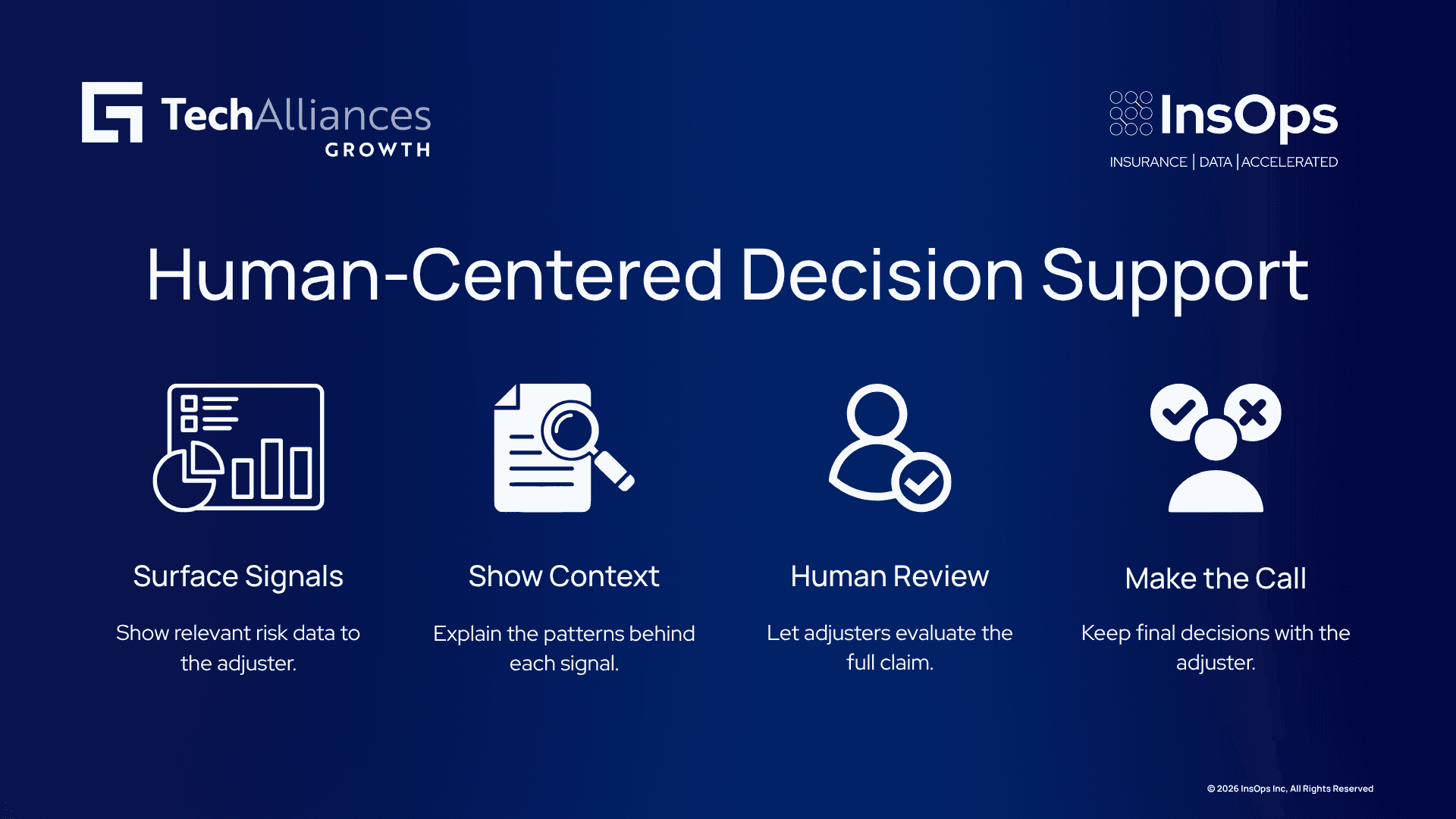
Surfacing Signals vs. Making the Call
Decision support means presenting relevant data and risk signals to an adjuster at the point of decision. It does not mean the system makes the decision on its own.
That distinction matters operationally, not just as a compliance statement. A system that surfaces signals still requires the adjuster to weigh context the data doesn't capture, like a claimant's tone in a call or a nuance in a medical record.
What a Decision-Support View Should Actually Show
A useful decision-support view for litigation risk shows an adjuster the specific case patterns and history driving a risk signal, not just a single score with no explanation.
An adjuster who can see why a claim was flagged can evaluate whether the flag makes sense given the full file. An adjuster who only sees a number has no way to sanity-check it, which undermines trust in the tool over time.
Where Claims Tech Stacks Typically Break
Data Silos and Legacy Systems
Many core claims systems were built before real-time API access was standard, and exposing their data still requires custom engineering work.
That's often where integration projects stall. The intake and analytics layers get built on modern infrastructure, then hit a legacy system in the middle that can't easily connect to either.
Point Solutions That Don't Connect to the Rest of the Stack
A tool that solves one layer well, a strong analytics engine, for example, can still leave a team worse off if it doesn't connect to the integration layer underneath it.
The result is another disconnected source of data rather than a solution to the fragmentation problem. Evaluating a new tool against the full four-layer stack, not just the layer it's built for, helps avoid this.
How InsOps Helps
InsOps builds an insurance-trained AI that assists claims teams in connecting fragmented data and surfacing litigation risk earlier. Our Integration Gateway connects to Guidewire ClaimCenter and related systems, so case history, policy, and billing data flow into your existing workflow without custom engineering.
LiLa, our insurance-trained LLM, reduces litigation risk by analyzing case patterns and claim history to surface high-risk claims for human review. It runs inside your own environment, so PII and PHI never leave controlled infrastructure.
A person reviews and validates every flagged claim before any action is taken. If your team is evaluating where your stack's integration layer is holding back litigation risk visibility, contact us to talk through what this could look like for your operation.
Frequently Asked Questions
What is a claims technology stack?
A claims technology stack is the set of systems, intake, integration, analytics, and decision support, that work together to process a claim from first notice of loss through resolution.
Why does data integration matter for litigation risk specifically?
Litigation risk depends on seeing patterns across case history, documents, and prior claims together. When that data sits in separate systems, those patterns are harder and slower to spot.
How should a claims team evaluate their current stack?
Map existing tools against the four layers, intake, integration, analytics, and decision support, and check whether data flows between them without manual export and re-import.
What's a common challenge in integrating claims systems?
Legacy core systems often weren't built for real-time API access, which makes connecting them to newer analytics or decision-support tools require custom engineering.
What metrics show a claims tech stack is actually reducing litigation risk?
Track how early litigation risk is flagged relative to when disputes escalate, how often adjusters act on flagged signals, and whether claims history is visible without manual lookup in a separate system.
How does AI-assisted decision support fit into the stack?
AI-assisted tools like LiLa analyze connected claims data to surface litigation risk signals at the point of decision, so an adjuster has the pattern in front of them without pulling it together manually.
What's a realistic timeline for closing an integration gap?
Connecting a modern claims platform to a legacy core system typically takes longer than building the analytics layer itself, and the timeline depends heavily on whether the legacy system already exposes data through an API.