

Spot Audits vs. Systematic Reviews: Which One Actually Catches Litigation Risk?
Litigation and bad-faith complaints are climbing on your book, even though your claims team runs a regular quality assurance program. The audits are happening. The random sample looks fine. The litigation numbers keep moving anyway.
This is not a contradiction. It is a sign that the audit method and the risk it is meant to catch do not match. A spot audit built for consistency monitoring is not built to catch the pattern-level signals that precede a lawsuit.
This article walks through what spot audits catch, what they miss, a framework for deciding when a file needs a full systematic review, and what to check for once it gets one.
Why Random Sampling Misses Litigation Risk
Random sampling catches broad quality trends, but it can miss systemic litigation risk patterns that only surface when claims are compared against similar cases. A single file, read on its own, can look complete and defensible.
That same file can look very different once it is set next to a few hundred other files with the same claim type, the same point of impact, or the same adjuster.
What Spot Audits Are Good At
A spot audit pulls a random slice of the claims population and scores it against a standard rubric. It is fast, it is cheap relative to full review, and it gives a reasonable read on whether the team is generally following procedure.
That makes it a solid tool for ongoing consistency monitoring across a large book of business.
A typical spot-audit scorecard checks a handful of procedural markers on each sampled file: prompt acknowledgment of the claim, documented coverage analysis, evidence of adequate investigation activity, and timely payment or denial. None of those markers, on their own, say anything about how the claim compares to others like it, which is exactly the gap Layer 2 exists to close.
Where They Fall Short
A spot audit is not designed to find the claim that is quietly heading toward litigation. It samples broadly and evenly, which means a file with real risk signals has the same chance of being picked as any routine file, no better.
That is not a flaw in how the audit is run. It is a structural limit of sampling at random instead of sampling by risk.
Spot Audits vs. Systematic Reviews: The Two-Layer Audit Model
Treating "claims audit" as one process hides the real distinction. A defensible program runs two separate layers, each doing a different job.
Layer | Trigger | Population reviewed | What it catches |
|---|---|---|---|
Layer 1: Spot audits | Ongoing, scheduled | Random sample across the whole book | Broad consistency and procedural drift |
Layer 2: Systematic review | Risk signal detected | Every file that hits a defined trigger | Litigation and bad-faith exposure on specific files |
Layer 1 stays random on purpose. It is a baseline health check, not a risk-detection tool.
Layer 2 is not random at all. It runs a full file review on any claim that hits a defined risk signal, before a dispute escalates, not after a lawsuit is already filed.
Keeping the two layers separate matters. Folding Layer 2 triggers into the Layer 1 sample dilutes both. The random sample stops being random, and the risk-triggered review stops being systematic.
What a Claim File Audit Should Actually Check For
A defensible claim file audit classifies findings by severity, separating errors that expose a carrier to bad faith litigation from routine documentation gaps. Treating every finding the same way buries the ones that matter.
A practical severity split looks like this: errors that directly expose the carrier to regulatory sanction or bad-faith litigation sit in one tier, process failures that affect the claimant but fall short of a statutory violation sit in a second tier, and documentation gaps with no material impact sit in a third.
That separation is what turns an audit report into something a legal or compliance team can act on quickly, instead of a flat list of findings with no priority order.
Documentation Standards That Hold Up in Disputes
Regulators define a claim file as any retrievable electronic or paper record, meaning audit findings must be reconstructable from that file alone. If a decision cannot be explained from the file itself, months later, without the adjuster's memory filling the gaps, the file has a documentation problem regardless of whether the underlying decision was correct.
This standard comes from the NAIC's Unfair Property/Casualty Claims Settlement Practices Model Regulation, which most states have adopted in some form.
Severity Classification in Practice
Sorting findings into tiers before they reach a manager turns an audit from a scoring exercise into a triage tool. A critical error on one file can justify pulling that file into Layer 2 review even if the rest of that adjuster's sample looks clean.
How to Decide Which Claims Move Into Full Systematic Review
This is the decision that spot audits alone cannot make. A file moves from the Layer 1 sample pool into Layer 2 systematic review when it hits one or more defined risk signals, checked at intake and again at key milestones, not just at closure.
Risk Signals to Trigger Layer 2
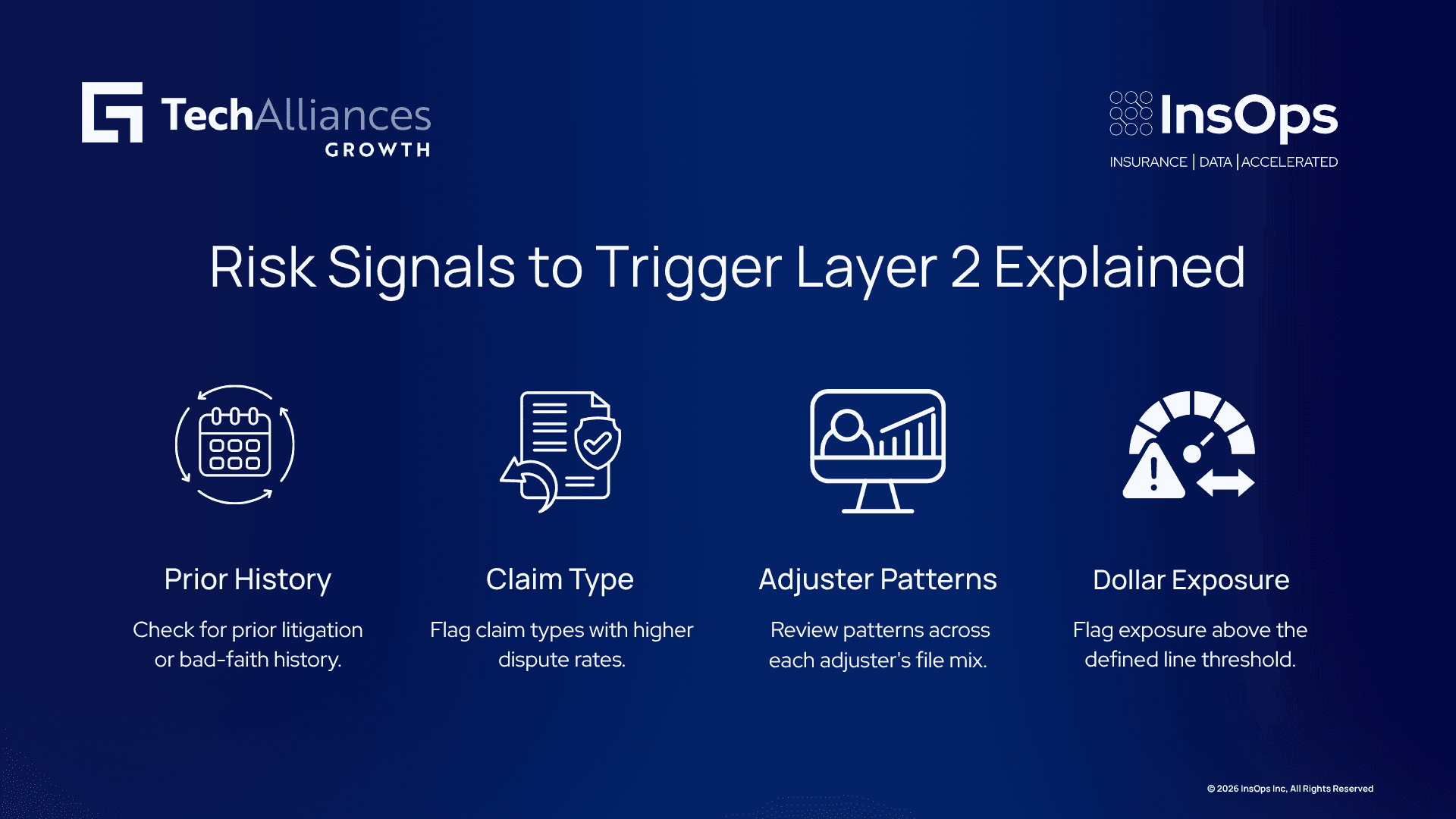
Four signals do most of the work in practice. A prior litigation or bad-faith history tied to the claimant, policy type, or handling adjuster is one.
A claim type with a known higher dispute rate, such as business interruption or disputed coverage, is another. A pattern across one adjuster's file mix, not just a single file, is a third. Dollar exposure above a defined threshold for the line of business rounds out the list.
None of these signals require reading every file in the book. They require checking every file against a short, defined list at the point risk actually appears, not waiting for the quarterly sample to land on it by chance.
Setting Review Frequency
There is no single defensible sample size that applies across claim types, jurisdictions, and carrier sizes, so resist the urge to borrow a number from an unrelated context. Set the sizing logic instead: define the population, the review period, and the escalation trigger before reviews begin, then size the sample to the risk level of what is being measured, not to a fixed percentage pulled from somewhere else.
How InsOps Helps
InsOps builds an insurance-trained AI that assists with surfacing high-risk claims for litigation-focused review. LiLa, our insurance-trained LLM, reduces litigation risk by analyzing case patterns and claim history to surface high-risk claims, the kind of Layer 2 triage decision this article walks through.
LiLa runs inside your own environment, so PII and PHI never leave controlled infrastructure. A person reviews and validates every flagged claim before it moves into full systematic review, LiLa surfaces the signal, your team makes the call.
Our Integration Gateway connects to Guidewire ClaimCenter and related systems, so claim history and case pattern data flow directly into your existing workflow without custom engineering.
If you are evaluating how to move high-risk claims into deeper review without adding headcount to your QA team, contact us to talk through what this could look like for your operation.
Frequently Asked Questions
What is insurance claims quality assurance?
Insurance claims quality assurance is the ongoing review of how claims are handled, checking documentation, decisions, and communication against company policy, procedure, and regulatory requirements. It is separate from a one-time audit, QA is a continuous process, not a single event.
What's the difference between a spot audit and a systematic claims review?
A spot audit reviews a random sample of the claims population on a set schedule, mainly to monitor general consistency. A systematic review is a full, triggered review of any file that hits a defined risk signal, run specifically to catch litigation or bad-faith exposure before it escalates.
Why does random sampling miss litigation risk in claim files?
A random sample gives every file the same chance of being picked, regardless of its actual risk level. A file with real litigation signals is not more likely to be selected than a routine file, so systemic patterns across many files can go unreviewed indefinitely.
What does a claims auditor look for that signals a file might go to litigation?
Prior litigation or bad-faith history tied to the claimant or adjuster, a claim type with a known higher dispute rate, a pattern across one adjuster's files rather than a single file, and dollar exposure above a defined threshold.
How many claim files should be reviewed to catch litigation risk early?
There is no single number that works across every carrier and claim type. The population, review period, and escalation triggers need to be defined first, sample size follows from those, not the other way around.
What makes a claim audit finding defensible in a bad-faith dispute?
A finding holds up when it is reconstructable from the claim file alone, documented at the time the decision was made rather than added later, and classified by severity so critical issues are visibly separated from minor documentation gaps.