

A claims team can hit every timeliness target, prompt contact, fast inspections, quick cycle times, and still see litigation and coverage errors rise. That happens when a metrics program measures whether steps occurred, not whether the outcome was right.
Sedgwick's 2025 year-end State of the Line report found that litigated claims made up just 5.76% of closed claims but accounted for nearly 70% of total dollars paid, with an average cost 37.5 times higher than non-litigated claims. A small slice of claims by count is driving most of the cost, and process metrics alone won't catch which ones.
This article covers the difference between process and outcome metrics, which litigation risk metrics actually predict escalation, and how to avoid diluting a measurement program with too many low-priority data points.
Process Metrics vs. Outcome Metrics
Claims quality metrics fall into two broad categories, and most programs are heavily weighted toward one of them.
The Two Categories
Category | What It Measures | Examples |
|---|---|---|
Process metrics | Whether the required steps happened | Contact timeliness, cycle time, FNOL abandonment rate, inspection speed |
Outcome metrics | Whether the final decision was right | Coverage and liability decision accuracy, litigation rate, subrogation identification |
Why a Claim Can Pass Every Process Metric and Still Be Handled Wrong
Process metrics are easy to track and easy to improve on paper. An adjuster can make contact on time, complete inspections quickly, and close a file within target cycle time, and still get the coverage decision wrong.
None of those process wins catch an incorrect liability call, a missed red flag, or a coverage decision that later gets contested. That gap between process performance and outcome accuracy is exactly where litigation risk accumulates unnoticed.
The Litigation Risk Metrics That Actually Predict Escalation

Litigation Rate on Closed Claims
Litigation rate is the most direct outcome metric available, but it only becomes useful when read against claim complexity and line of business, not as a single flat number across the whole book.
A litigation rate that looks fine in aggregate can hide a much higher rate concentrated in a specific claim type or severity band, the kind of concentration a flat, book-wide number won't surface.
Time From Red-Flag Detection to Escalation
Most claims programs don't track this one at all, even though it's an early-warning signal. It measures how long a claim sits after a red flag is identified before it's escalated for closer review.
A long gap here means red flags are being noticed but not acted on quickly, which narrows the window for proactive resolution before a claim moves toward litigation.
Liability and Coverage Decision Accuracy
This metric requires auditing a sample of closed files specifically for whether the coverage and liability call was correct, not just whether it was made on time.
It's harder to measure than a timeliness metric because it requires a second reviewer's judgment, but it's the outcome metric most directly tied to litigation risk.
Why Metric Overload Dilutes What Matters
The "Everything Is a Low Priority" Problem
When a claims program tracks dozens of metrics with roughly equal weight, no single metric gets enough attention to actually drive behavior. A metric that represents 2% of an annual evaluation gets 2% of everyone's attention.
Outcome metrics, which tend to be harder to measure, often lose out to process metrics in this competition, since process metrics are simpler to report on a dashboard.
How to Decide What to Cut, Not Just What to Add
A useful exercise is asking, for each tracked metric, whether it would have caught a claim that recently went sideways. Metrics that wouldn't have flagged the actual problem are candidates for reduction, regardless of how easy they are to track.
This isn't about tracking fewer things for its own sake. It's about making sure the metrics that remain are the ones tied to accuracy, not just activity.
Building a Measurement Approach That Catches Litigation Risk Early
Pairing Outcome Metrics With a Documented Red-Flag Review
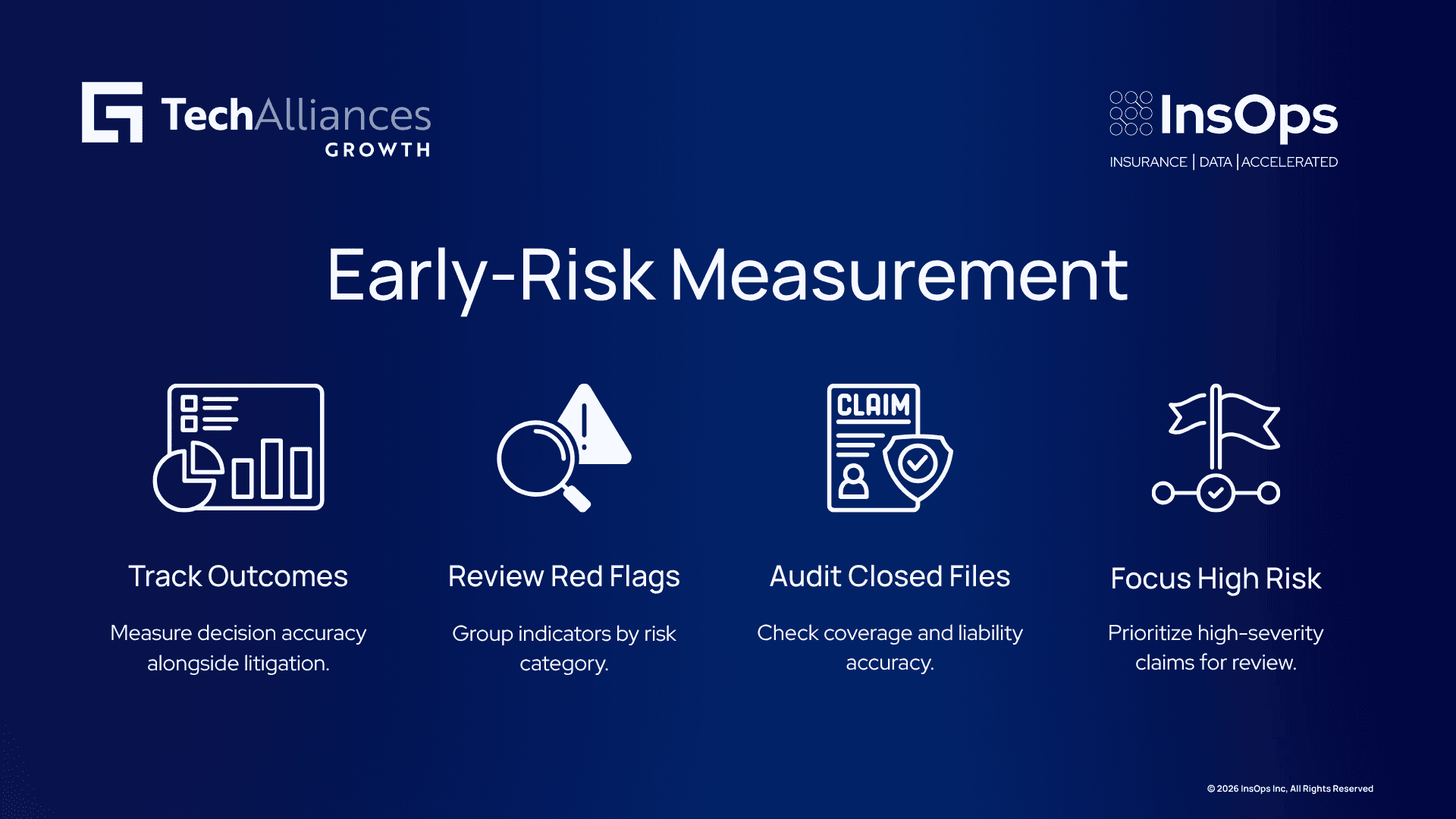
Outcome metrics work best alongside a structured red-flag review process, one that groups indicators by category (insured-related, claim-related, evidence-related) rather than treating any single flag as disqualifying.
That pairing connects the measurement side of claims quality to the operational side, so a rising litigation rate in a specific segment can be traced back to which red flags were present and whether they were acted on.
Auditing a Sample of Closed Files for Decision Accuracy
A monthly or quarterly audit of a sample of closed files, specifically checking coverage and liability accuracy rather than timeliness, gives a claims program direct visibility into the metric that matters most.
This audit doesn't need to cover every file. A representative sample, weighted toward your highest-severity claims, gives a reliable read without adding significant overhead.
How InsOps Helps
InsOps builds an insurance-trained AI that assists claims teams in surfacing high-risk claims earlier, so outcome accuracy gets the same visibility that process metrics already have. LiLa, our insurance-trained LLM, reduces litigation risk by analyzing case patterns and claim history to surface high-risk claims for human review.
LiLa runs inside your own environment, so PII and PHI never leave controlled infrastructure. A person still reviews and validates every flagged claim before any action is taken.
Our Integration Gateway connects to Guidewire ClaimCenter, so claim history and case data are available where the review happens, without a separate audit process built from scratch. If your team is auditing whether your current metrics actually catch litigation risk, contact us to talk through what this could look like for your operation.
Frequently Asked Questions
What's the difference between process metrics and outcome metrics in claims?
Process metrics measure whether required steps happened, like timely contact or fast inspections. Outcome metrics measure whether the final decision, coverage, liability, or settlement, was actually correct.
Why does measuring claims quality matter beyond compliance?
A small share of claims by count can account for a disproportionate share of total cost, particularly litigated claims, so measuring quality accurately affects the bottom line, not just audit results.
How should a claims team choose which metrics to prioritize?
Check whether each tracked metric would have caught a claim that recently went sideways. Metrics that wouldn't have flagged the actual problem are candidates for reduction, regardless of how easy they are to report.
What's a common challenge in building a claims metrics program?
Outcome metrics are harder to measure than process metrics because they require a second reviewer's judgment, so programs often default to tracking more process metrics instead, even when they don't catch the same risks.
What litigation risk metrics should be tracked?
Litigation rate on closed claims segmented by complexity, time from red-flag detection to escalation, and liability and coverage decision accuracy on audited files.
How does AI-assisted analysis help with litigation risk metrics?
AI-assisted tools like LiLa analyze case patterns and claim history to surface high-risk claims for review, giving outcome accuracy the same visibility that process metrics already get on a standard dashboard.
What's a realistic timeline for fixing a metrics program that's spread too thin?
Identifying which metrics to cut can happen within a few weeks through the file-review exercise described above. Building a reliable outcome-accuracy audit process typically takes longer and depends on existing file-review capacity.