

Litigation rates keep climbing at plenty of carriers that already run annual compliance training. The training isn't necessarily the problem. What's usually missing is everything around it.
Claims rarely end up in litigation because of one dramatic error. They get there through a sequence of smaller, avoidable failures, delayed contact, thin documentation, or inconsistent communication, that compound over the life of a file.
This article covers why training alone doesn't move the litigation number, how incentive design can quietly work against prevention, and what real accountability looks like day to day, not just at annual review time.
Why Litigation Rates Don't Move With Training Alone
Litigation as a Sequence, Not a Single Mistake
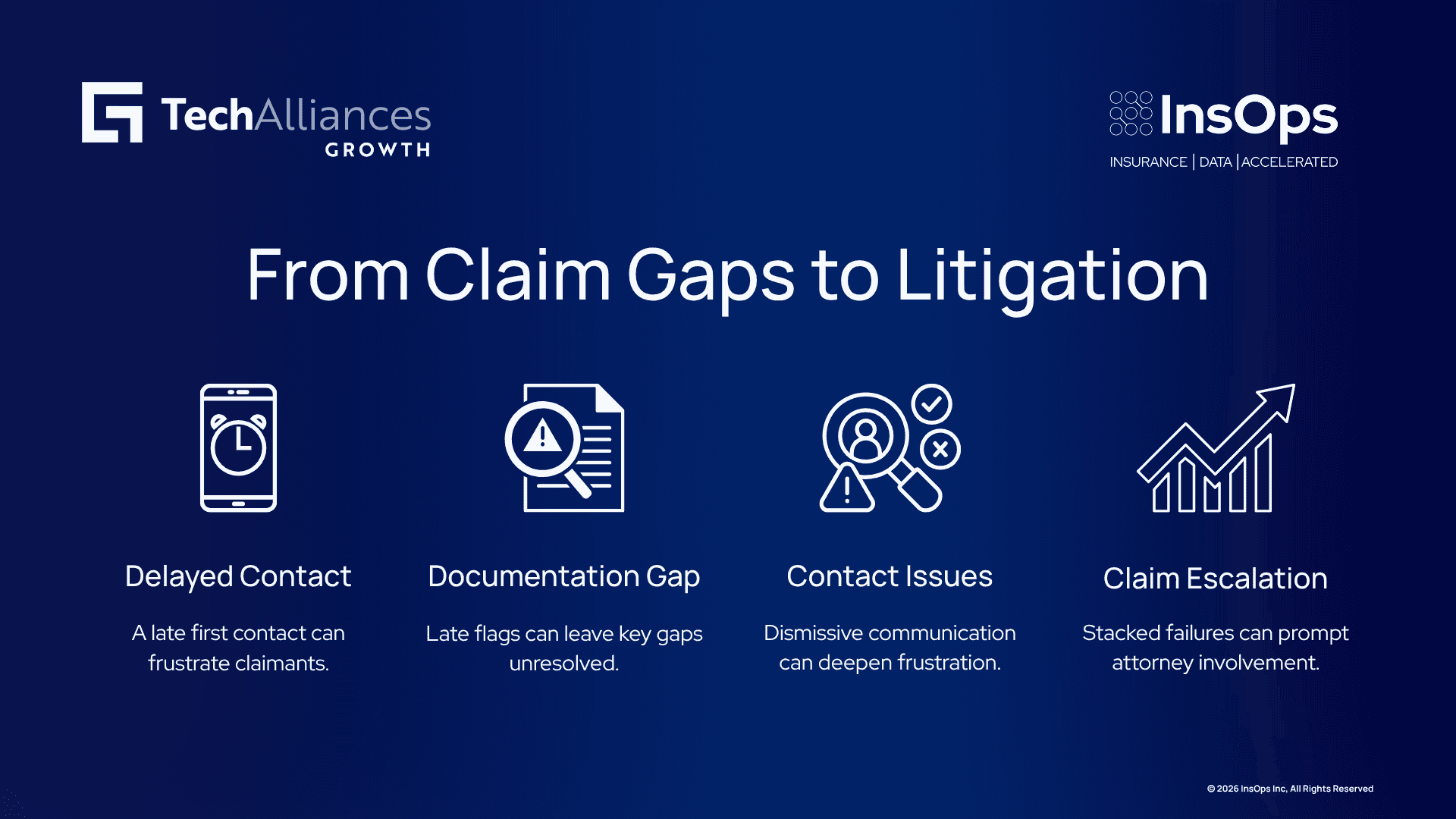
The pattern shows up the same way across claim types: a delayed first contact, a documentation gap that gets flagged too late, a communication tone that reads as dismissive to a claimant who's already frustrated.
Each of those failures is individually survivable. Stacked together across the life of a file, they build the exact conditions that make a claimant call an attorney.
Why Annual Training Doesn't Catch This
Annual compliance training tends to cover procedure: what documentation is required, what notices must go out, what timelines apply. Those things matter, but they don't touch the interpretive judgment calls that actually determine whether a claim escalates.
A once-a-year class also can't reinforce anything. The judgment adjusters need in month eight of the year isn't something a January training session can carry them through on its own.
What Attorney Involvement Actually Costs
The Scale of the Shift
Attorney representation in auto injury claims rose from 40% in 2017 to nearly 50% in 2022, and litigation rates nearly doubled over the same period, climbing from 10% to 18% of claimants. That's according to the Insurance Research Council's Auto Injury Claims Analytics Database, built from more than 7.4 million claims across nine insurers representing roughly 43% of the US private passenger auto market.
The underlying dataset runs through mid-2022, so it doesn't capture the most recent two years. Still, the five-year window it does cover shows a claims environment that shifted substantially, not gradually.
What It Costs the Claimant, Not Just the Carrier
The consequences of that shift land on claimants too. Represented bodily injury claimants waited a median of almost 440 days for their claim to close, more than twice as long as unrepresented claimants.
After accounting for medical costs and legal fees, represented claimants also netted less per dollar of medical bills paid: $1.40, compared to $1.80 for those who settled without an attorney. Litigation doesn't just cost the carrier money and time. It often leaves the claimant worse off too, waiting longer for less.
The Pressure Hasn't Eased Since
More recent data suggests this trend hasn't reversed. CCC Intelligent Solutions' 2026 Crash Course report found bodily injury claim severity rose a further 10.3% year-over-year into 2025, up 32% over four years, even as claim frequency on other auto coverages softened.
Two different datasets, measuring two different things, point in the same direction. Litigation exposure in claims handling isn't a temporary spike. It's a structural shift claims leaders need to plan around, not wait out.
The Incentive Trap
Incentive structures built purely around speed or closure rate can create real bad-faith exposure. A bonus plan that rewards minimizing payouts is exactly the kind of pattern plaintiff attorneys look for.
This isn't a hypothetical concern. Bad-faith litigation has specifically targeted adjuster compensation structures in the past, arguing that contingent pay tied to claim outcomes pressures adjusters to deny or underpay legitimate claims. Whether or not any individual bonus plan crosses that line, the pattern itself is what draws scrutiny.
A better-designed incentive doesn't reward speed or payout minimization on its own. It rewards documented, defensible handling: clear reasoning captured in the file, consistent communication with the claimant, and coverage decisions an adjuster can walk a supervisor or examiner through without hesitation.
That distinction matters more than it sounds. Two incentive plans can look nearly identical on paper, but one measures how fast a file closes and the other measures whether the file would hold up if someone outside the company reviewed it later. Only one of those actually reduces litigation risk.
The Prevention-Incentive Fit
Getting training and incentives to reinforce each other, rather than work against each other, comes down to three practices.

Train for judgment, not just process. Litigation prevention training that only covers procedure, documentation steps, required notices, misses the interpretive judgment calls that actually determine whether a claim escalates. Judgment training means working through real scenarios: how to read a claimant's frustration early, how to document a coverage decision so it holds up months later, how to recognize when a file needs to be escalated before it turns adversarial.
Incentivize the behavior that prevents litigation, not just the outcome that looks good this quarter. Rewarding closure speed or payout minimization alone creates the exact pattern that draws bad-faith scrutiny. The incentive has to reward the behaviors that actually prevent litigation: thorough documentation, timely communication, and coverage decisions that can be defended on their merits.
Give supervisors a real-time feedback loop, not just a post-mortem. Catching a claim's trajectory early, before it turns adversarial, requires supervisors reviewing open files, not just auditing closed ones after litigation has already happened. A supervisor who only sees a file after a lawsuit is filed has already missed every chance to change the outcome.
Practice | What it replaces | Why it matters |
|---|---|---|
Judgment-based training | Procedure-only compliance modules | Builds the interpretive skill that prevents escalation |
Behavior-based incentives | Speed- or payout-based bonuses | Reduces bad-faith exposure while still rewarding performance |
Open-file supervision | Post-litigation audits | Catches problems while there's still time to act |
What to Measure While You Wait for the Litigation Number to Move
Litigation rates don't shift overnight, and leaders who wait for that single number to move miss months of opportunity to course-correct.
Leading indicators give an earlier read on whether training and incentive changes are taking hold: speed to first contact, documentation quality scores, call audit results, and complaint frequency all shift faster than litigation rates do.
Lagging indicators still matter, since they're the outcomes that ultimately count: attorney representation rate, litigation rate, and escalation patterns on targeted claim types. The mistake is treating lagging indicators as the only signal worth watching.
The strongest measurement approach combines both. Leading indicators tell a claims leader whether this month's coaching is working. Lagging indicators confirm, over a longer horizon, whether it actually moved the outcome that matters.
How InsOps Helps
InsOps builds an insurance-trained AI that assists claims supervisors by surfacing documentation gaps and file-quality signals for review, so open files can be caught and coached before they turn adversarial. A person reviews every flagged file and decides what action to take.
LiLa, our insurance-trained LLM, runs inside your own environment, so PII and PHI never leave controlled infrastructure.
Our Integration Gateway connects to Guidewire ClaimCenter and related systems, so file-quality signals flow directly into your existing supervisor review workflow without custom engineering.
If you are evaluating how to build litigation prevention into your day-to-day claims operation rather than just your annual training calendar, contact us to talk through what this could look like for your team.
Frequently Asked Questions
Why do claims end up in litigation?
Claims rarely turn adversarial because of one dramatic mistake. More often, it's a sequence of smaller, avoidable failures, delayed contact, thin documentation, inconsistent communication, that compound over the life of a file until a claimant decides to call an attorney.
What KPIs should a claims team track to reduce litigation?
A combination of leading indicators (speed to first contact, documentation quality, call audit scores) and lagging indicators (attorney representation rate, litigation rate, escalation patterns) gives the clearest picture, since leading indicators show whether coaching is working now and lagging indicators confirm whether it moved the outcome over time.
Can adjuster bonuses tied to closure speed create legal risk?
Yes. A bonus structure that rewards speed or payout minimization on its own can draw bad-faith scrutiny, since plaintiff attorneys look for exactly that pattern when building a case against a carrier's claims handling practices.
Does attorney representation actually increase claim costs?
Yes. Industry data covering more than 7 million auto injury claims found attorney representation rose from 40% to nearly 50% between 2017 and 2022, while litigation rates nearly doubled, and represented claimants waited more than twice as long to close their claims.
How do claims supervisors catch problems before a claim goes adversarial?
By reviewing open files in real time rather than only auditing closed files after litigation has occurred, supervisors can spot documentation gaps, communication issues, or coverage ambiguity early enough to correct course.
How long does it take for litigation prevention training to show results?
Litigation rates themselves move slowly and shouldn't be the only signal watched. Leading indicators like documentation quality and call audit scores typically shift within weeks or months, while lagging indicators like litigation rate take longer to reflect the change.
What's the difference between leading and lagging indicators in claims?
Leading indicators, like speed to first contact or documentation quality, show whether current practices are improving in real time. Lagging indicators, like attorney representation rate or litigation rate, confirm the outcome, but only after enough time has passed for the effect to show up.