

Coverage Counsel Engagement: When to Involve Counsel and How to Reduce Legal Spend
Coverage counsel is too often brought in only after a claim is denied or a settlement effort stalls. By that point, leverage has usually slipped, costs have already climbed, and the coverage position has to be untangled under time pressure instead of built in from the start.
Most claims and litigation teams don't lack access to coverage counsel. What they lack is a consistent, defensible rule for when to call them. Without one, teams either wait too long and pay for it, or escalate reflexively and burn budget on claims that never needed a coverage opinion.
This article covers the triggers that signal a claim needs coverage counsel, what waiting actually costs, and how to build a repeatable process for making that call.
What Coverage Counsel Actually Does
Coverage counsel and defense counsel serve different functions on the same claim, and mixing them up is where a lot of missteps start.
Coverage Counsel vs. Defense Counsel
Defense counsel is hired to defend the insured against the underlying liability claim, whether that's a lawsuit, an arbitration, or a demand. Coverage counsel is engaged separately to determine whether the policy actually covers the claim at all.
Defense counsel's job is to reduce or avoid a liability finding. Coverage counsel's job is to answer a narrower, upstream question: does this policy respond, and if so, on what terms.
Why the Distinction Matters for Cost
When the two roles blur, teams end up paying defense counsel to make coverage calls they aren't positioned to make, or waiting for a formal coverage dispute to force the distinction.
Getting the roles separated early means each function does its job efficiently, instead of one absorbing costs that belong to the other.
The Five Triggers That Signal It's Time
Rather than treating coverage counsel engagement as a gut call, most teams do better with a fixed set of triggers applied consistently at intake and again as a claim develops.
Trigger | Why It Matters | Typical Timing |
|---|---|---|
Reservation of rights issued | Signals a possible coverage dispute is already forming | At the ROR letter |
Multiple policies or insurers involved | Allocation disputes between carriers slow resolution | Pre-litigation |
Ambiguous or excluded policy language | Risk of a denied claim surfacing later, after cost is sunk | Claim intake |
Claim flagged as high litigation risk | Early legal input shapes strategy before positions harden | At triage |
Settlement or mediation approaching | Coverage gaps between insured and insurer can stall resolution | Pre-mediation |
Applying the Table at Different Stages
At intake, the table works as a screen: does this claim show any of the five signals right now. Mid-litigation, it works as a recheck: has a new fact, a new party, or a new policy period changed the answer.
The Real Cost of Waiting
Engaging coverage counsel after a denial or a stalled settlement is a fundamentally different, and more expensive, exercise than engaging them at the start.
What Happens After the Fact
By the time a claim is denied or a mediation breaks down over insurance questions, positions have hardened. Coverage counsel brought in at this stage often has to reconstruct a coverage position under pressure rather than build one proactively.
Duplicated Work and Lost Leverage
Late engagement tends to mean redoing investigation work that should have been coverage-focused from the start. It also tends to mean less room to negotiate, since the insurer or insured has already staked out a position before counsel weighs in.
Involving coverage counsel earlier helps align litigation and insurance strategy from day one, rather than reconciling the two after a dispute has already formed.
Building a Repeatable Escalation Process
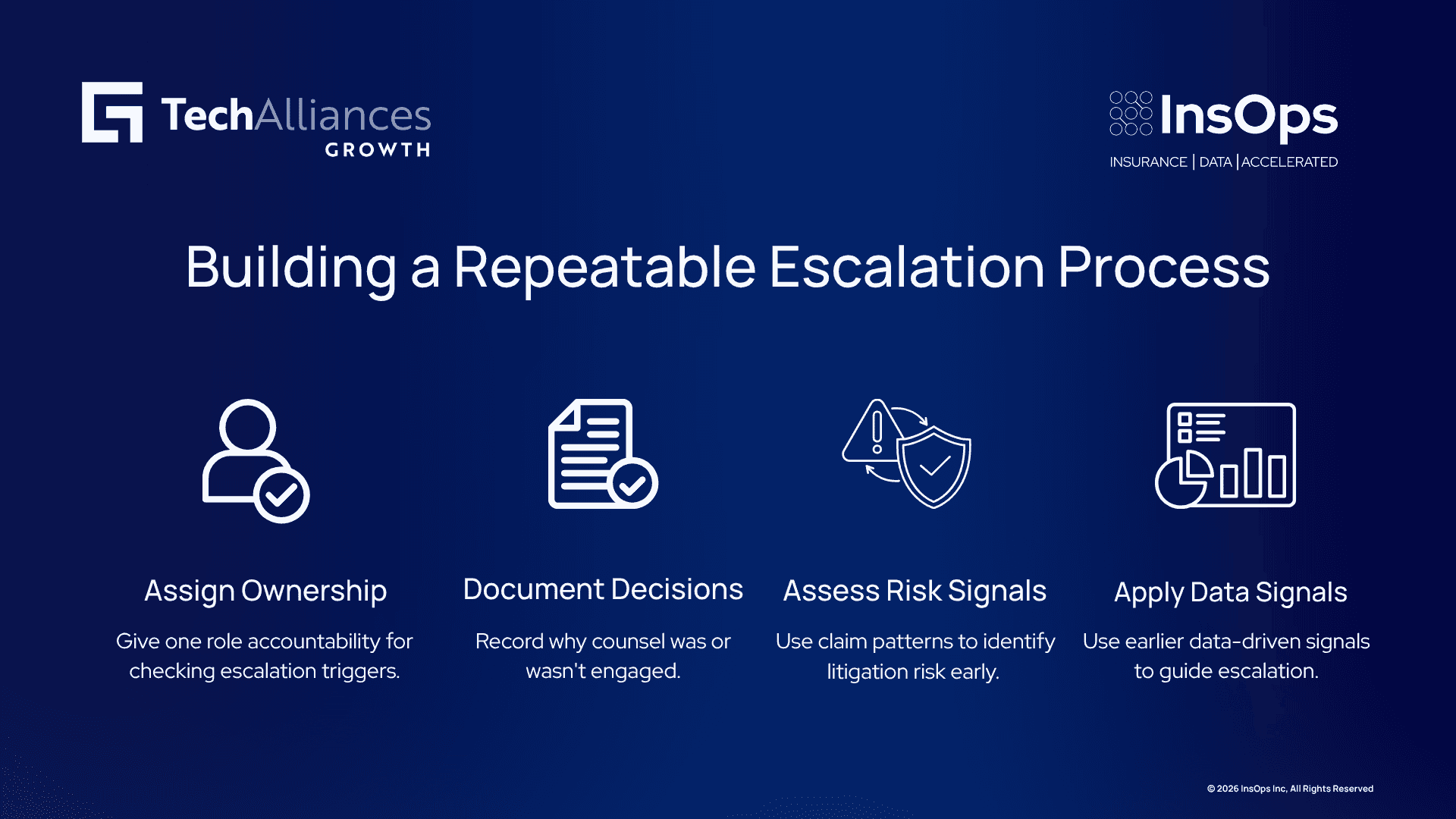
A trigger table only works if someone owns the decision and the decision gets documented.
Who Owns the Call
In most operations, this sits with a claims manager or litigation manager, sometimes in consultation with in-house counsel. What matters less is the title, and more that one role is accountable for checking the trigger table at intake.
Documenting the Decision
Recording why a claim did or didn't trigger coverage counsel engagement matters later, both for consistency across adjusters and for defending the decision if it's questioned in a bad-faith context.
Where Early Signal Fits In
The hardest trigger to apply consistently is litigation risk, since it depends on case patterns and claim history that aren't always visible to an individual adjuster at intake. This is where earlier, data-driven signal becomes useful. For a closer look at how that scoring works in practice, see How to Surface Litigation Risk Before Claims Escalate.
How InsOps Helps
InsOps builds an insurance-trained AI that assists claims teams in identifying which claims carry elevated litigation risk, early enough to inform decisions like coverage counsel engagement. LiLa, our insurance-trained LLM, analyzes case patterns and claim history to surface high-risk claims, and runs inside your own environment, so claim data never leaves controlled infrastructure.
A person reviews and validates every flagged claim before any escalation decision is made. LiLa assists the trigger process, it doesn't replace the judgment of the claims or legal team applying it.
If you are evaluating how to catch litigation risk earlier without adding headcount or exposing claim data to a generic model, contact us to talk through what this could look like for your operation.
Frequently Asked Questions
What is coverage counsel?
Coverage counsel is an attorney engaged specifically to determine whether an insurance policy covers a given claim, separate from the defense counsel handling the underlying liability dispute.
Why does timing matter when engaging coverage counsel?
Coverage positions are easier to establish before parties have taken hard stances. Waiting until a denial or a stalled settlement means rebuilding a coverage position under pressure instead of shaping it from the start.
What are the clearest signs a claim needs coverage counsel?
A reservation of rights letter, multiple policies or insurers on one claim, ambiguous or excluded policy language, a claim flagged as high litigation risk, or an approaching settlement or mediation date.
What's the common mistake teams make with this decision?
Treating engagement as a case-by-case judgment call instead of applying a consistent set of triggers, which leads to either late escalation or unnecessary escalation.
How do you measure whether earlier engagement is actually saving money?
Track how often claims reach a reservation of rights or denial stage without prior coverage review, and compare legal spend on claims escalated at intake versus claims escalated after a dispute has already surfaced.
How does AI-assisted litigation risk scoring support this decision?
It analyzes case patterns and claim history to surface high-risk claims earlier than manual review alone, giving the team a data point to apply against the trigger table before a coverage dispute has already formed. A person still reviews and validates every flagged claim.
How long does it take to build a working trigger process?
Most teams can define and start applying a basic trigger table within a few weeks. The harder part is documentation discipline, ensuring the decision and its rationale are recorded consistently across adjusters and claims.