

When two adjusters look at nearly identical claims and reach different settlement amounts, the gap is rarely about fraud or error. It comes down to how each adjuster interprets the same policy language, weighs the same evidence, and applies judgment built from their own experience.
That variance creates real costs. Disputes rise, leakage grows, and reserving gets harder to trust when similar claims don't settle in a similar range.
This article covers why settlement decisions vary between adjusters, what AI-based decision support actually does about it, and where the line sits between helping an adjuster decide and deciding for them.
Why Settlement Decisions Vary Between Adjusters
How Experience and Interpretation Drive Different Outcomes
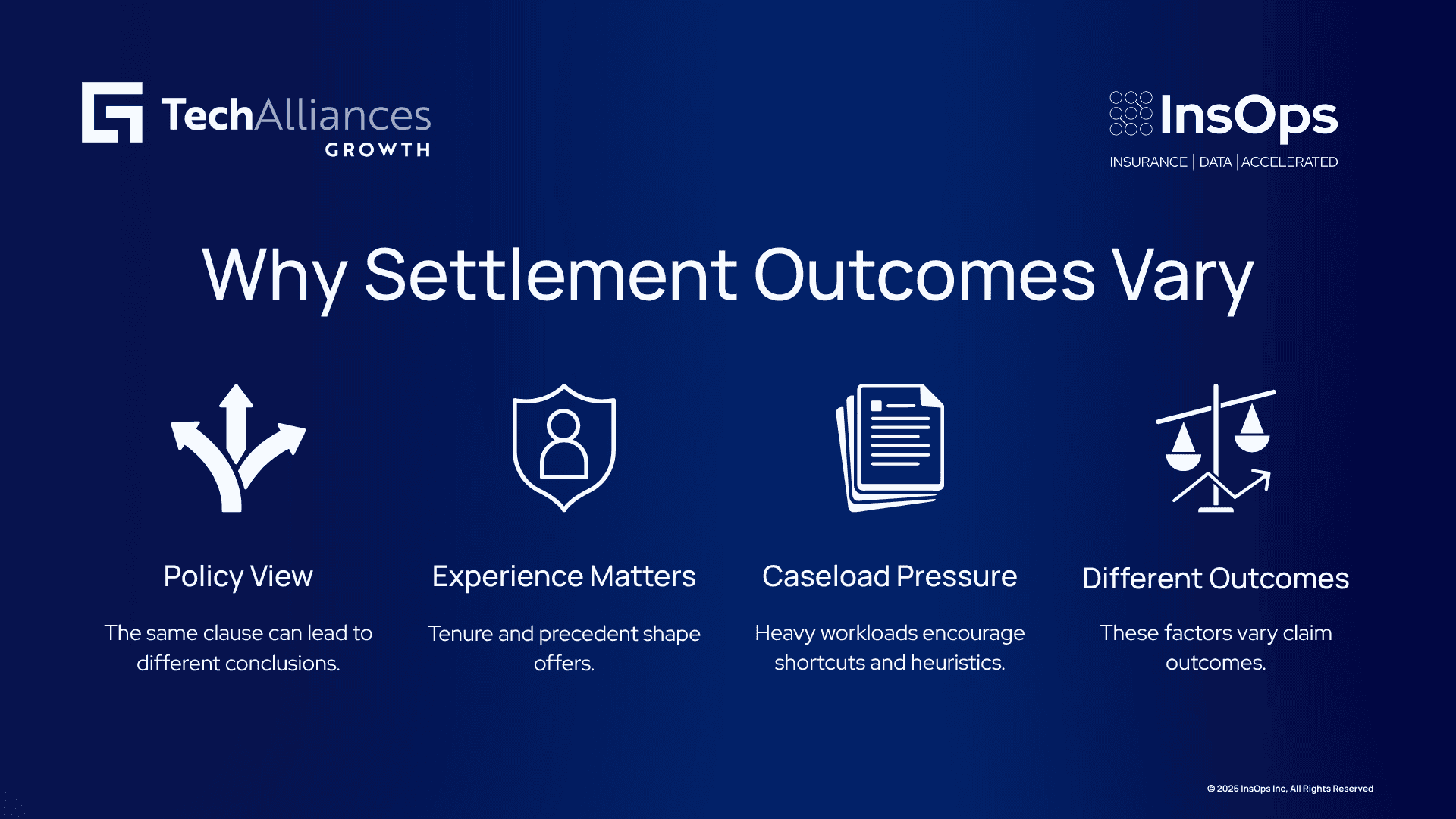
Two adjusters can read the same policy clause and land on different conclusions. One weighs a prior claim as a close comparable; another doesn't see the connection at all.
Newer adjusters often work with less settlement authority and less access to precedent than experienced ones, so their offers cluster differently even on comparable claims.
Tenure isn't the only factor. An adjuster's caseload at the time of a decision matters too. Someone managing a heavy backlog tends to lean on shortcuts and personal heuristics more than someone working through a lighter queue with time to research comparable claims properly.
What This Variance Costs
Inconsistent settlements on similar claims invite disputes, since claimants and their representatives notice when comparable losses pay out differently.
They also complicate reserving. When settlement outcomes swing based on which adjuster handled a file, reserves built on historical averages become less reliable.
There's a quieter cost too. Supervisors spend real time reviewing outlier settlements after the fact, trying to determine whether a high or low payout reflected sound judgment or just an individual adjuster's habits. That review work is hard to scale as claim volume grows.
Why This Is Hard to Fix With Training Alone
Training programs teach adjusters the same policy language and the same general approach. But training happens once, while claim interpretation happens on every single file, often months or years after the initial training took place.
Institutional knowledge about how similar claims were handled tends to live in individual adjusters' memory rather than in a shared, searchable record. That makes consistency dependent on who happens to remember what, rather than on a shared reference every adjuster can check.
What "AI Decision Support" Actually Means (and Doesn't)
A human adjuster still reviews and approves every settlement recommendation an AI system produces. The technology supports the decision, it does not make it.

That distinction separates two different things people sometimes lump together. Some AI tools speed up a single step, like reading a document or estimating repair cost. Decision support is different: it surfaces the context an adjuster needs at the moment of the decision itself, then drafts a recommendation the adjuster reviews before anything is finalized.
The first kind saves time on a task. The second kind aims at the decision itself, which is why it needs a stricter human review step built in.
This matters because the two categories carry very different risk profiles. A tool that speeds up document reading makes a mistake that costs time. A tool that touches the decision itself makes a mistake that could affect what a claimant is paid, so the review step around it has to be built with that difference in mind.
The Decision Consistency Loop
Standardizing settlement decisions without removing adjuster judgment comes down to three steps, run in sequence for every claim.
Surface. The relevant policy language, prior similar claims, and company guidelines get pulled into one view at the point of decision, so the adjuster isn't reconstructing precedent from memory or a separate search.
Recommend. A settlement recommendation gets drafted, along with the reasoning behind it, built from that same surfaced context. Every adjuster starts from the same baseline logic instead of their own individual recall of similar files.
Validate. The adjuster checks the recommendation against their own read of the file, changes it where their judgment differs, and signs off before anything moves forward.
Step | What happens | Who does it |
|---|---|---|
Surface | Pulls policy language, prior claims, and guidelines into one view | The system |
Recommend | Drafts a settlement recommendation with stated reasoning | The system |
Validate | Reviews, adjusts, and approves the recommendation | The adjuster |
The value of this loop isn't that it produces a single "correct" answer. Two adjusters working the same claim through this process might still land on slightly different final numbers, since judgment still plays a role in the validate step.
What changes is the starting point. Instead of ten adjusters drawing on ten different sets of remembered precedent, they're all working from the same surfaced context, which narrows the spread between their final decisions considerably.
Will This Hold Up to Regulator and Adjuster Scrutiny?
Most P&C insurers are already using generative AI somewhere in their operations, but consumer comfort with AI making autonomous coverage or claims decisions remains limited. That gap is why decision support, not decision-making, is the more defensible design.
A February 2026 Deloitte survey of US insurance executives found that 76% have implemented generative AI in at least one business function. Adoption at the operational level is widespread.
Consumer comfort tells a different story. Insurity's 2026 AI in Insurance Report, based on a February 2026 survey of more than 1,000 US adults, found only about a third of consumers trust AI-driven insurance decisions overall. Just 16% said they're comfortable with AI canceling or renewing a policy on its own, and only 22% are comfortable with AI filing a claim on their behalf.
The same report found more comfort with AI in supporting roles: 46% would let AI generate a quote, and 39% are comfortable with AI tracking claim status.
That pattern, comfort with assistance and discomfort with autonomy, is exactly what a decision-support design is built around: the system surfaces and recommends, and the adjuster stays the one who decides.
Explainability follows the same logic. A recommendation an adjuster can trace back to specific policy language and specific prior claims is one they can defend to a supervisor, an examiner, or a claimant asking why their claim settled the way it did.
Regulators evaluating claims practices tend to ask the same basic question regardless of jurisdiction: can the carrier show why a decision was made. A recommendation with no visible reasoning behind it is much harder to defend than one built on documented policy language and comparable claims, no matter how accurate it turns out to be.
Adjuster trust runs on a similar logic to regulator trust. An adjuster who can't see why a recommendation says what it says has no real reason to rely on it, and will likely revert to working the claim from scratch, which defeats the purpose of building the recommendation in the first place.
What Adjuster Trust Requires Alongside Standardization
AI-assisted claims decision support applies policy terms and coverage rules the same way across every adjuster, narrowing the settlement variance that comes from individual interpretation.
That only works if adjusters trust the recommendation enough to actually use it, rather than treating it as one more thing to double-check from scratch. Trust builds when the reasoning behind a recommendation is visible, not just the number.
Keeping judgment with the adjuster isn't a limitation on standardization. It's what makes the standardized recommendation something an adjuster will actually rely on instead of routing around.
Rollout matters as much as the underlying design. Adjusters who are introduced to a new recommendation tool without a clear explanation of how it reaches its conclusions tend to distrust it by default, treating it the same as any other black-box change to their workflow. Involving experienced adjusters early, and being transparent about what the tool does and doesn't decide, tends to shorten that adjustment period.
How InsOps Helps
InsOps builds an insurance-trained AI that assists with surfacing relevant policy language, prior claims, and guidelines at the point of a settlement decision, then drafts a recommendation for the adjuster to review. A person reviews and validates every recommendation before it is finalized.
LiLa, our insurance-trained LLM, runs inside your own environment, so PII and PHI never leave controlled infrastructure.
Our Integration Gateway connects to Guidewire ClaimCenter and related systems, so claim data flows directly into your existing workflow without custom engineering.
If you are evaluating how to reduce settlement variance without losing adjuster judgment in the process, contact us to talk through what this could look like for your operation.
Frequently Asked Questions
Why do similar claims get different settlement amounts from different adjusters?
Adjusters bring different levels of experience, different access to precedent, and different interpretations of the same policy language to a claim, which produces different settlement outcomes even on comparable losses. Caseload pressure at the time of the decision can widen that gap further.
How do insurance adjusters calculate settlement values?
An adjuster weighs policy terms, coverage limits, evidence in the claim file, and any comparable prior claims they're aware of, then applies judgment to arrive at a settlement figure within their authority.
How does AI help adjusters make consistent settlement decisions?
It surfaces the same policy language, prior similar claims, and guidelines for every adjuster at the point of decision, then drafts a recommendation built from that shared context, so adjusters start from the same baseline rather than individual recall.
Does AI replace the adjuster's final settlement decision?
No. A human adjuster reviews, adjusts, and approves every recommendation before it's finalized. The system supports the decision rather than making it.
What is claims leakage and how does AI reduce it?
Claims leakage is the gap between what a claim should settle for under the policy and what it actually settles for, often caused by inconsistent application of policy terms. Surfacing consistent policy context and prior claims at the point of decision is one way to narrow that gap.
Can AI explain why it recommended a settlement amount?
A well-built recommendation should trace back to specific policy language and specific comparable claims, not just a number, which is what lets an adjuster defend the recommendation to a supervisor or a claimant.
Is AI making claims decisions fair?
Fairness depends on whether a human stays responsible for the final decision and whether the reasoning behind a recommendation is visible enough to check for bias, not on whether AI is involved at all.
How long does it typically take to roll out this kind of decision support to a claims team?
Timelines vary by carrier, but rollouts that involve experienced adjusters early in the process, and that are transparent about what the tool does and doesn't decide, tend to see faster adoption than rollouts introduced as a top-down change with no adjuster input.