

When your referral queue keeps filling up and the mix of risk coming through the door hasn't gotten any harder to evaluate, the usual first move is to add review capacity. More underwriters, more triage staff, another layer of prioritization software on top of the queue.
That move treats the symptom. It doesn't touch the actual driver in most cases: submissions arriving incomplete at the point of intake, before an underwriter ever opens the file.
This article walks through why incomplete submissions turn into referrals, what "complete enough to quote" actually means at intake, and a way to think about sequencing the fix that puts completeness ahead of capacity.
Why Submissions Get Referred Even When the Risk Is Simple
A referral doesn't always mean the risk itself is complicated. It often means the underwriter can't make a clean decision with what's in front of them yet.
One published range for mid-market commercial multi-line underwriting puts manual referral rates as high as the mid-50 percent range before a rules-based intake layer is in place. That figure drops meaningfully once completeness checks run automatically at intake.
It's worth noting this is a single vendor's stated figure, not an independent industry benchmark. Still, the direction matches how referral queues actually behave. A submission missing a mandatory field, carrying an inconsistent loss run, or tagged with an unclear classification can't clear straight-through, no matter how straightforward the underlying risk is.
The result is a queue where "complex" and "incomplete" get treated the same way, because both end up in the same referral bucket. Only one of those two is actually a risk-judgment problem.
What "Complete Enough to Quote" Actually Means at Intake
A submission is complete enough to quote when an underwriter can confirm appetite, set base pricing inputs, and identify material risk factors without going back to the broker first.
That's a narrower bar than "every field filled in." One commercial-lines process analysis frames this as a defined minimum viable submission per product and segment: the specific data needed to confirm appetite, set pricing inputs, and generate clear terms, made explicit to brokers and internal teams up front rather than discovered case by case.
Without that definition written down, every underwriter ends up applying a personal standard for "complete," which means some submissions get bounced back for details another underwriter would have accepted. That inconsistency is itself a source of avoidable referrals.
How an Incomplete Submission Turns Into a Referral
The path from a missing field to a referral queue is mechanical, not a risk judgment.
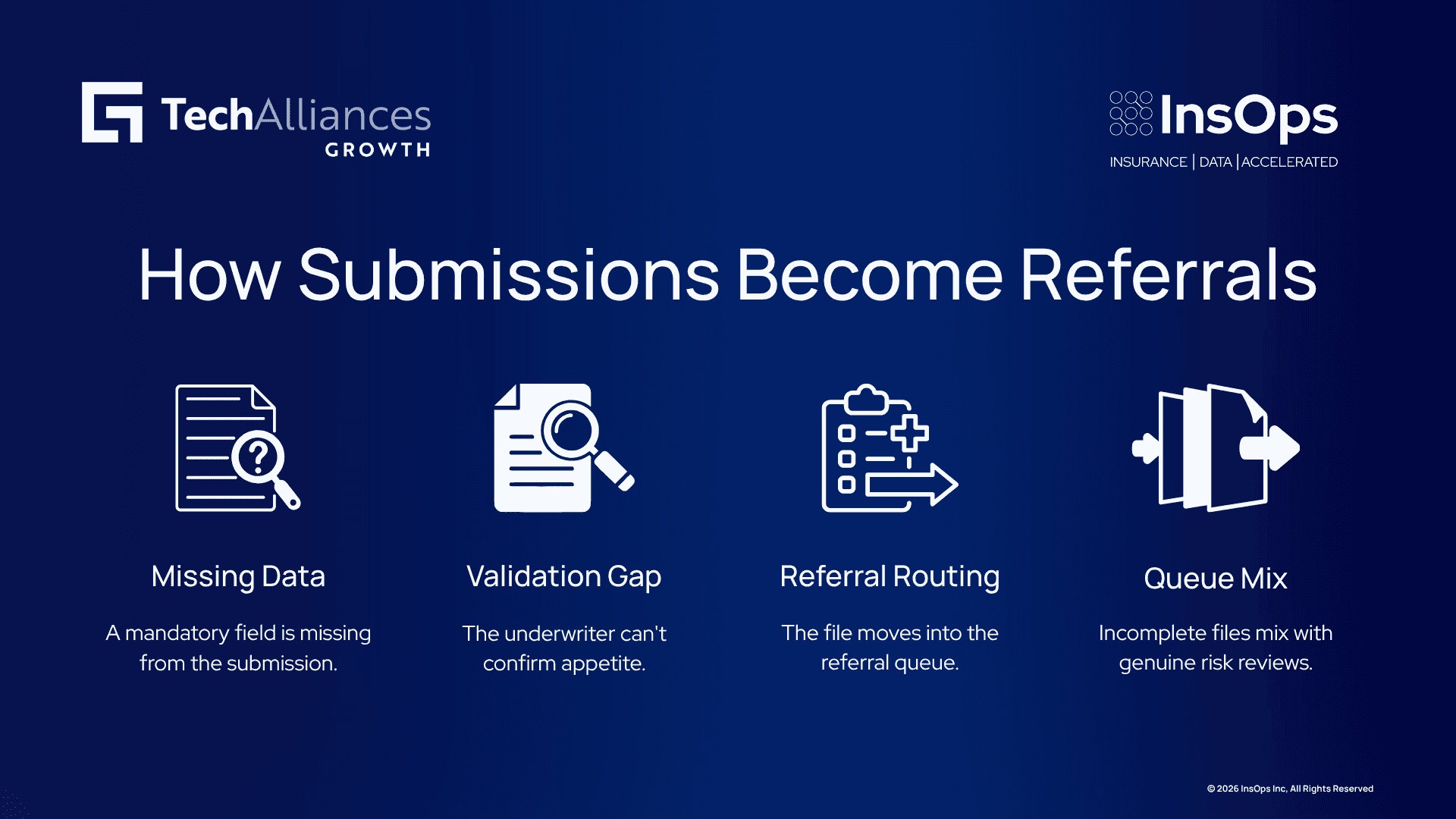
A submission arrives with one mandatory field missing, a mismatched loss run, or an ambiguous classification. The underwriter can't confirm appetite or set a base rate with that gap present. Rather than declining outright or guessing, the file gets routed to referral, sometimes for a second look, sometimes just to hold while the broker is asked for the missing piece.
Multiply that pattern across a queue, and a large share of what looks like "referral volume" is really "intake volume that hasn't been validated yet." The submissions that actually need a risk judgment call get mixed in with the ones that just need one missing field.
Completeness Before Capacity
Here's a way to name the sequencing problem directly: completeness before capacity.
Carriers facing a high referral rate tend to reach for more capacity first, more reviewers, more prioritization tooling on top of the existing queue. That adds throughput for handling referrals once they exist. It doesn't reduce how many submissions become referrals in the first place.
Fixing completeness at intake is the upstream lever. If a submission's mandatory fields, classification, and loss history are validated before it reaches an underwriter, the referral queue shrinks to the submissions that genuinely need judgment, not the ones that just needed a form filled out correctly. Capacity is still useful. It's just not the first lever to pull.
How InsOps Helps
InsOps' Integration Gateway maps incoming submission data directly into Guidewire structures, including UnderwritingCenter and PolicyCenter, so gaps in a submission surface at intake instead of after it's already sitting in a referral queue.
LiLa, our insurance-trained AI, assists with that mapping and flags fields that don't match required data before the file reaches an underwriter. A person reviews and confirms every flagged item before anything moves forward.
The core difference from a generic tool: LiLa runs inside your own environment, so submission data never leaves controlled infrastructure while this validation happens.
If you're evaluating how to bring completeness checks upstream of your referral queue without adding headcount or custom engineering, contact us to talk through what this could look like for your operation.
Frequently Asked Questions
What is submission triage in insurance underwriting?
Submission triage is the process of sorting incoming submissions by appetite fit, completeness, and urgency before they reach a full underwriting review.
Why do insurance submissions get delayed?
The most common causes are incomplete data at intake, manual document handling, and unclear handoffs between intake, triage, and underwriting, not the complexity of the underlying risk analysis itself.
What counts as a complete submission at intake?
A submission is complete enough to quote when an underwriter can confirm appetite, set base pricing inputs, and identify material risk factors without a follow-up request to the broker.
Is a high referral rate a sign of bad data or a bad appetite fit?
It can be either, and they require different fixes. A pattern of referrals tied to missing fields or inconsistent documentation points to a data problem at intake. A pattern tied to risks genuinely outside stated appetite points to an appetite or rules problem instead.
Why does fixing completeness at intake lower referral rates more than adding review capacity?
Adding capacity increases how many referrals a team can process, not how many submissions become referrals in the first place. Validating completeness before a submission reaches underwriting reduces the number of files routed to referral for reasons that had nothing to do with risk judgment.
Where does a human still need to review the submission if AI is validating it?
A person reviews and confirms any field an AI system flags as missing or inconsistent before the submission moves forward. The validation step identifies gaps. It doesn't make the underwriting decision.
What should a broker's submission package include so it doesn't bounce back?
A completed application, current loss runs matching the requested term, an accurate classification, and any supplemental schedules or questionnaires the product requires, submitted together rather than in pieces.