

Brokers are chasing quotes, submissions are stacking up in the underwriting queue, and the request for more headcount came back denied. That leaves more demand than the team can turn around, and no new underwriters coming.
Hiring is the obvious fix, and right now it's off the table. The more useful question is where each submission actually spends its time between the broker's email and the quote going back out.
This guide defines quote turnaround, explains why commercial quotes stall, and gives you a five-stage audit called the Quote Clock. Use it to find the stage costing your team the most time.
What is quote turnaround time in insurance?
Quote turnaround time is the elapsed time from a broker's submission arriving to a quote going back to that broker. It splits into wait time, when the submission sits between steps, and work time, when someone is actively on it.
Where the clock starts and stops
Start the clock when the submission lands in your inbox or portal, not when an underwriter first opens it. Stop it when the quote is sent, not when pricing is finished.
Measuring from assignment instead hides every hour the submission spent unopened. Track declines separately, since time to decline is its own number worth knowing.
Wait time vs. work time
Work time covers clearing, reviewing, and pricing the risk. Wait time covers everything else: sitting in the inbox, waiting to be keyed in, waiting in the queue, and waiting on the broker.
An extra underwriter adds work capacity. It does nothing for a submission sitting in a shared inbox or waiting for someone to type it into the core system.
Why do commercial insurance quotes take so long?
Commercial quotes take long because each submission passes through several handoffs before anyone evaluates the risk. Every handoff adds waiting, and three mechanisms create it.
Data gets re-keyed before anyone reviews the risk
Submissions arrive as emails, ACORD forms, loss runs, and schedules. Someone has to enter that data into the core system before an underwriter can work the file.
For the person keying, that's work time. For the submission, it's wait time, and it adds up across every file in the queue.
Queues run first-in, first-out
A first-in, first-out queue treats a complete, in-appetite renewal the same as a long shot the carrier will decline. The strongest submissions end up waiting behind the weakest.
Missing information restarts the clock
An incomplete submission triggers an email to the broker, and the file gets parked until the answer comes back. If the gap is only found at pricing, the round trip happens after the file has already sat in the queue.
Checking completeness at intake moves that round trip to the front, before the file waits in the queue.
The Quote Clock: A Five-Stage Audit of Your Turnaround
The Quote Clock breaks quote turnaround into five stages, each with its own wait time and work time. Timing each stage separately shows you exactly where submissions sit idle.
The five stages
Stage | What happens | Where wait time builds up | What fixing it looks like |
|---|---|---|---|
1. Received | Submission arrives by email or portal | Sits in a shared inbox before anyone opens it | One intake point with a timestamp and a named owner |
2. Cleared | Checks for duplicates, appetite, and broker authority | Waits on manual lookups across systems | Clearance checks run against one data view |
3. Keyed | Submission data is entered into the core system | Waits for someone to re-key it by hand | Data mapped into the system, with a person validating it |
4. Assigned | Routed to an underwriter | Sits in first-in, first-out order regardless of fit or value | Ranked by appetite fit, completeness, and deadline |
5. Evaluated and priced | The underwriter assesses and prices the risk | Waits on missing information from the broker | Completeness checked at intake, not at pricing |
How to time each stage in your operation
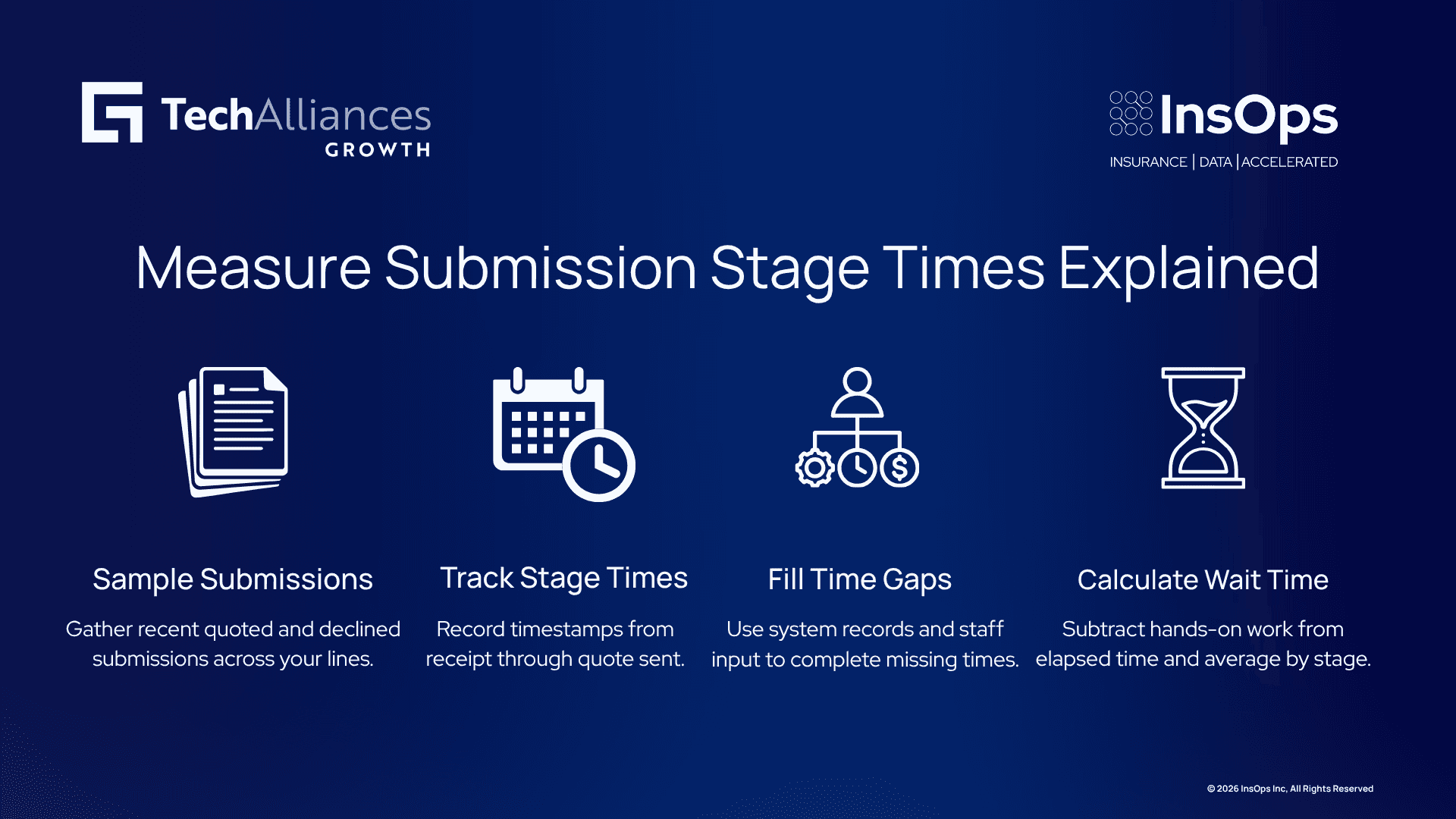
Pull a sample of recent submissions across the lines you write, including both quoted and declined files.
For each one, record the timestamp at every stage change: receipt, clearance, data entry complete, assignment, first underwriter touch, and quote sent.
Start with the timestamps your email and core systems already record, and fill gaps with the people who handled the files.
With those same people, estimate the hands-on work time for each stage.
Subtract work time from each stage's elapsed time to get its wait time, then average wait time by stage.
Reading the results
The stage with the largest wait time is the first one to fix. Heavy wait at Keyed points to data entry, heavy wait at Assigned points to queue order, and heavy wait at Evaluated points to incomplete submissions.
Large work time at the Evaluated stage is not a problem. That's the underwriting itself, and it's where you want your team's hours to go.
What slows down underwriting submission intake?
Intake slows at the first three Quote Clock stages. Submissions wait in the inbox, wait on clearance lookups, and wait to be keyed into the core system.
Clearing faster
Clearance checks for duplicates, appetite, and broker authority. When each check means a lookup in a different system, the submission waits until someone has time to run all three.
Pulling that reference data into one view shortens the stage without changing the rules themselves.
Getting submission data into the system without re-keying
Insurance-trained AI can map incoming submission data into Guidewire UnderwritingCenter, PricingCenter, and Quoting Services, with an underwriter validating every mapping before it is used.
The job shifts from typing fields to checking them, which turns the Keyed stage into a review step instead of a data-entry step.
Keeping sensitive submission data under control
An AI model that runs inside the carrier's own environment keeps submission data containing PII within controlled infrastructure. Underwriters still review everything it prepares.
Before adopting any tool at this stage, ask three questions. Where does the model run? What data leaves your environment? Who signs off on the output?
How do underwriters decide which submissions to quote first?
Underwriting teams can rank submissions by appetite fit, completeness, and broker deadline instead of arrival order. The underwriter still decides what gets worked and when.
Why first-in, first-out works against you
Arrival order is easy to run and easy to defend. It also guarantees that some of your best-fit files sit behind ones the team will decline after reviewing them.
Ranking by fit, completeness, and deadline
Factor | What it tells you |
|---|---|
Appetite fit | Whether the risk matches what the carrier wants to write |
Completeness | Whether the underwriter can work the file without going back to the broker |
Broker deadline | When the broker needs an answer to place the risk |
Keeping the underwriter in charge of the call
A ranked queue is a suggested order, not a decision. The underwriter confirms it, overrides it, or pulls a file forward based on the broker relationship.
AI-assisted triage should follow the same pattern. The tool proposes an order, and the queue only changes when a person agrees.
How can underwriters handle more submissions without adding staff?
Carriers handle more submissions with the same team by cutting the time spent preparing each one. Underwriters then spend more of their day evaluating risk and pricing.
Manual vs. AI-assisted handling at each stage
Stage | Manual handling | AI-assisted handling (a person reviews) |
|---|---|---|
Received | Someone monitors a shared inbox | Submissions land in one queue with timestamps |
Cleared | Lookups across several systems | Checks run against one data view |
Keyed | Fields typed by hand | Data mapped into the system for validation |
Assigned | First-in, first-out | Proposed ranking for the underwriter to confirm |
Evaluated and priced | Gaps found during review | Gaps flagged at intake, before the queue |
What stays with the underwriter
Risk judgment, the pricing decision, and the broker relationship stay with the underwriter. AI-assisted handling moves preparation work off their desk, not decisions.
How InsOps Helps
InsOps builds an insurance-trained AI that assists underwriting teams with getting submission data into core systems. Our Integration Gateway connects to Guidewire UnderwritingCenter, PricingCenter, and Quoting Services, so submission data flows into your underwriting workflow without custom engineering.
LiLa, our insurance-trained LLM, maps incoming data to Guidewire structures, and a person on your team validates every mapping before deployment. LiLa runs inside your own environment, so PII and PHI never leave controlled infrastructure.
InsOps is building toward AI-assisted submission triage inside LiLa, with a suggested work order your underwriters confirm or override. Contact us to talk through where it fits in your queue.
If you are working out how to cut time from the Keyed and Assigned stages of your Quote Clock without adding headcount, contact us to walk through your numbers.
Frequently Asked Questions
What is speed to quote and why does it matter?
Speed to quote is quote turnaround seen from the broker's side, meaning how long they wait between sending a submission and receiving a quote. It matters because the broker needs your answer to place the risk, and every idle stage adds to that wait.
What is submission triage in underwriting?
Submission triage is the practice of setting the order in which incoming submissions get worked. Teams set it by risk fit and file readiness, and an underwriter signs off before anything moves.
How do insurance carriers speed up quote turnaround without hiring more underwriters?
They measure where submissions wait, stage by stage, and fix the stage with the most wait time first. Because that wait sits between handoffs, the fix targets the handoff rather than the underwriter's pace.
How does AI help underwriters process submissions faster?
AI assists with the preparation work around underwriting, such as mapping submission data into core systems, flagging missing information, and suggesting a work order. Someone on the underwriting team reviews each output before anyone relies on it.
Does AI replace underwriters?
No. AI takes on preparation tasks, while risk judgment, pricing decisions, and broker relationships stay with the underwriter.
How long does it take to put AI-assisted underwriting in place?
It happens in phases. Measure your current Quote Clock, start with the stage that has the most wait time, and run AI-assisted output alongside your existing process until your team trusts it. The mistake to avoid is skipping the baseline, which leaves you no way to show what changed.
What should we measure to know quote turnaround is improving?
Track total turnaround from receipt to quote sent, wait time at each Quote Clock stage, and time to decline. Also track how often submissions go back to the broker for missing information. Re-run the same sampling method each quarter so the numbers stay comparable.